Atelier · France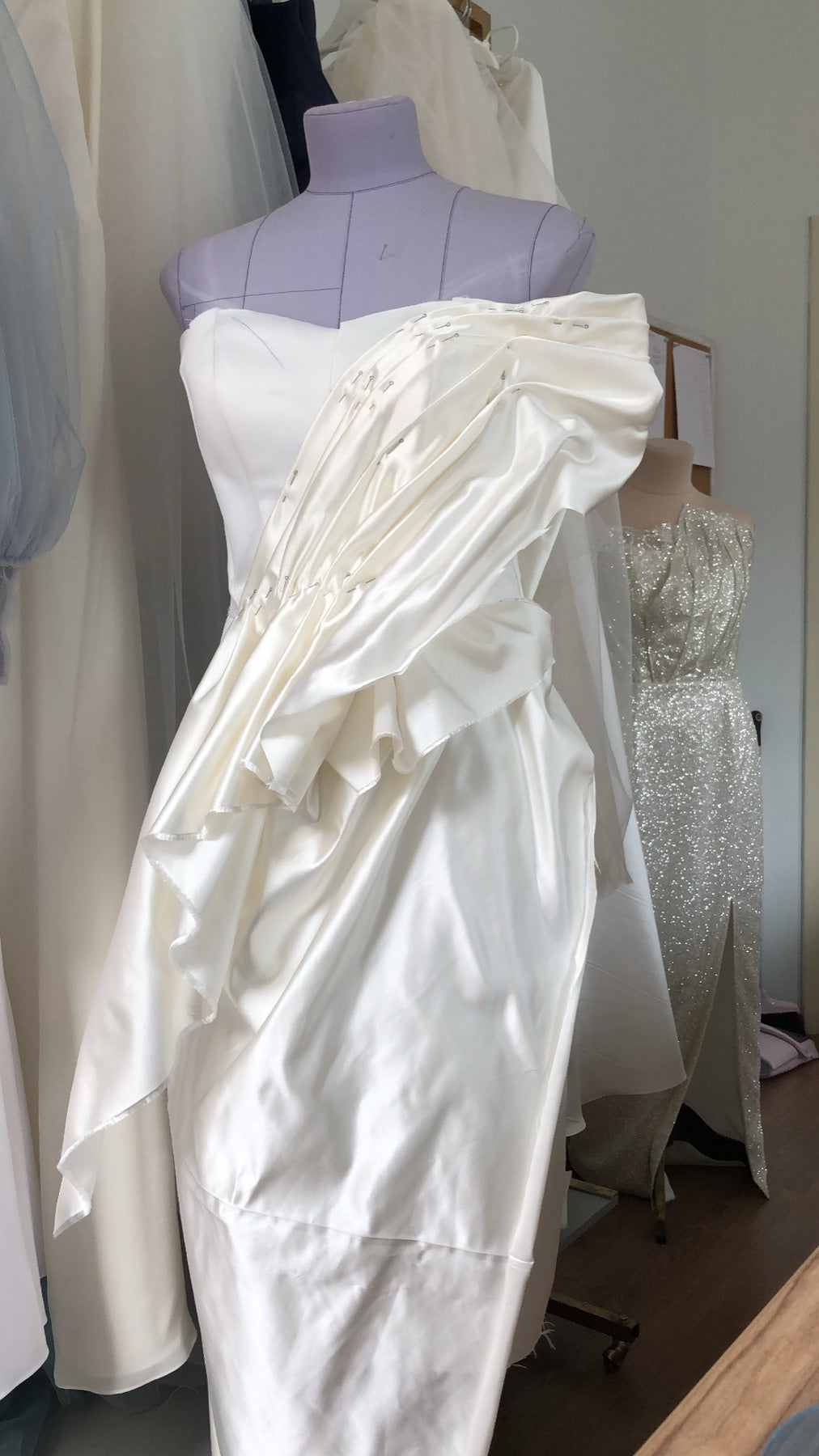

A cascading ruffle is a single continuous frill that spirals or runs diagonally down a wedding dress, usually from one shoulder or hip to the opposite hem. Instead of the horizontal bands of a tiered skirt, it draws one sweeping line across the dress, which is dramatic from every angle and especially strong from behind.
The design work is where the ruffle starts and ends, how deep it is along its length, and how it is supported so it holds the line without collapsing or dragging the dress off-grain.
Key Takeaways
- A cascading ruffle is one continuous frill that spirals or runs diagonally down the dress, drawing a single sweeping line.
- It differs from a tiered skirt (horizontal bands) and reads more dynamic and asymmetric.
- It usually runs from a shoulder or hip to the opposite hem, and often continues into a train.
- The ruffle is graded: narrower where it starts, deeper toward the hem, so it grows as it falls.
- On a custom order the line is drawn on you or the form and the ruffle is cut on a curve so it lies flat and does not pull.
What a Cascading Ruffle Is
A long, continuous ruffle attached along a diagonal or spiral seam, so it falls in one sweep rather than a stack of bands. It can be a single ruffle on an otherwise plain sheath or column, or the main feature of the skirt.
Cascading vs Tiered
- Tiered: horizontal bands, symmetrical, builds volume evenly toward the hem. Covered in the tiered skirt guide.
- Cascading: one diagonal or spiral line, asymmetric, dynamic, draws the eye across the body.
- Cascade of ruffles: several short ruffles stepping diagonally, a hybrid.
Where It Starts and Ends
Common paths:
- Shoulder to opposite hem. Starts at or near a one-shoulder strap, spirals across the bodice and skirt to the far hem. The most dramatic.
- Hip to hem. Starts at one hip, sweeps across the skirt front to the opposite hem.
- Waist, spiralling once. Wraps the skirt in a single turn from the waist to the hem.
- Into the train. The ruffle continues off the hem and along the train edge, so the sweep carries behind you.
How It Is Cut and Supported
- The ruffle is cut on a curve, not a straight strip, so it lies flat against the diagonal seam without puckering or pulling the dress off-grain.
- It is graded in depth, narrow at the start and deeper toward the hem, so it grows as it falls.
- Longer or heavier ruffles are backed with a fine net or a rolled hem so the edge holds its shape.
- The bodice and skirt beneath are fully structured; the ruffle is decorative.
Fabrics That Work
- Chiffon, georgette, organza. Soft, floating cascade that ripples.
- Crepe and light satin. A defined, sculptural cascade with more weight.
- Tulle. Volume and bounce along the line.
- Stiff structured fabrics hold the ruffle as a hard shape rather than letting it fall, so they are a poorer choice.
The Line From Behind
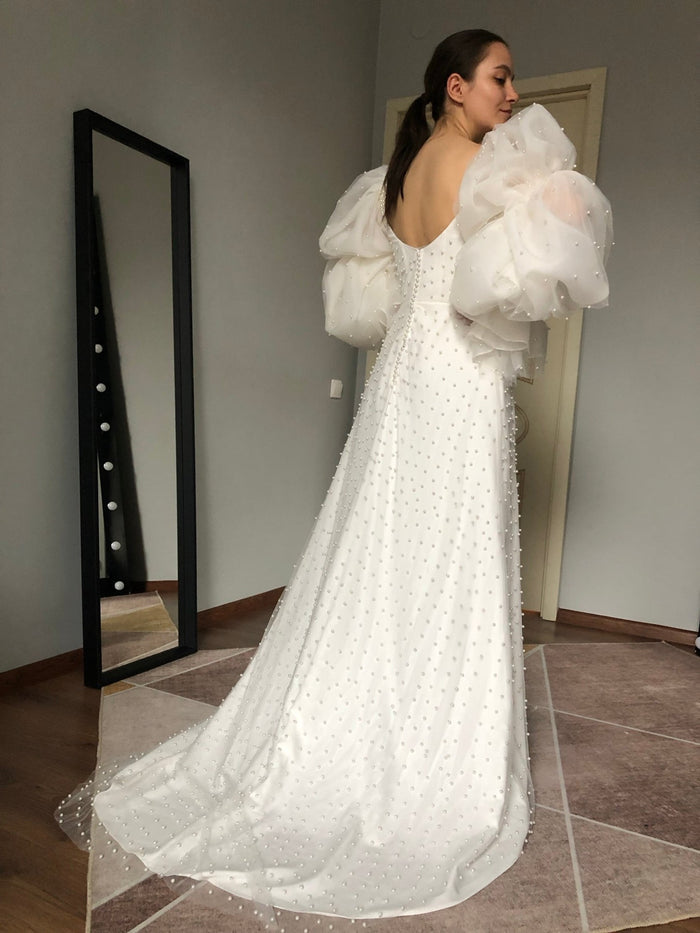
A cascading ruffle is often designed to read best from behind, where the full sweep is visible during the ceremony and in portraits. It pairs well with a plain, open, or backless back so nothing competes with the line, and it can replace a veil as the drama from behind.
Planning a Cascading Ruffle Custom
Steps:
- Draw the line on you or the form, from the start point to the hem, and check it from every angle.
- Grade the depth along the line.
- Cut the ruffle on a curve and test it lies flat on a mockup.
- Confirm walking and turning, and re-check after the fabric has hung.
For a remote order the line is set to your proportions and the finished ruffle shown from every angle on a form in photos and video during the remote fitting process. Every dress is made over 10 to 12 weeks, with UPS shipping to the US in 3 to 5 days. A long curved ruffle is skilled cutting and hand-finishing; see the price breakdown.
FAQ
What is a cascading ruffle on a wedding dress? A single continuous frill attached along a diagonal or spiral seam, so it falls in one sweeping line down the dress, usually from a shoulder or hip to the opposite hem. It reads more dynamic and asymmetric than a tiered skirt.
How is a cascading ruffle different from a tiered skirt? A tiered skirt is horizontal bands, symmetrical, building volume evenly toward the hem. A cascading ruffle is one diagonal or spiral line that draws the eye across the body. One is even and layered; the other is a single dramatic sweep.
Why is the ruffle cut on a curve? So it lies flat against the diagonal seam without puckering and without pulling the dress off-grain. A straight strip gathered onto a diagonal seam ripples unevenly and distorts the skirt. The curved cut lets it fall cleanly.
Where does a cascading ruffle usually start? At or near a one-shoulder strap for a full spiral across the bodice and skirt, at one hip sweeping across the skirt front, or at the waist wrapping the skirt in a single turn. It often continues off the hem along the train edge.
Which fabrics suit a cascading ruffle? Soft, fluid fabrics: chiffon, georgette, organza for a floating cascade; crepe and light satin for a defined, sculptural one; tulle for volume. Stiff structured fabrics hold the ruffle as a hard shape and are a poorer choice.
Want one sweeping ruffle drawn to your proportions? Start with a sketch consultation at Lutien Bridal.
About the author: Vlad Ivanov is the Director of Business Development at Lutien Bridal Atelier in France, home to the design team behind more than 1,000 custom wedding gowns delivered to brides across the US and Europe.