Atelier · France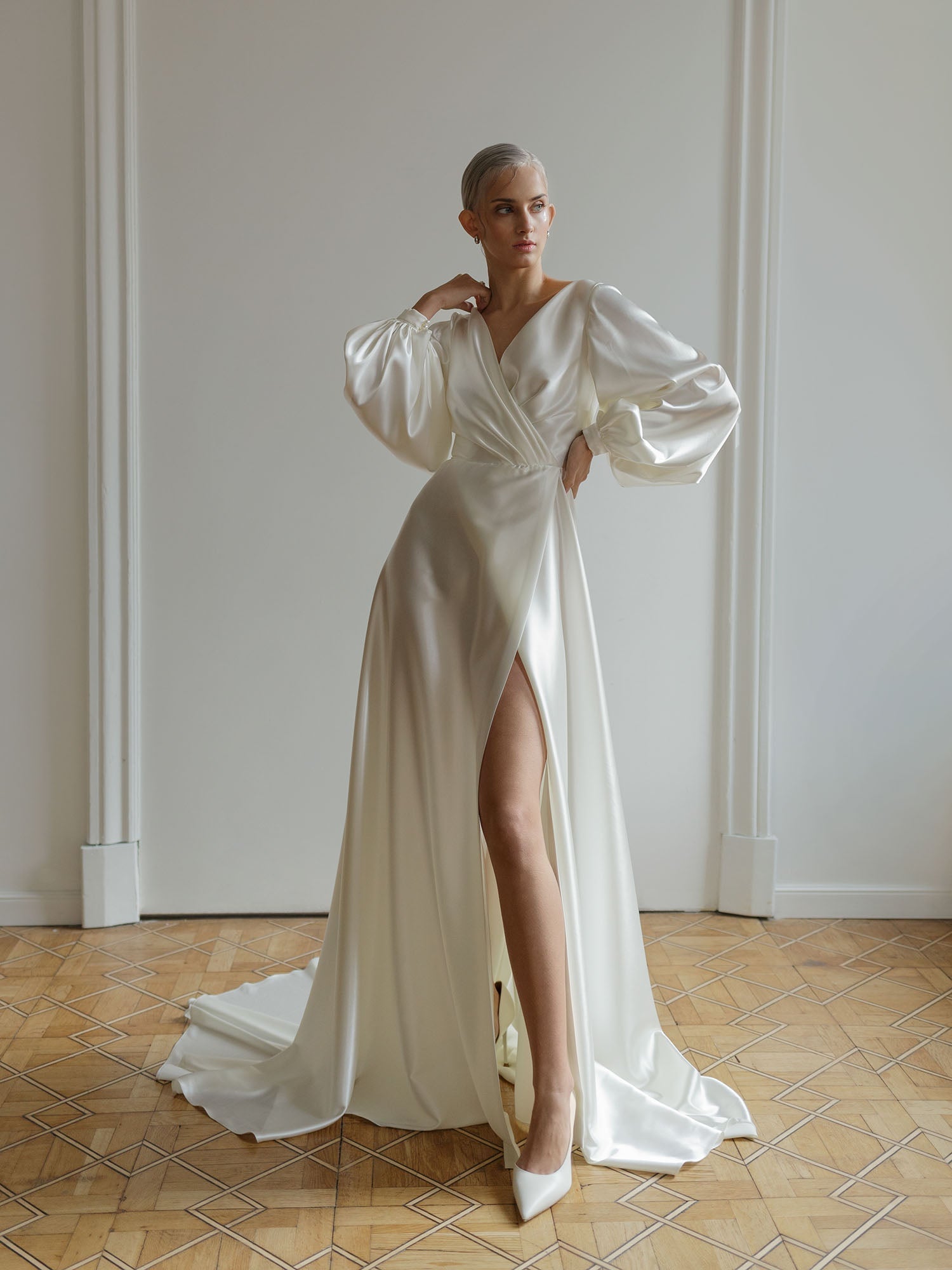
If you have been drawn to the luminous, polished look of satin wedding dresses, you are not alone. Satin has been one of the most sought-after bridal fabrics for decades, but the word "satin" covers a wide range of textures, weights, and behaviors that feel completely different in real life and on camera.
Before you commit to a satin gown, here is what you need to know: what satin actually is, how the main types differ, which silhouette each one suits, and why fit and construction matter more with satin than with almost any other bridal fabric.
Key Takeaways
- Satin is a weave structure, not a fiber. The base material (silk, polyester, acetate) changes everything about how it looks and feels
- Duchess satin is structured and formal; charmeuse drapes softly against the body; crepe-back satin gives you both in one fabric
- Satin reflects light and shows every curve, so construction quality and precise measurements are non-negotiable
- Satin reads differently on camera than in person; know this before finalizing your fabric choice
- At Lutien Bridal, we sketch your dress and you approve every detail before any fabric is cut

| Satin type | Weight and structure | Drape | Best suited to |
|---|---|---|---|
| Duchess satin | Heavy and structured | Holds shape rather than falling close | Ballgowns, A-lines, architectural bodices |
| Charmeuse | Lightweight and fluid | Soft, close, and bias-friendly | Slip dresses, cowl necks, fluid columns |
| Crepe-back satin | Medium weight with two usable faces | Controlled drape | Columns, sleeves, contrast panels |
| Stretch satin | Varies, with added give | Follows the body | Fitted gowns where movement is a priority |
Satin can show seam tension, underwear lines, and wrinkles more readily than textured fabrics. Heavier satin usually holds structure and conceals more; lighter satin gives a softer drape but demands especially precise fit and finishing.
What Satin Actually Is
"Satin" refers to the weave structure of a fabric, not the fiber it is made from. In a satin weave, threads float over each other in a way that creates a smooth, continuous surface on one side, which is what gives satin its characteristic sheen.
The fiber underneath determines almost everything else: how the fabric moves, how heavy it feels, how it responds to body heat, and how well it holds up over the years.
The three main base fibers you will encounter in bridal satin are silk, polyester, and acetate. Silk satin is lightweight, breathes well, and has a subtle, non-plastic luminosity. Polyester satin is heavier, more rigid, and has a brighter sheen that can look harsh in strong light. Acetate sits between the two but is less common today. For a wider view of the materials we reach for, see the fabrics we use most for custom gowns.
At Lutien Bridal, we work with natural silk satins. The specific weave is selected for the design and confirmed in your individual proposal.
The Main Types of Satin for Wedding Dresses
The word "satin" is used loosely in bridal, which causes real confusion. Here is what the main types actually mean:
Duchess satin is heavy, smooth, and has a formal sheen on one side and a matte finish on the other. It holds structure well and does not drape or cling; it stands away from the body. This makes it ideal for ballgowns, structured A-lines, and any silhouette that needs volume or projection.
Charmeuse is lightweight, fluid, and drapes against the body rather than away from it. It moves with you. This makes it ideal for bias-cut column gowns and any silhouette where softness and ease of movement matter. It is also more forgiving in heat, which matters for outdoor or summer weddings.
Crepe-back satin is woven with two distinct faces: a smooth satin front and a textured crepe back. Designers use one or both depending on the effect they want. The satin face reads more formal; the crepe face reads softer and more modern. Some dresses are cut so both faces are visible as a design element.
Mikado is sometimes grouped with satins, though it is technically its own category. It has a crisp hand and moderate sheen, and is often used for structured bodices.
Which Silhouettes Work Best in Satin
Satin's behavior depends entirely on which type you are using, so this breaks down by category:
Duchess satin works best in structured silhouettes: ballgowns, fit-and-flare, princess-line A. It holds shape without boning and projects well in photos. It does not drape elegantly in a bias cut.
Charmeuse works best in soft, draped silhouettes: column, slip-style, bias-cut A-line. It reads body-conscious on camera and moves beautifully in video. It is not suitable for structured skirts or bodices that need to hold form.
Crepe-back satin is the most versatile. The satin face handles structured bodices and formal silhouettes; the crepe back handles soft skirts and draped details. It is a frequent choice for custom gowns that combine structure and movement in the same dress.

How Satin Reads in Photos
Satin is one of the most camera-sensitive bridal fabrics. The sheen that looks luminous in person can look washed out or reflective in bright sun, or flat and dull in low light. This matters more for custom dresses than off-the-rack, because you will not have a fitting to see it in both contexts before committing.
A few things to know:
- Duchess satin in bright outdoor light can blow out (too much reflection). Works better in shade or diffused natural light.
- Charmeuse photographs softly and warmly. It does not blow out but can look fluid to the point of shapeless if the silhouette is not intentional.
- Crepe-back satin photographs consistently in most light conditions. The matte and satin combination diffuses reflection.
- Ivory satin reads warmer on camera than white satin, which can help for darker or olive skin tones.
If you know your wedding will be in direct outdoor sun, ask specifically about the fabric's reflectance before finalizing. At Lutien Bridal, this is part of the initial design conversation.
Comfort and Season
Satin is not the most breathable bridal fabric. Polyester-based satin in particular absorbs very little moisture, roughly 0.4 percent of its weight against about 8.5 percent for cotton, according to a 2025 study in the journal Materials. Because the fiber does not take up perspiration, a polyester satin gown can feel warm and clammy in a hot room or outdoors in summer.
Natural silk charmeuse and satin can feel lighter and more breathable than structured satin. Your proposal identifies the specific fabric selected for your design.
Construction also affects comfort. A lined satin gown with poor lining can feel scratchy or clammy. At Lutien Bridal, all satin dresses are lined with materials selected for skin comfort, not just cost.
Why Fit and Construction Are Non-Negotiable in Satin
Satin is unforgiving. The fabric surface reveals every seam, every tension variation, every millimeter of misalignment. A poorly fitted satin dress shows its problems immediately and there is nowhere to hide.
This means:
- Measurements need to be precise. A half-inch off across the hip reads differently in satin than in chiffon.
- Seam finishing matters. Satin can show internal stitching through the outer surface if seam allowances are not handled correctly.
- Pressing is difficult. Satin requires very specific heat and pressure to press without marking. A rushed iron can leave marks that are hard to remove.
- Alterations are limited. Satin has a memory, and needle marks may remain visible where a seam has been moved.
These are reasons to be especially careful when ordering a custom satin dress online. The atelier's experience with this fabric, its lining choices, and what measurements we need and how they are taken matter more here than with most other fabrics. Our complete guide to ordering a custom wedding dress online covers the full process.

Working With a Designer on Your Satin Dress
If you are considering a satin wedding dress from a custom atelier, the early design conversation should cover:
- Which type of satin you are drawn to, and why: is it the structure, the drape, or the sheen?
- Your wedding setting and season, which changes the fabric recommendation
- Whether you are comfortable with the measurement precision satin requires
- The silhouette and how the satin's behavior will support or work against it
At Lutien Bridal, we use natural silk for silk garments. We sketch the dress before any fabric is cut, and the design is approved before production starts, so you see how the silhouette and fabric will work together before anything is irreversible.
Our starting price is an individual quote and the average order is around the final individual quote; what goes into the price of a custom gown is broken down separately. Production runs 10 to 12 weeks, and for most brides we recommend starting about 10 months before the wedding date.
Ready to Talk About Your Dress?
If you know you want satin but are not sure which type, or you want to work out whether satin makes sense for your silhouette, the easiest first step is a conversation. There is no obligation to order.