Atelier · France

Key Takeaways
- The silhouette is the single most important structural decision in a wedding dress, it determines everything else: fabric drape, embellishment placement, movement, and fit.
- There are six main silhouettes: A-line, ball gown, sheath/column, mermaid/trumpet, tea-length, and empire waist. Each creates a distinct shape and serves a different vision.
- In a custom dress, the silhouette is built to your measurements, not adapted from a sample. That difference is significant, especially for mermaid and sheath.
- You don't need to know the name of what you want. We work from feelings, references, and images, and translate them into a precise structure before production begins.
- At Lutien Bridal, every order starts with a bespoke sketch. You approve it before we touch fabric.
- Plan for 10 to 12 weeks of production. More complex silhouettes, like heavily embellished ball gowns, fall toward the longer end of that window.
Table of Contents
- What Is a Wedding Dress Silhouette?
- The 6 Wedding Dress Silhouettes, Explained
- How to Choose Your Silhouette
- Why Custom Changes What's Possible
- How We Help You Find the Right Silhouette
- Silhouette and Craft: How Shape and Detail Work Together
- FAQ
The silhouette is the architecture of a dress. Before fabric, before embellishment, before color, the silhouette determines how the dress moves, how it photographs, and how it feels to wear.
Most brides arrive at this question with a feeling rather than a name. A phrase from a movie. A photo saved three years ago. A sense of "structured but not stiff" or "romantic but not costume-y." At Lutien Bridal, that's exactly where we start: not with a catalog, but with a conversation. Part of what we offer is designer service, helping you translate a feeling into a structure, and then building that structure precisely for you.
In 2025, the average US bride spent about $2,100 on her wedding dress, according to The Knot's 2026 Real Weddings Study, which surveyed 10,474 US couples married that year. For that investment, it's worth understanding what you're choosing. And it's worth knowing that a custom dress gives you options no boutique can match.
What Is a Wedding Dress Silhouette?
A wedding dress silhouette is the overall structural shape of the gown, the line it creates from shoulder to hem when viewed from the front or side. It's the first decision in custom design because everything else follows from it. Think of it as the architecture before the interior design: get the structure right, and every detail you layer on top will land as intended.
There are six recognized silhouettes, and while trends push one or another into the editorial spotlight each season, the right silhouette for you is the one that fits your body, your venue, and the way you want to move through the day. A-line is the most widely produced silhouette in bridal, and mermaid has had a strong run in designer collections and editorial coverage over recent seasons. But neither of those facts determines your choice.
The honest answer is that silhouette is personal, and in a custom dress, it's also adjustable in ways that off-the-rack buying never is.
The 6 Wedding Dress Silhouettes, Explained
A-Line
A-line gowns flare gradually from the natural waist or hip, creating a shape that resembles the letter A. It's the most widely produced silhouette in bridal, and for good reason. The flare skims the waist and moves past the hips without hugging them, creating a clean vertical line that works with almost any body type.
An A-line can carry a cathedral train or stop at the floor with unadorned simplicity. It works equally well with a fitted lace bodice, a structured satin top, or a relaxed georgette drape. Of all the silhouettes, A-line offers the widest design range, and in a custom dress, that range is built specifically for your proportions: where your waist actually is, how much flare serves your height, how the hem should land.
If you're uncertain about silhouette, A-line is the most forgiving starting point. That's not a limitation, it's flexibility.
Ball Gown
The ball gown has a structured bodice and a full skirt that begins at the natural waist and expands dramatically to the floor. It's the most formally theatrical of the six silhouettes, what most people imagine when they picture a "classic wedding dress." The volume is created through layers of tulle, structured petticoats, or both, depending on how much drama is needed.
In a custom ball gown, the construction is more complex than it appears. The skirt must hold its shape across hours of movement without collapsing or losing structure. The bodice must be built to support the volume above and below it, see corset construction in custom bridal for how that support is engineered. The waist transition must be clean and proportional. When it's executed correctly, the effect is unmistakable, and worth every week of the 10 to 12 week production window.

Sheath / Column
The sheath silhouette follows the body's natural lines closely from shoulder to hem, with no significant flare or break at the waist. It creates a long, uninterrupted vertical line, precise, modern, and elegant without theatrics. A column version sits slightly closer to the body with less shaping through the torso.
Because the sheath relies entirely on fit, it's the silhouette where the difference between custom and off-the-rack is most visible. A sheath fitted to someone else's measurements looks like it belongs to someone else. A sheath cut to your exact measurements moves with you. For this reason, brides who want a sheath should strongly consider custom, it's the silhouette that most directly rewards the precision of made-to-order construction.

Mermaid / Trumpet
The mermaid silhouette fits closely through the bodice, waist, hips, and upper thighs, then flares dramatically below the knee. The trumpet variation begins its flare slightly higher on the thigh, creating a softer transition. Both produce a strong, continuous body line and one of the highest-impact entrances of any silhouette.
In custom construction, mermaid is among the most technically demanding silhouettes to build. The flare point must fall at precisely the right place on the body, set for your height, your proportions, and how you naturally walk. This is not an approximation. It requires a custom pattern.

Tea-Length
Tea-length dresses hit mid-calf, between the knee and the ankle. The silhouette can be applied across different dress shapes, a tea-length A-line, a tea-length full skirt, a tea-length column, but what they share is the abbreviated hemline. That shorter length carries strong associations with garden ceremonies, civil weddings, vintage aesthetics, and second weddings.
In custom work, the tea-length hemline requires careful finishing, at this length, every detail at the hem is fully visible in photographs and in motion. The proportions of bodice to skirt must also be adjusted to the shorter length; what balances at floor length doesn't automatically translate.

Empire Waist
The empire waist places its seam just below the bust, with the skirt falling straight from that point to the floor. The silhouette creates a long, fluid line that doesn't emphasize the waist or hips, volume is distributed evenly from the chest down. It's one of the more comfortable silhouettes to wear across a long day, and one of the most flattering for brides who want ease of movement.
Empire waist gowns work best in lightweight, flowing fabrics: silk chiffon, georgette, or fine natural silk. In custom, the seam is placed at your actual underbust measurement, not at a standardized point on a sizing chart. That single adjustment changes how the silhouette reads on the body entirely.
How to Choose Your Silhouette
The most useful question isn't "which silhouette is most popular?" It's "what feeling do I want the dress to create, and which structure creates that feeling?" Here's a decision framework based on what Lutien Bridal's brides consistently ask during consultation.
If your first instinct is "I want to feel like myself" → A-line. It adapts to almost any body, doesn't impose a shape on you, and carries any embellishment well. It's the silhouette with the highest ceiling for customization.
If you have a specific image saved and want to recreate it → Identify the silhouette in the image first. Most "romantic editorial" images are mermaid or A-line; most "grand entrance" images are ball gown; most "sleek and modern" images are sheath. Bring the image to your designer.
If movement matters most → A-line, empire, or tea-length. Mermaid and sheath restrict the natural stride; ball gown restricts differently. If you're dancing, moving between venues, or walking over grass, this matters.
If drama is the central goal → Ball gown or mermaid. Both create high-impact visual moments. Ball gown reads as formally grand; mermaid reads as precisely sculpted.
If the venue is a garden, beach, or intimate space → Tea-length, sheath, or empire waist. Full ball gowns work best in formal settings with height and space. An A-line works across venue types.
One thing custom changes significantly: in a boutique, you choose a silhouette and accept what it does on a sample cut for someone else's body. In a custom dress, the silhouette is built to your measurements. A-line on a petite frame and A-line on a 5'10" frame are structurally different dresses, the flare begins in a different place, falls at a different angle, and lands at a different hem length. The standard "what works for your body type" rules are useful starting points, not limits. A good designer adjusts, see plus-size custom wedding dresses for how this plays out specifically when a boutique's sample size range doesn't fit.

Why Custom Changes What's Possible
In a custom dress, the silhouette is built from your measurements, not adapted from a sample that was cut for a different body. That difference is more significant than most brides expect when they first start shopping.
Off-the-rack wedding dresses are graded from a standard size and then altered at the point of purchase. Every alteration has a limit. A sheath can be taken in at the side seams, but the mermaid's flare point was set for someone else's thigh-to-knee transition. The back of a ball gown can be let out, but the bone structure of the bodice was patterned for a different torso. The result, even after skilled alterations, is a dress that approximates your shape rather than one built for it.
Custom means the seam that holds the mermaid's flare is placed at your actual transition point. The A-line's flare begins at your natural waist, not a calculated average. The ball gown's bodice is patterned from your measurements, not graded from a size 10 sample.
At Lutien Bridal, every dress starts with a pattern drafted from your measurements and a design sketch reviewed before we cut any fabric. We've completed more than 1,000 custom orders from our atelier in France, each one starts from scratch, not from a pattern we already own.
Custom also means you're not limited to what a boutique happens to have in stock. Every silhouette in this guide is available. Combinations that don't exist off the rack, a sheath bodice with a detachable A-line skirt for the reception, a mermaid with an empire-waist overlay for the ceremony, are entirely possible. If you can describe it, we can build it.
About 19% of brides wore custom-made attire in 2025, according to The Knot's 2026 Real Weddings Study of 10,474 couples, which means the custom route is still the exception rather than the rule. There's a reason the brides who choose it do: the result is different in a way that's visible from across the room.
How We Help You Find the Right Silhouette
Most brides arrive at the first conversation without a silhouette name. They have a feeling, a folder of saved images, a phrase, "something that moves," "not too bride-y," "structured at the top but free at the bottom." That's exactly the right starting point. We don't expect you to arrive prepared with terminology. We expect you to arrive with a vision, and our job is the translation.
Step 1: Tell us everything.
Send photos that resonated with you, even if they seem to contradict each other. Tell us what you tried on at a boutique and hated. Tell us what the venue looks like: outdoor garden, cathedral, rooftop, beach. Tell us whether you want to dance in the dress all night, or whether you plan to change at the reception. Tell us if you're 5'3" and have always felt overwhelmed by volume, or 5'11" and want height rather than fighting it. The more specific, the better.
We also ask about fabric preferences, embellishment level (from no decoration to hand embroidery), and neckline instincts. None of this is a commitment. It's the raw material for a conversation.
Step 2: We identify the structure.
In our experience, when a bride sends twenty saved images, there's almost always a structural pattern running through them. Most show the same silhouette from different angles, in different fabrics, with different surface details. Some brides have been collecting toward a sheath without ever using the word. Others are circling a mermaid and don't realize it because they've been focused on fabric.
We find the pattern. Then we discuss it, why it works for your vision, whether it serves your venue and body, whether there are adjustments worth making. This is the design conversation. It's where the silhouette gets decided.
Step 3: We sketch your dress.
We produce a bespoke design sketch: the dress in your proportions, showing the silhouette we've agreed on along with the main structural and decorative elements. You review it. You request changes. We revise until it's exactly right. Nothing is approximate, the sketch reflects the actual design decisions: where the waist falls, how the skirt flares, where embellishments are placed, what the back looks like.
You approve the sketch before we touch fabric. That approval is the moment the design is locked.
Step 4: Production begins.
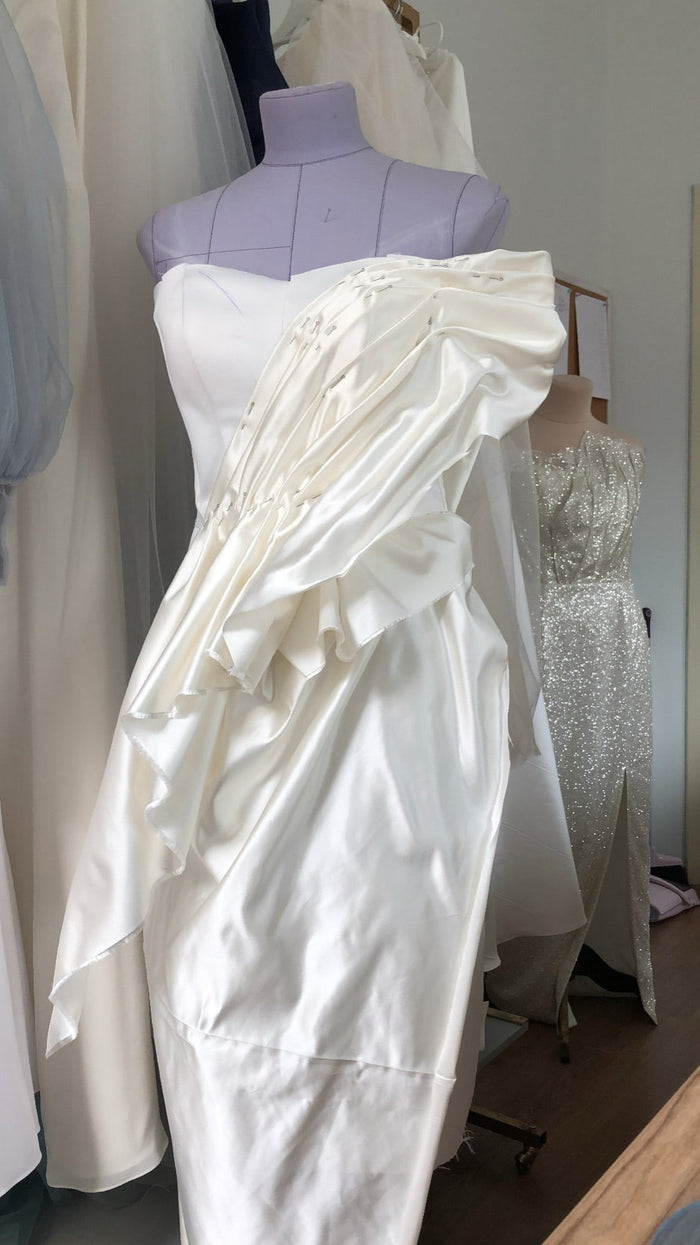
From payment to completed dress: 10 to 12 weeks. We send photos at every major production stage, not just a finished product photo at the end. You see the dress being built. If anything requires adjustment before it's finalized, that's when we address it.
There's no charge for the consultation or the sketch. No commitment to proceed until you're ready. The service is the service.
If you want to understand more about the full ordering process before reaching out, the complete guide to ordering a custom wedding dress online walks through every step from first message to delivery. For timeline details, the custom wedding dress timeline covers what happens in each of the 10 to 12 weeks.

Silhouette and Craft: How Shape and Detail Work Together {#silhouette-and-craft}
The silhouette determines where embellishment can live, how fabric drapes, and what the dress does when you walk. A detail that's stunning on one silhouette can disappear, or overwhelm, on another. Understanding the pairing helps you build a coherent vision from the start.
A-line + full lace overlay. The gradual flare creates natural movement in the fabric, so a lace overlay comes alive as the bride walks. The silhouette also gives the lace pattern room to read clearly across both the bodice and skirt. Particularly strong with a sweetheart, V-neck, or off-shoulder neckline, see wedding dress necklines explained for how each one pairs with different silhouettes, and wedding dress sleeve styles if you're also considering bishop, puff, or illusion sleeves.
Mermaid + clean satin or natural silk. The body-skimming fit means every texture is visible and every seam matters. Satin and fine natural silk work exceptionally well here, they show the line of the silhouette without adding visual noise. Embellishment, if any, concentrates at the neckline or back.
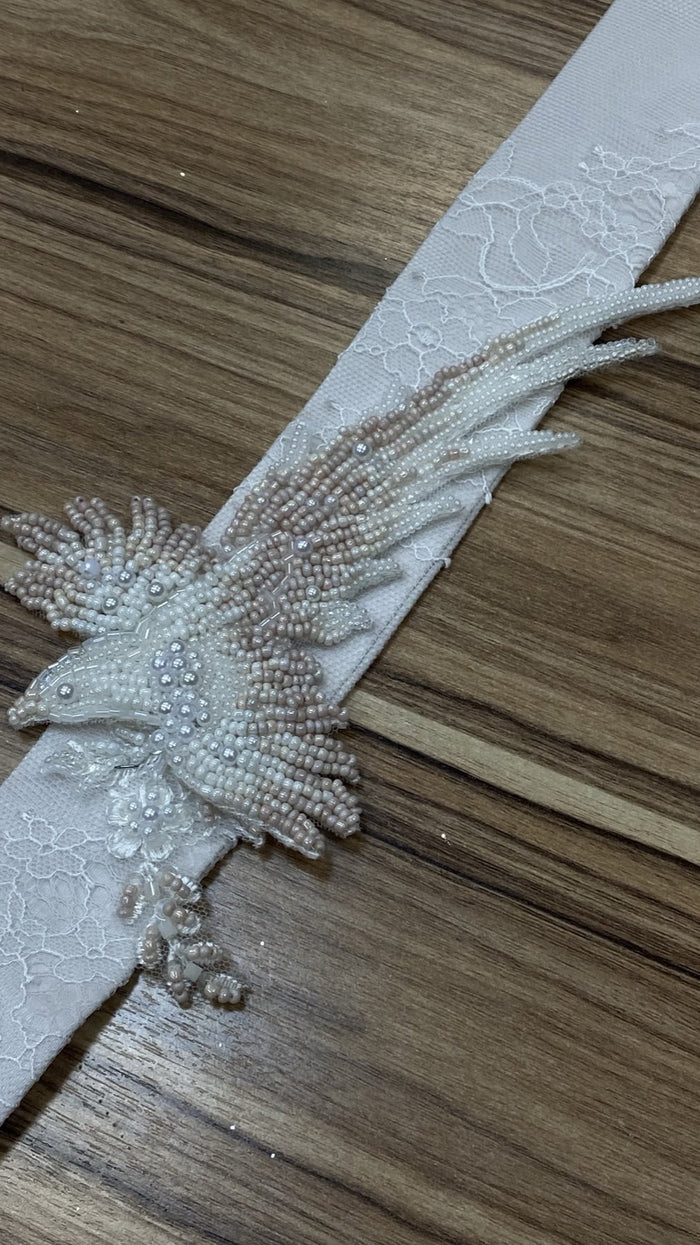
Ball gown + structured bodice embroidery. The volume of the skirt creates room for drama at the top. Heavy beading, hand embroidery, or 3D floral work at the bodice reads clearly against the full skirt below without being lost in the volume, see hand embroidery on a wedding dress for how that work is actually done. The contrast between elaborate top and sweeping skirt is what gives a ball gown its narrative.
Sheath + open back detail. With no volume to carry the eye through the dress, the back becomes the primary visual moment. A sheath is the ideal silhouette for a dramatic open back, deep keyhole, or trailing ribbon bow. The unbroken vertical line at the front throws all attention to the back.
Empire waist + flowing fabric. The silhouette requires movement to read correctly. Heavy or structured fabrics fight the line; silk chiffon, fine georgette, or lightweight natural silk work with it. The seam placement and the fabric choice are decisions that need to be made together.
We work in all silhouettes, all fabric categories, and all combinations. If a combination you're imagining isn't on this list, that doesn't mean it doesn't exist, it may mean no one's tried it yet with your measurements. That's one of the advantages of custom.
For a deeper look at how each material behaves across these silhouettes, see our guide to the best wedding dress fabrics for a custom gown, which covers drape, weight, and structure fabric by fabric.
FAQ
What is the most flattering wedding dress silhouette for most body types?
A-line is consistently identified as the most universally flattering silhouette, it flows away from the body at the waist, skims the hips without hugging them, and creates a clean vertical line without emphasizing any specific area. In a custom A-line, the flare point and degree are adjusted to your actual measurements, which makes the dress work significantly better than any off-the-rack version in the same style.
Can I combine elements from two different silhouettes?
Yes, in custom design, hybrid structures are entirely possible. A popular combination is a closely fitted bodice paired with a softer, more relaxed skirt (a gentler alternative to a strict mermaid). Another is a tea-length A-line with a detachable floor-length train for the ceremony. At Lutien Bridal, we sketch all hybrid designs before committing to a pattern, you see exactly what the combined structure will look like before production begins.
What wedding dress silhouette works best for a garden or outdoor wedding?
A-line, empire waist, and tea-length all translate well to outdoor and garden settings. They allow comfortable movement across uneven ground, photograph naturally in open light, and feel proportional without architectural height around them. Mermaid and ball gown can work outdoors, but require more careful planning around train length, venue surface, and movement logistics.
How do I describe what I want if I don't know the silhouette names?
You don't need the names. Tell us whether you want the dress to follow the body or flow away from it. Tell us where you'd like the waist to fall, at your natural waist, higher, or lower. Tell us whether you want the skirt to be full or fitted. Photos help most, even images of dresses you specifically don't want can clarify the direction. That's the conversation we're designed to have.
How long does it take to make a custom wedding dress?
Production at Lutien Bridal takes 10 to 12 weeks from payment to completed dress, regardless of silhouette. More complex constructions, heavily embellished ball gowns, hand-beaded mermaid gowns, fall toward the 12-week end. Add 3 to 5 days for UPS shipping to the US. We recommend ordering about 10 months before your wedding date to allow for comfortable review time and a reasonable buffer. There is no rush surcharge at six months or more. Inside that window, a rush surcharge applies: €500 at five months, €700 at four months, and €1,000 at three months. Three months before the wedding is the hard floor; we do not take orders inside that.
Every silhouette described in this guide is available through custom design, made for your measurements, not borrowed from a sample. The difference isn't only in fit; it's in the clarity of the process. You work with a designer who helps you find what you're looking for, approve a sketch before production begins, and receive photos throughout.
The right silhouette for you exists. If you know what it is, we'll build it precisely. If you're still finding it, that's what the consultation is for.
More Wedding Dress Style Guides
Each silhouette pairs with its own set of style directions, worth a closer look once you've settled on the shape: