Atelier · France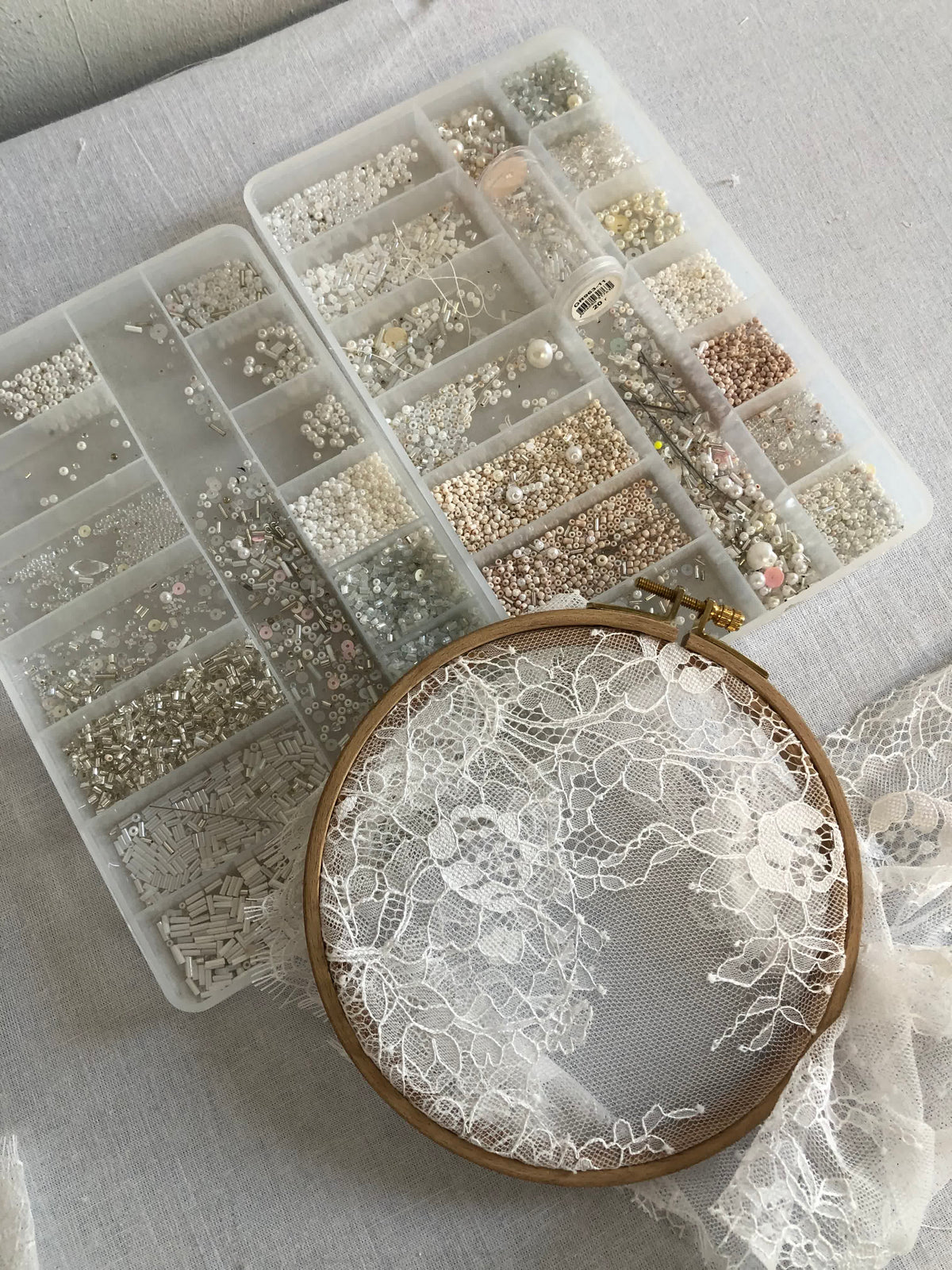

Key Takeaways
- Every piece of hand embroidery at Lutien Bridal is applied after the gown is constructed, individual beads, crystals, sequins, and lace motifs, placed one at a time, not machine-run.
- We work in four core techniques: bead and crystal embroidery, sequin work, lace appliqué, and direct thread embroidery, most gowns combine two or more.
- Embroidered coverage from the waist to the hem takes 2–3 months. We confirm the production schedule for the specific design before the order is placed.
- Price scales with coverage: from the final individual quote for embroidery to the waist to $5,000+ for full coverage with a train.
- The motif is sketched and approved before a single bead touches the gown, nothing is improvised mid-construction.
Table of Contents
- What "Hand Embroidery" Actually Means
- The Four Techniques We Use
- How Long It Actually Takes
- Designing the Embroidery: From Motif to Bodice
- What It Costs
- FAQ
Machine embroidery runs a pre-programmed pattern through a hoop at speed. Hand embroidery doesn't run, it's built, stitch by stitch, bead by bead, by someone sitting with the garment for hours at a stretch. The difference isn't just process. It shows up in the finished dress, in how the light catches an irregular bead placement that a machine would never produce, and in how the embellishment follows the exact curve of a body that was never a standard size to begin with.
This is what that process actually involves at our atelier, the techniques, the time, and what it costs to have it built for you specifically.
What "Hand Embroidery" Actually Means {#what-it-means}
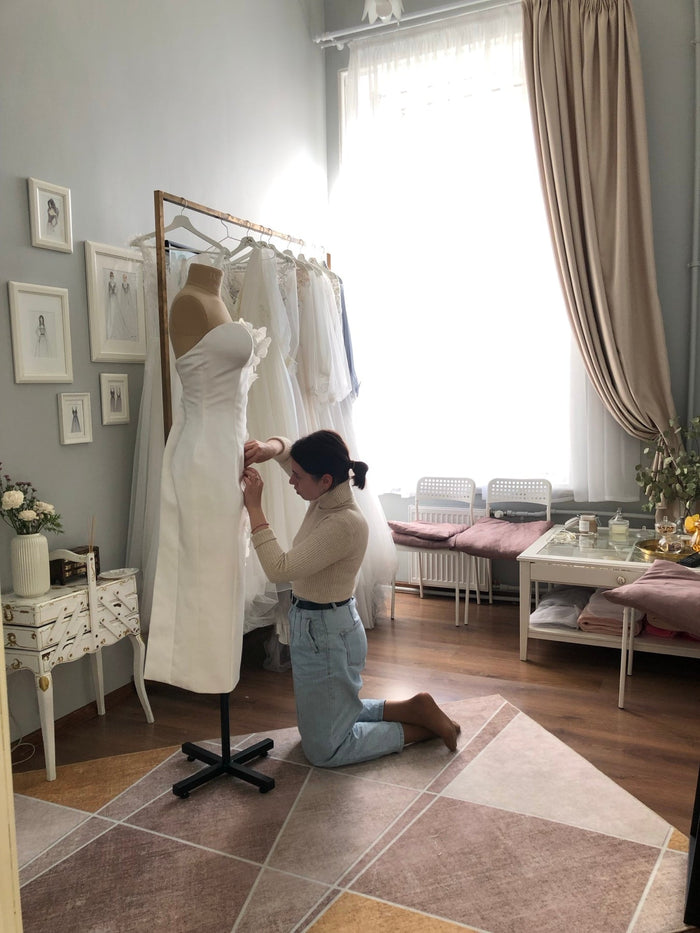
At Lutien Bridal, hand embroidery is applied after the gown is fully constructed, on the finished garment, not on flat fabric before it's cut and sewn. This matters because it means every bead follows the actual seam lines, darts, and curves of your specific dress, not a generic panel that gets assembled afterward.
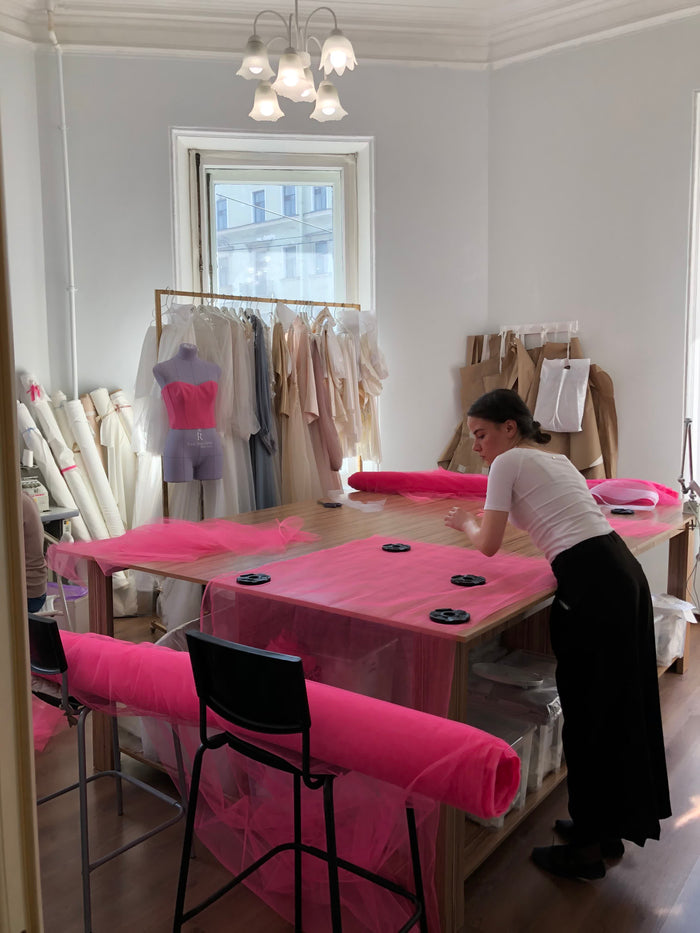
There's no batch production and no machine assist at any stage. An artisan works directly on the gown, section by section, threading and securing each element individually. This is also why embroidery decisions are locked in before production starts: once the base garment is built and the embellishment begins, the design isn't something we revise mid-process.

The Four Techniques We Use {#techniques}
"Hand embroidery" isn't one skill, it's a category that covers several distinct techniques, and most gowns combine more than one.
Bead and crystal embroidery. Individual beads and crystals are threaded and sewn onto a mesh or tulle base, following the motif drawn onto the fabric beforehand. This is the slowest of the four techniques and the one most people picture when they hear "hand-beaded gown." For how hand beadwork compares with machine beading on cost, weight, and durability, see hand beading vs. machine beading.
Sequin work. Sequins are hand-tacked in overlapping, directional rows so they catch light consistently as the fabric moves. Direction matters, sequins laid the wrong way against the body's movement look flat under any light.
Lace appliqué. Individual motifs are cut from raw lace yardage, then hand-positioned and stitched onto the gown one piece at a time. Every motif at a seam has to match across the seam line, which is its own layer of precision work.

Direct thread embroidery. Needle-and-thread work stitched straight into the fabric, florals, monograms, raised satin-stitch detail. This is the technique closest to traditional embroidery in the historical sense, and it's what produces texture you can feel, not just see.
How Long It Actually Takes {#time}
Hand embroidery cannot be accelerated without changing the result. Each bead or stitch is placed individually, and the density, consistency, and thread tension across the whole piece are what determine whether it reads as craft or as something rushed.
The process starts with the motif marked directly onto the gown or mesh base. From there, an artisan works in sections, typically from the center of a motif outward, or top to bottom across a panel, so spacing stays even across large areas. Work is checked in stages against the original sketch before moving forward.
| Embroidery Coverage | Added Finishing Time |
|---|---|
| Waist area | 1–3 months (minimum one month) |
| From waist to hem | 2–3 months |
| Full to hem | 2–3 months |
| Full to hem, with train | 2–3 months; exact timing depends on the design and train |
Allow 2–3 months for embroidery from the waist to the hem. The overall production schedule depends on the design and is confirmed before the order is placed. Rush fees are €500 at five months, €700 at four months, and €1,000 at three months before the wedding; we do not accept orders with less than three months remaining. Hand embroidery time cannot be shortened by a rush fee. For the full week-by-week breakdown of how finishing fits into production, see our custom wedding dress timeline.

Designing the Embroidery: From Motif to Bodice {#designing}
You don't need embroidery vocabulary to start this conversation. Send us what you're drawn to, a Pinterest board, a photo of embellishment you love, even a rough description of "shimmer along the neckline", and we take it from there. If you are still weighing whether to add embellishment at all, simple vs. embellished wedding dress walks through that trade-off before you commit to coverage.
The process runs in a fixed order:
- You share references. What you send tells us whether you're picturing dense coverage or a light accent, geometric pattern or organic florals.
- We sketch the placement. The dress sketch shows exactly where embroidery starts and stops, at what density, before anything is built.
- You approve the motif. For denser or more unusual designs, we can show the specific bead or lace pattern before it's applied to your gown.
- The base gown is constructed. Silhouette, seams, and structure come first.
- Embroidery is applied by hand, on the finished garment. This is the stage that adds the finishing weeks described above.
Nothing about the embroidery is improvised once production begins. The coverage and density you approved at the sketch stage is what gets built, which is also why changes to embroidery scope after payment are difficult once fabric and motif have been sourced.

For a broader look at how the whole custom process runs, from your first message to the finished gown, see our complete guide to ordering a custom wedding dress online.
What It Costs {#cost}
Coverage, how far down the gown the embroidery extends, is the main driver of price, because a skirt is radial. Circumference expands from waist to hem, so full-hem coverage requires several times the material and hours of a waist-only application.
| Embroidery Coverage | Starting Price |
|---|---|
| To waist | the final individual quote |
| To mid-thigh | $2,690 |
| To knee | $2,890 |
| Full to hem | $3,890 |
| Full to hem, with train | $5,000+ |
These are starting prices; the exact figure depends on motif density, technique mix, and whether natural silk or specialty lace is involved. Our guide to the best fabrics for a custom gown covers how material choice moves that number. For the complete price breakdown across construction, fabric, and embellishment, see how much does a custom wedding dress cost.
Start with a free sketch consultation
FAQ {#faq}
Is hand embroidery really done entirely by hand?
Yes. Every bead, crystal, sequin, and lace motif on a Lutien Bridal gown is placed individually by an artisan, after the base garment is constructed. There's no machine-run embroidery and no pre-assembled panels, the work follows the actual seams and curves of your specific dress.
How much does hand embroidery add to the timeline?
Embroidery from the waist to the hem takes 2–3 months. The exact production schedule is confirmed for the design before the order is placed.
Can I combine embroidery with a train or corset construction?
Yes. Embroidery coverage, train length, and corset construction are separate design specifications that we plan together during the consultation. Combining several complex elements adds cost and finishing time, but there's no technical limit, tell us what you're picturing and we'll tell you what it takes.
Can I choose the specific motif, or do I pick from a set list?
You choose. We work from your references to design an original motif, florals, geometric patterns, abstract shimmer, sketched and approved before it's applied to your gown. We don't reproduce another designer's embroidery pattern exactly; we build something that's yours.
What happens if I want to change the embroidery after payment?
Changes are possible before the motif has been finalized and sourced. Once beads, lace, or thread specific to the approved design have been ordered, changes become more limited. We'll always tell you clearly what a change requires before you decide.
All technique, timing, and process details in this guide come from Lutien Bridal's experience completing 1,000+ custom orders from our atelier in France.