Atelier · France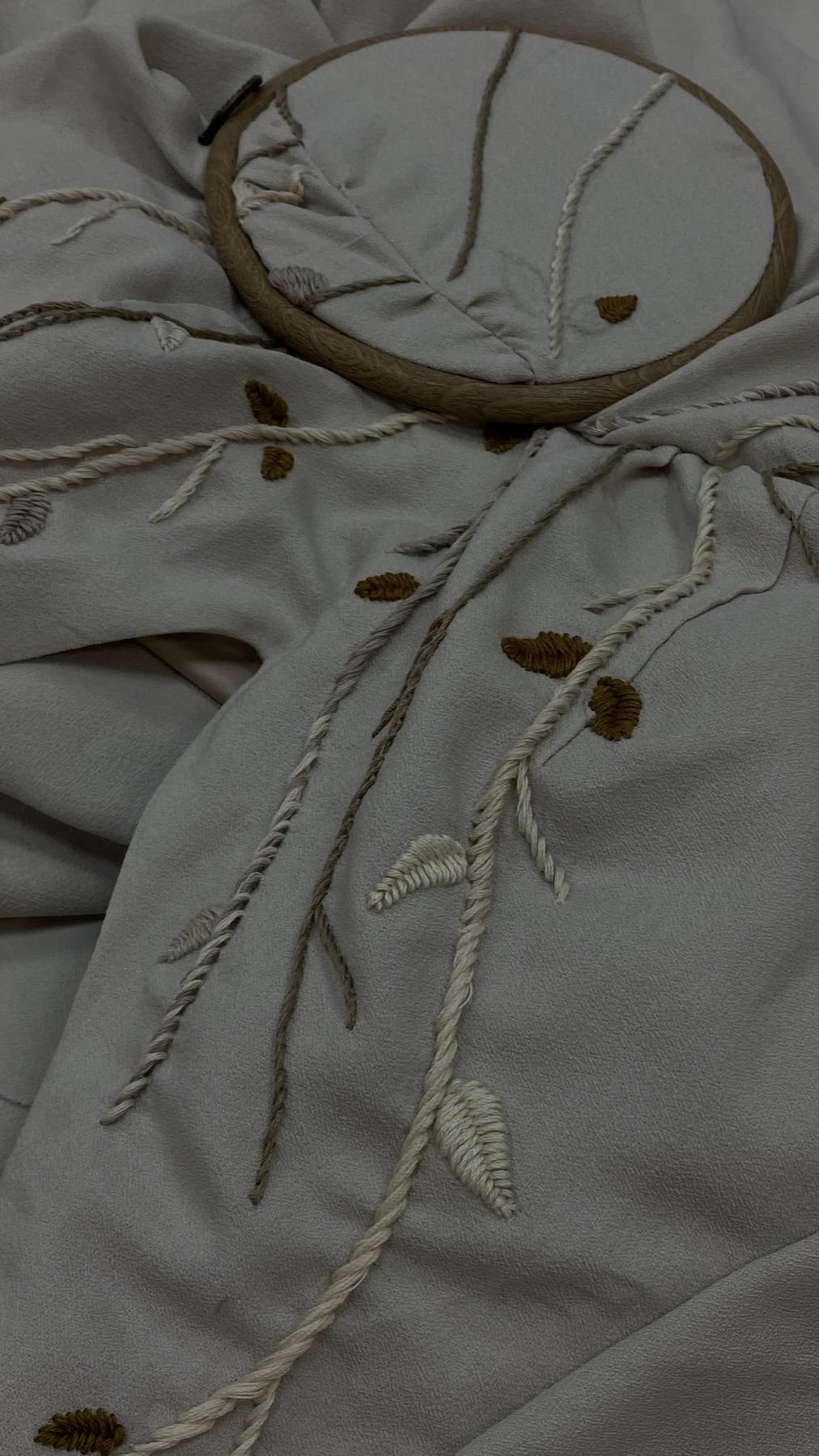

Botanical thread embroidery is stitched plant imagery, branches, leaves, vines, wildflowers, worked directly onto the dress fabric in thread rather than applied as lace or beading. It adds pattern and a hand-made quality with almost no weight and no sparkle, which makes it a good fit for a quiet, natural design.
The design work is choosing the motif, deciding whether it reads tonal or as a contrast, and placing it so it follows the body and the seams rather than fighting them. On a custom dress the embroidery is drawn for your gown specifically, not pulled from a stock panel.
Key Takeaways
- Botanical embroidery is plant imagery stitched in thread directly onto the dress fabric, adding pattern with no weight and no sparkle.
- Tonal (thread close to the fabric color) reads as texture; contrast thread reads as a clear drawing.
- Placement follows the body: climbing a bodice, trailing down a skirt, bordering a hem or cuff, framing a neckline or back.
- It is drawn as artwork for your dress, stitched on the flat fabric panels before the dress is assembled.
- Coverage ranges from a single sprig to an all-over pattern; more coverage means more hand-hours and cost.
What Botanical Embroidery Is
Thread stitched to form leaves, stems, buds, and flowers on the surface of the fabric. Unlike a 3D floral appliqué that stands off the dress, or beading that adds sparkle and weight, thread embroidery sits flat and matte and adds only grams. It is closer in feel to hand embroidery costed by the hour than to any trim you buy by the meter.
Motifs
Common botanical directions:
- Branch and leaf. Fine stems with scattered leaves. Understated, architectural, works tonal.
- Trailing vine. A continuous line of foliage that can climb or trail across a seam.
- Wildflower spray. Loose stems of small flowers, informal and soft.
- Single species. Olive, eucalyptus, fern, wheat, lily of the valley, chosen for meaning or to match the wedding's flowers.
- Dense garden. Overlapping foliage and blooms for an all-over effect.
The motif can be tied to the season, the venue, or a themed brief.
Tonal or Contrast
- Tonal. Thread within a shade or two of the fabric. Reads as texture and light-catch rather than a picture. Ivory-on-ivory is the classic; it photographs as subtle relief.
- Low contrast. A half-step darker or a soft metallic. Visible up close, quiet from across a room.
- Contrast. A clearly different color, a sage or moss green, a soft gold, a black outline. Reads as a drawing on the dress and becomes the focal point, in the spirit of a colored or non-white approach.
Where It Goes on the Dress
Placement follows the body and the seams:
- Climbing a bodice, heaviest at the hem of the bodice and thinning upward.
- Trailing down a skirt, denser at the hem, scattered toward the waist.
- Bordering a hem, a cuff, or a neckline.
- Framing an open back or a backless design.
- A single sprig at the shoulder, hip, or the base of a train.
The design is drawn to cross seams cleanly, so a vine that runs over a side seam lines up on both panels.
Thread, Stitch, and Fabric
- Thread. Fine cotton or silk floss for a matte botanical look; a single strand of metallic for a hint of shine.
- Stitch. Stem stitch and split stitch for outlines, satin stitch for filled leaves, seed stitch and French knots for texture and buds.
- Fabric. Works best on a smooth, stable ground: crepe, satin, fine mikado, or a firm cotton-backed lining under a sheer top layer. Very loose or stretchy fabric is stabilized first.
Coverage and Cost
Thread embroidery is priced by hand-hours, so coverage drives the cost:
- A single sprig or a small border: modest.
- A climbing bodice or a hem border: moderate.
- An all-over garden: the largest addition, comparable to heavy hand beading in hours.
Our price breakdown explains how hand-work is quoted.
Designing Embroidery for a Custom Dress
Steps:
- Brief the motif, species, density, and mood, with reference images.
- Artwork. The embroidery is drawn to scale on the pattern pieces and approved with the sketch.
- Stitch samples on the actual fabric, tonal and contrast, to choose the thread.
- Stitched flat, on the cut panels, before the dress is assembled, then the dress is constructed around it.
For a remote order the stitch samples are sent to you and the finished embroidery is shown in photos and video during the remote fitting process. Embroidery from the waist to the hem takes 2–3 months. We confirm the overall production schedule for the design before the order is placed. UPS delivery to the US takes 3 to 5 days.
FAQ
What is botanical thread embroidery on a wedding dress? Plant imagery, branches, leaves, vines, and wildflowers, stitched in thread directly onto the dress fabric. It adds pattern and a hand-made quality with almost no weight and no sparkle, unlike beading or a 3D floral appliqué.
Should the embroidery match the dress or contrast with it? Tonal thread, within a shade or two of the fabric, reads as texture and photographs as subtle relief. Contrast thread, a sage green, soft gold, or black outline, reads as a drawing on the dress and becomes the focal point. Both are shown on stitch samples before you choose.
Where is botanical embroidery usually placed? Following the body and the seams: climbing a bodice, trailing down a skirt from a denser hem, bordering a hem, cuff, or neckline, or framing an open back. It can also be a single sprig at the shoulder or the base of the train.
Is thread embroidery heavy? No. It adds only grams and sits flat and matte, which is why it suits a soft, natural design. Beading and 3D florals add real weight; thread embroidery does not.
How is embroidery priced? By hand-hours, so coverage drives the cost. A single sprig or small border is modest; a climbing bodice or hem border is moderate; an all-over garden is comparable to heavy hand beading in hours.
Want stitched foliage drawn for your dress? Start with a sketch consultation at Lutien Bridal.
About the author: Vlad Ivanov is the Director of Business Development at Lutien Bridal Atelier in France, home to the design team behind more than 1,000 custom wedding gowns delivered to brides across the US and Europe.