Atelier · France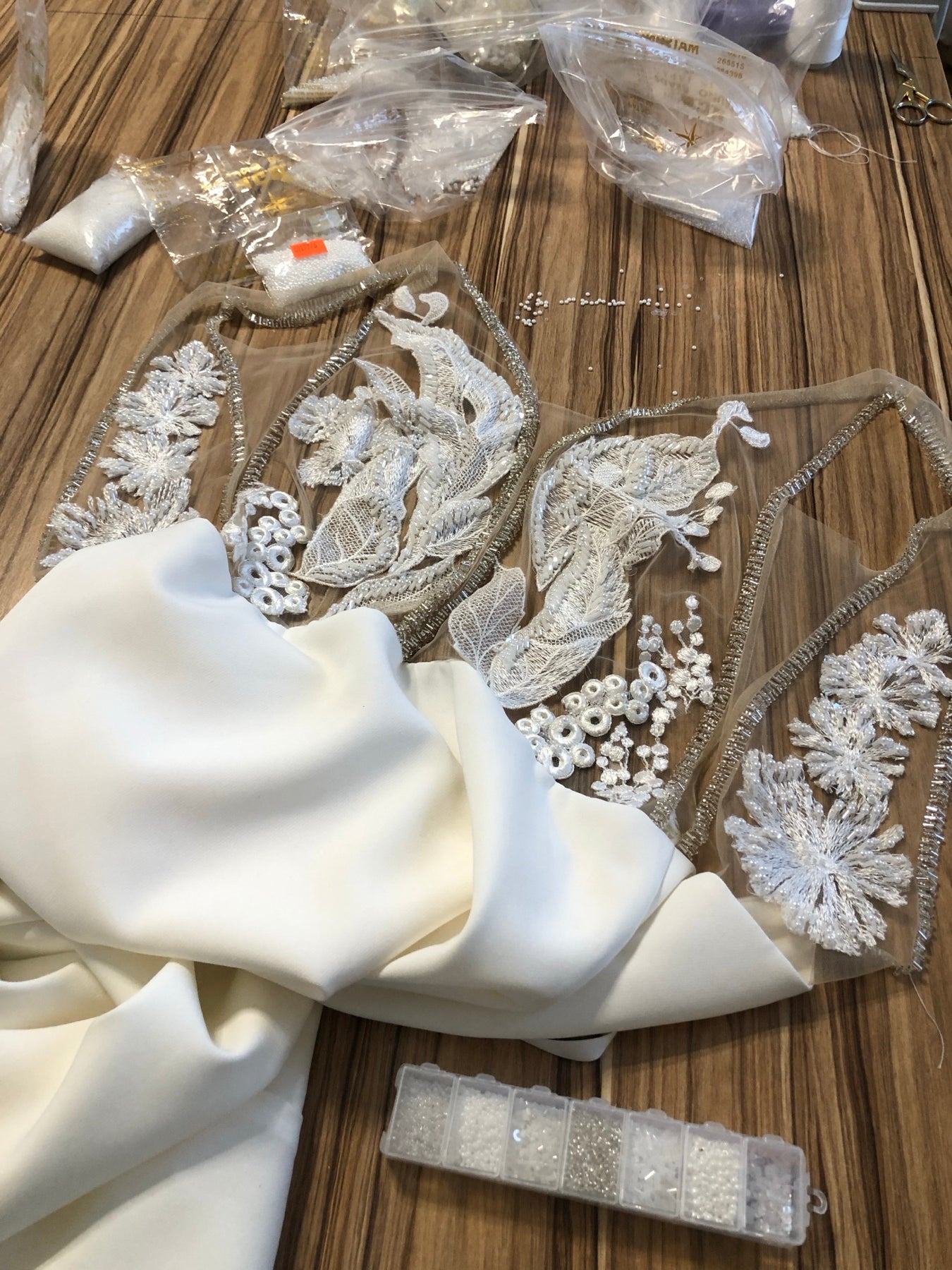

"Beaded" covers a lot of different effects. A pearl-covered bodice, a crystal-scattered skirt, an all-over sequin gown, and a thread-embroidered border all read as embellished from a distance, but they behave very differently up close: different light, different weight, different texture against the skin, and different cost to apply.
Choosing embellishment by picture alone often leads to a surprise at the fitting. Understanding what each type does helps you pick the effect you actually want.
Key Takeaways
- Pearls give a soft, matte glow. They add weight and a bumpy texture, and read as classic.
- Crystals and rhinestones give sharp, bright sparkle that changes with the light. They can feel scratchy without a smooth backing.
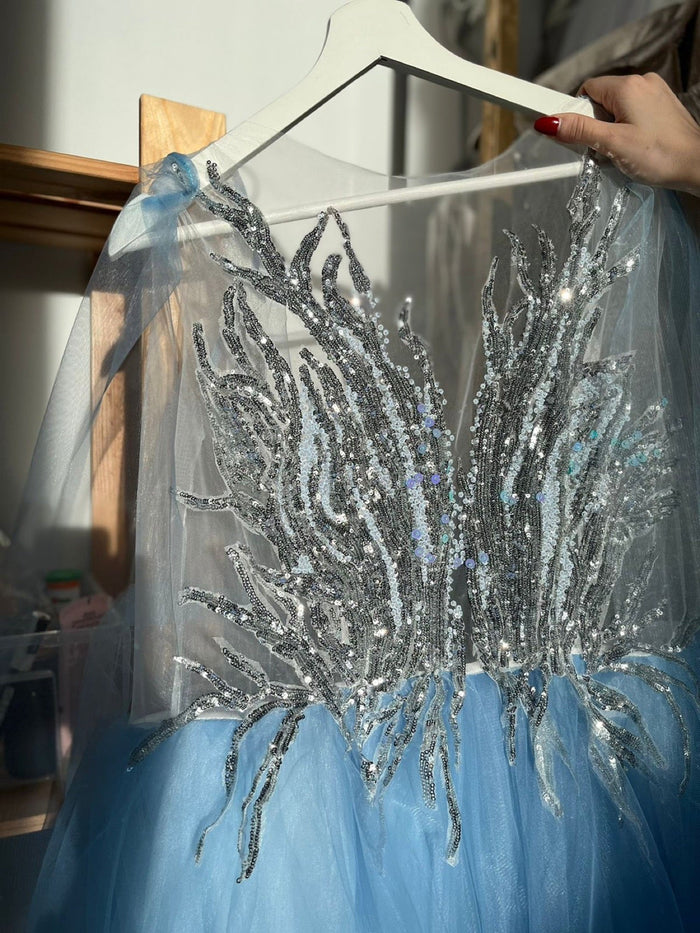
- Sequins give continuous shimmer and movement. All-over sequin fabric is the lightest way to cover a whole gown in shine.
- Bugle and seed beads give fine texture and a subtle shine, and are the base of most "beaded lace."
- Thread embroidery gives colour and pattern with almost no weight or sparkle.
Pearls
Pearls, usually glass or resin rather than real, give a soft, low sheen rather than sparkle. They read as timeless and quiet.
- Light. A gentle, even glow. Does not flash in photos.
- Texture. Rounded and raised. A pearl-covered bodice has a distinct bumpy surface.
- Weight. Moderate to heavy at full coverage. Pearls are denser than sequins.
- Best for. A bodice, a scattered skirt, a neckline or back edge, a hem border. Classic and understated at any density.
Crystals and Rhinestones
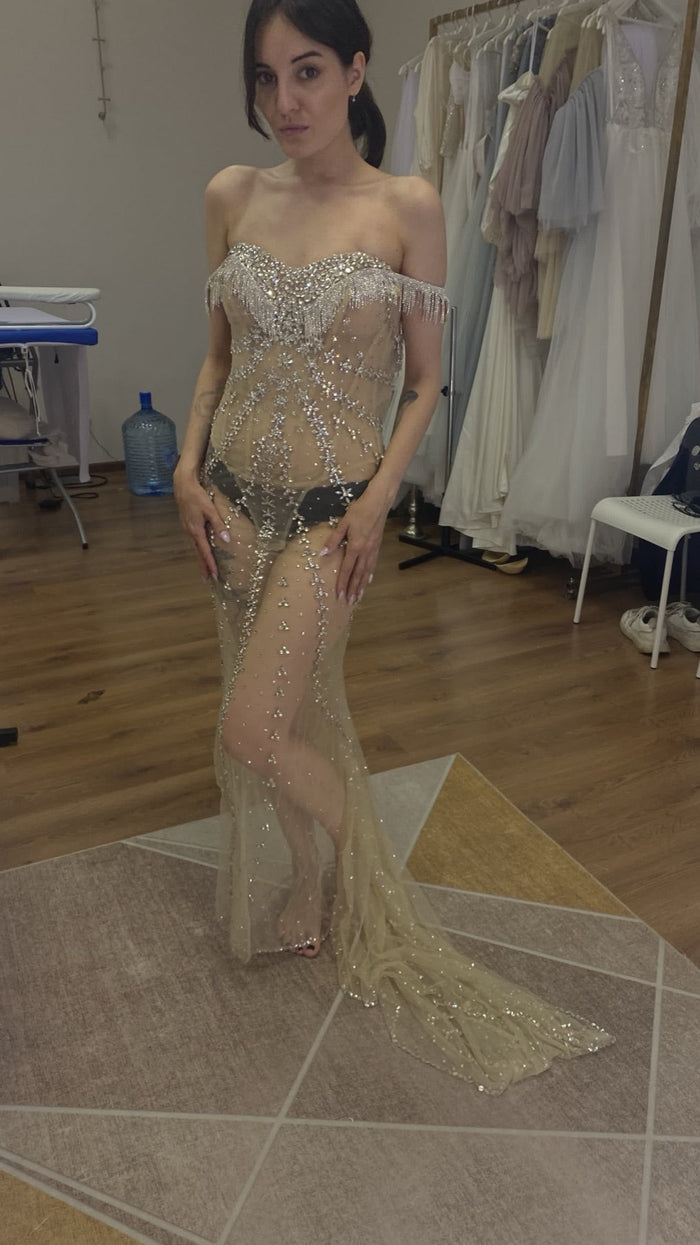
Faceted glass or acrylic stones, set in metal cups or glued, that catch and split light.
- Light. Sharp, bright, directional sparkle that moves as you move. The most dramatic under a flash or spotlight.
- Texture. Hard and faceted. Against bare skin, a crystal edge can feel scratchy, so crystal-heavy areas usually sit over a smooth lining or away from skin contact.
- Weight. Heavy at density, especially cup-set stones. A fully crystalled bodice is one of the heaviest embellishments.
- Best for. A statement bodice, a belt, a scattered "starlight" effect on a skirt, edging a neckline or a cape.
Sequins and Paillettes
Flat or cupped discs, small (sequins) or large (paillettes), stitched so they overlap or scatter.
- Light. Continuous shimmer that shifts as the fabric moves. Softer than crystal, brighter than pearl.
- Texture. Smooth and flat if stitched down; loose and moving if attached at one point.
- Weight. The lightest way to cover a whole gown in shine. All-over sequin fabric weighs far less than an all-over crystal or pearl application.
- Best for. A full glamour gown, a column or sheath in sequin fabric, an Art Deco design, a graduated sparkle from the hem up.
Seed and Bugle Beads
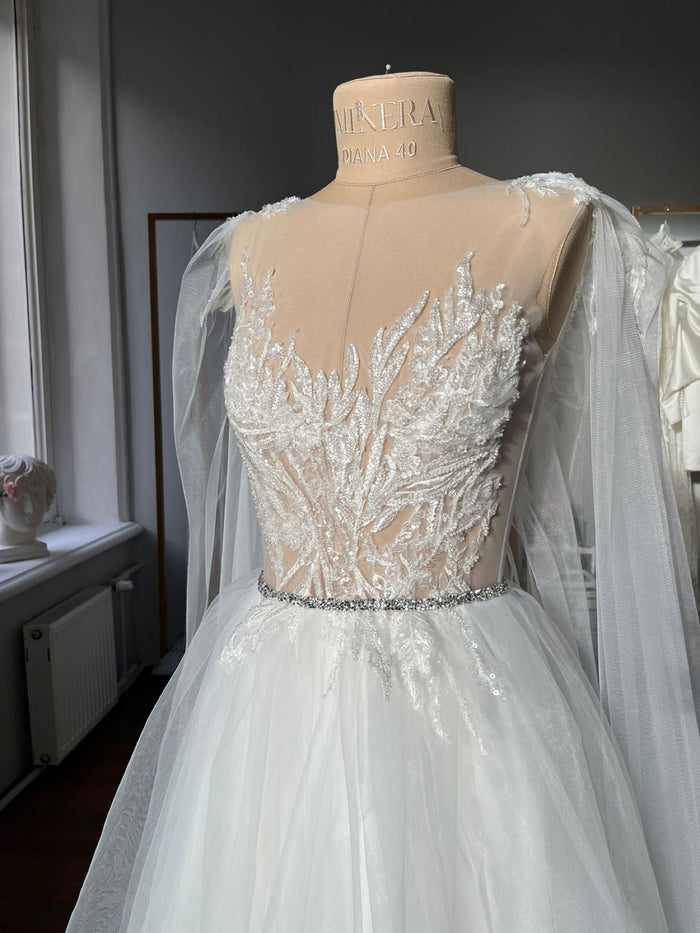
Tiny round (seed) or short tubular (bugle) glass beads, applied by hand or machine.
- Light. A fine, low-key shine, more texture than flash.
- Texture. A subtle grain. Comfortable and unobtrusive.
- Weight. Light at scattered density, moderate when packed.
- Best for. Outlining lace motifs (this is what "beaded lace" usually means), filling an embroidered shape, adding quiet dimension. The base layer of most mixed embellishment.
Thread and Cord Embroidery
Stitched pattern in silk, cotton, or metallic thread, sometimes with a raised cord (soutache).
- Light. Matte, or a soft sheen with metallic thread. No sparkle.
- Texture. Raised line-work. Cord embroidery has a defined, sculptural edge.
- Weight. The lightest of all. Adds pattern and colour with almost nothing on the scale.
- Best for. Botanical or geometric pattern, colour (a coloured thread on ivory), a hem or bodice border. Covered in our guide to what hand embroidery costs.
Weight, Comfort, and Durability
Roughly, from lightest to heaviest at the same coverage: thread embroidery, sequins, seed beads, pearls, crystals.
- Comfort. Smooth applications (sequins stitched flat, embroidery) sit easily. Raised, hard applications (crystals, dense pearls) need a lining between them and the skin, and are kept off high-friction areas like the inner arm.
- Durability. Hand-stitched beads and pearls, secured individually, survive a full day well and can be re-secured. Glued crystals can shed. Loose paillettes can catch. We hand-secure load-bearing embellishment.
- Travel. Heavy embellishment adds bulk for packing, which matters for a destination wedding.
What Each One Costs to Apply
Cost tracks application hours far more than material:
- Machine-applied sequin or beaded fabric bought by the metre is the most efficient way to get all-over shine.
- Hand-scattered beads, pearls, or crystals are priced per hour and rise sharply with density and area.
- Hand embroidery and cord-work are among the most time-intensive, as our comparison of hand beading versus machine beading explains.
- Cup-set crystals cost more than glued or sewn ones, in both material and time.
Our price breakdown covers how detail work is quoted. In a consultation we can show where a change of embellishment type, or concentrating it in one area, keeps the effect for less.
Planning Embellishment as a Custom Order
The decisions:
- The effect: soft glow, sharp sparkle, continuous shimmer, fine texture, or matte pattern.
- The type or combination that produces it.
- Density and placement, mapped on your sketch and confirmed on a mockup or the real bodice.
- Weight and comfort, planned around how you move.
- Colour, tonal or contrast, confirmed against a sample.
We start with a conversation about the effect and the budget, then translate it into a sketch you approve before any fabric is cut. Our design process walks through each stage. Every dress is made to your measurements over 10 to 12 weeks, with UPS shipping to the US in 3 to 5 days, from a starting price of 1,490 euros.
FAQ
What is the difference between pearls and crystals on a wedding dress? Pearls give a soft, matte glow that does not flash in photos, and a rounded, bumpy texture. Crystals give sharp, bright, directional sparkle that moves with the light, and a hard, faceted surface that usually needs a smooth lining behind it.
What is the lightest way to cover a whole wedding dress in sparkle? All-over sequin fabric. Sequins stitched or woven into the fabric weigh far less than an equivalent area of hand-applied pearls or crystals, which is why full-glamour gowns are usually sequin rather than crystal.
Is a heavily beaded wedding dress uncomfortable? It can be if raised, hard embellishment sits against the skin. On a custom gown, crystal and dense pearl areas sit over a lining and are kept off high-friction spots. Smooth applications like flat sequins and embroidery sit easily.
Why is a beaded wedding dress so expensive? The cost is application hours, not usually the materials. Hand-scattered beads, pearls, or crystals are priced per hour and rise with density and area, and hand embroidery is among the most time-intensive work. Machine-beaded fabric by the metre is the efficient option.
What does "beaded lace" actually mean? Lace with seed or bugle beads applied along the motifs, usually by hand, to outline and add subtle shine and dimension. It is the most common form of bridal beadwork and is often the base for mixed embellishment.
Want the sparkle you're picturing, at a weight you can wear all day? Start with a sketch consultation at Lutien Bridal.
About the author: Vlad Ivanov is the Director of Business Development at Lutien Bridal Atelier in France, home to the design team behind more than 1,000 custom wedding gowns delivered to brides across the US and Europe.