Atelier · France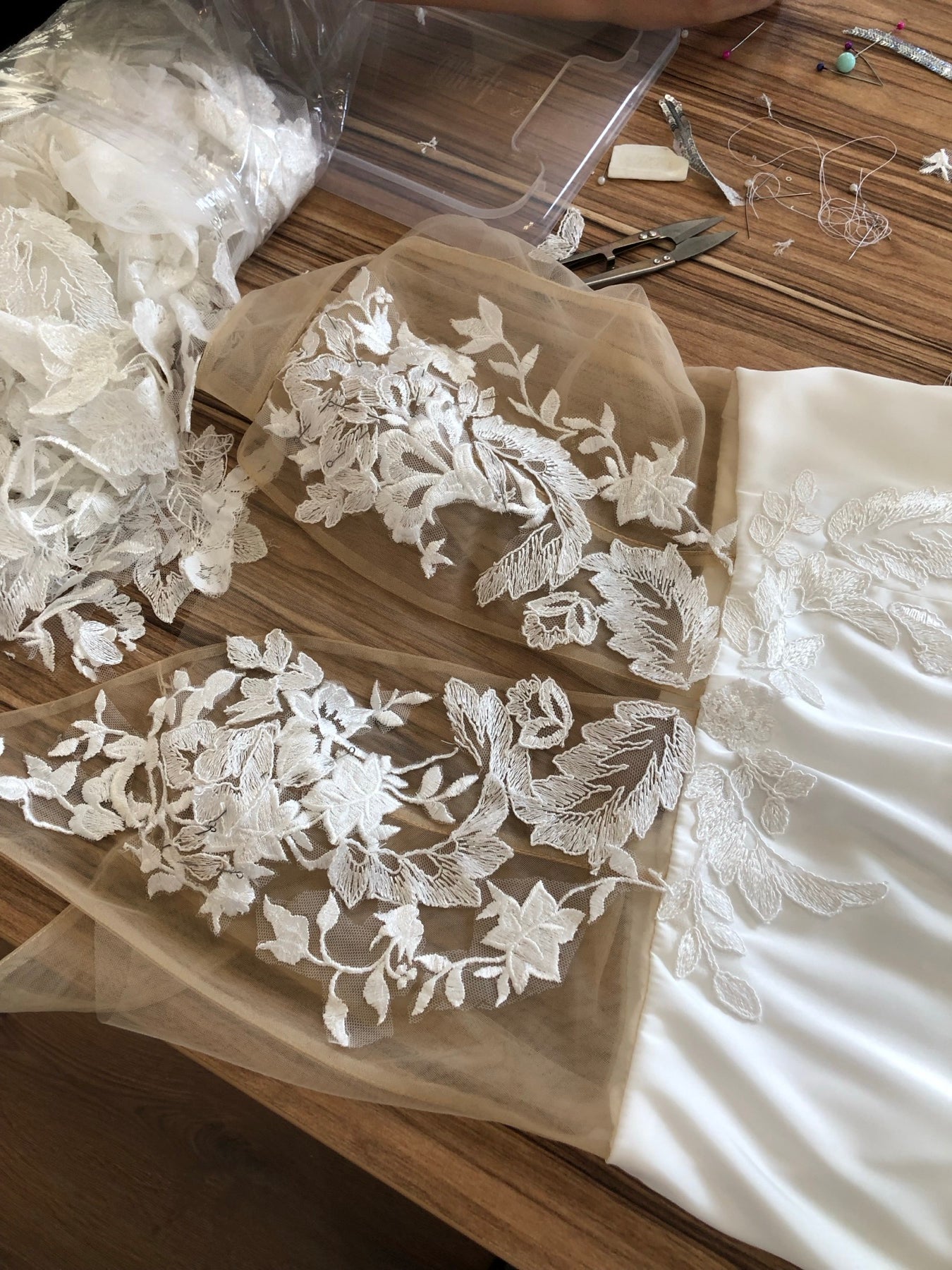

A 3D floral appliqué is a fabric flower that stands away from the surface of the dress rather than lying flat on it. Each one is cut, shaped, and often layered from petals, then hand-stitched to the gown so it catches light and shadow from every angle.
It is one of the most hand-intensive things we do. It is also one of the most misjudged in planning, because the flowers add real weight and can restrict movement if they are placed without thinking about how the dress is worn.
Key Takeaways
- A 3D floral appliqué sits proud of the surface, built from cut and shaped petals, then hand-stitched on.
- It is slow, hand-placed work, which is the main reason it adds cost.
- Density and placement are design decisions: a scattered few flowers behave very differently from full coverage.
- Heavy 3D work adds weight and can catch on itself, on chairs, and on other people, so placement follows how you move.
- It works best concentrated at the bodice, one shoulder, a hip, or trailing down a skirt or train, rather than evenly everywhere.
How a 3D Flower Is Built
There is no single method. Depending on the look, a flower can be:
- Cut from lace, with the motif released from its net and its edges shaped so the petals curl up.
- Built from layered fabric petals, cut individually from tulle, organza, or satin, sometimes wired or heat-shaped, then assembled into a bloom.
- A pre-made trim of ready-formed flowers, faster but with less control over scale and colour.
- Mixed, with a lace base flower given a few raised fabric petals and a beaded centre.
The centres are often finished with hand beading, a pearl cluster, or a French knot. Our article on hand beading versus machine beading covers that finishing work.
How It's Placed on the Dress
Placement is done by hand, on the dress form, over the actual gown fabric. The atelier arranges the flowers loosely first, steps back, adjusts, and only then stitches. Each flower is secured at its base with enough stitches to hold through a full day without crushing the petals flat.
On a custom order, the placement is planned on your sketch and confirmed on a mockup or the real bodice before it is finalized, so the flowers frame your figure the way the design intends. Our article on how a custom wedding dress is made shows this stage in the atelier.
Scattered, Graduated, or Full Coverage
Density changes the whole character of the dress.
| Approach | Effect |
|---|---|
| A few scattered flowers | A light, romantic accent. Minimal added weight. Easy to place around movement. |
| Graduated / cascading | Dense at the bodice, one shoulder, or hip, thinning as it travels down the skirt or train. The most common and the most flattering. |
| Full coverage | Flowers across the entire gown. Dramatic and heavy. Needs careful planning for weight, movement, and how the dress packs and travels. |
Our guide to simple versus embellished covers how to keep one focal point rather than letting the whole dress compete with itself.
What It Does to Weight and Movement
3D work is not weightless. A densely flowered bodice or a fully covered skirt adds noticeable weight, and unlike flat beading it also adds bulk that can:
- Catch on a chair back or an armrest when you sit.
- Snag on lace, jewellery, or another guest's outfit in a hug.
- Restrict a close hug or crossing your arms if the flowers sit at the inner arm or waist front.
None of this rules it out. It means we place the densest work where it does not fight your movement, usually the outer bodice, the back, one shoulder, a hip, and the lower skirt or train, and keep the inner arms, the underarm, and the seat clearer.
Where 3D Floral Works Best
- The bodice, especially framing a neckline or an open back.
- One shoulder or a single strap, as a strong asymmetric accent.
- A hip, drawing the eye and defining the waist.
- Trailing down a skirt or train, the classic cascade.
- On a ball gown skirt, where the volume gives the flowers room to read.
It is a weaker choice for a close sheath where you need a full stride, unless the flowers are kept high on the bodice.
What Drives the Cost
3D floral is priced mainly on hours:
- How the flowers are made. Hand-built layered petals take far longer than cut-lace motifs or pre-made trim.
- How many. Each flower is cut, shaped, and stitched individually.
- Placement complexity. Scattered flowers are quick. A graduated cascade that has to flow across seams and mirror correctly is slow.
- Finishing. Beaded or pearled centres add a second pass of handwork.
Our price breakdown and our article on what hand embroidery costs explain how detail work is quoted. In a consultation we can show where reducing the count, using a cut-lace base, or concentrating the work in one area keeps the effect while lowering the cost.
Planning 3D Floral as a Custom Order
The decisions:
- Construction method. Layered fabric petals, cut lace, pre-made trim, or a mix.
- Density and layout. Scattered, graduated, or full coverage, mapped on your sketch.
- Placement around movement, planned for how you sit, hug, and dance.
- Colour. Tonal (ivory on ivory) or contrast (blush, green, or a painted edge).
- Centres. Plain, beaded, pearled, or knotted.
We start with a conversation about the effect and the budget, then translate it into a sketch you approve before any fabric is cut. Our design process walks through each stage. Every dress is made to your measurements over 10 to 12 weeks, with UPS shipping to the US in 3 to 5 days, from a starting price of 1,490 euros.
FAQ
Why are 3D floral wedding dresses so expensive? The cost is almost entirely handwork hours. Each flower is cut, shaped, and stitched by hand, and a graduated cascade that flows across seams and mirrors correctly is slow to place. Beaded centres add a second pass.
Is a 3D floral wedding dress heavy? A scattered few flowers add almost nothing. A densely flowered bodice or a fully covered skirt adds real weight and bulk. We concentrate the heavy work where it does not fight your movement and keep the inner arms and seat clearer.
Will the flowers get crushed or fall off? Each flower is secured at its base with enough stitches to survive a full day without being crushed flat. Very dense work should still be handled carefully when sitting and hugging, and the dress needs a plan for packing and travel.
Can 3D flowers be added to any dress? Most. They work best on a bodice, one shoulder, a hip, or trailing down a skirt or train, and on a full ball-gown skirt. They are a weaker fit for a close sheath where you need a full stride, unless kept high on the bodice.
Can the flowers be a colour other than white? Yes. Tonal ivory-on-ivory is the most common, but blush, sage, or a hand-painted petal edge are all possible. Colour is confirmed against a physical sample during the design stage.
Want a floral gown planned around how you'll actually move in it? Start with a sketch consultation at Lutien Bridal.
About the author: Vlad Ivanov is the Director of Business Development at Lutien Bridal Atelier in France, home to the design team behind more than 1,000 custom wedding gowns delivered to brides across the US and Europe.