Atelier · France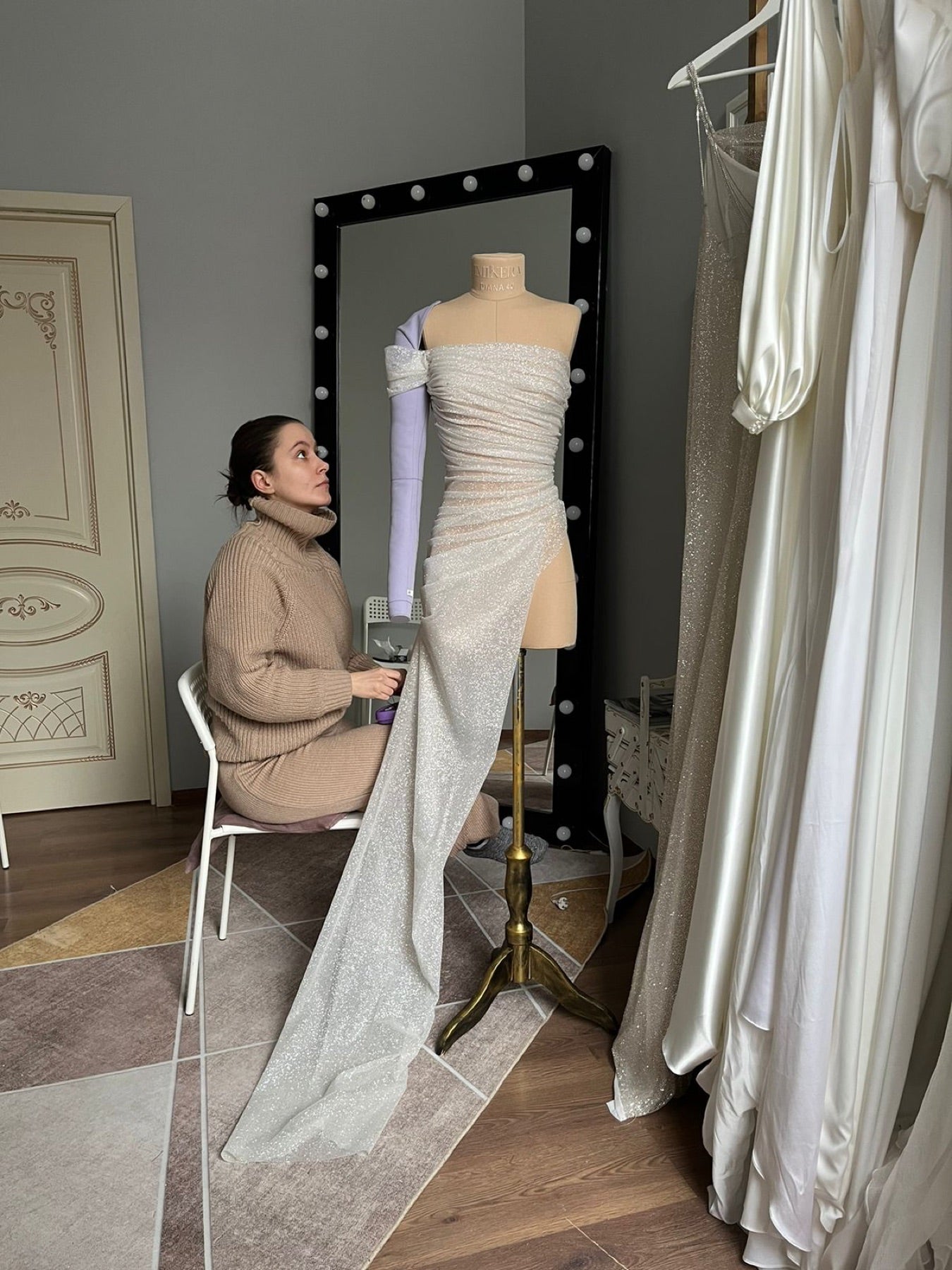

A slit is a vertical opening in the skirt of a wedding dress, usually on the front or side of one leg, that shows the leg when you walk and lets you move freely. It runs from a low, subtle knee slit to a high slit that reaches the upper thigh.
The two things to plan are how high it goes and how it behaves when you are standing still. A well-made slit stays closed and modest at rest and opens only with movement. Getting that right is a matter of where the opening starts, how it is finished, and what sits behind it.
Key Takeaways
- A slit is a vertical opening in the skirt, most often on the front or side of one leg.
- Height runs from knee (subtle, practical) to mid-thigh (visible when walking) to high thigh (dramatic, needs planning to stay modest).
- A slit that overlaps or is backed with a modesty panel stays closed at rest and opens only when you move.
- Front slits show the leg walking toward the camera; side slits are more discreet and read only in profile or in motion.
- On a custom order the height is set on you in your shoes, and the finish is chosen so the edge does not gape or fray.
Why Choose a Slit
- Movement. A slit lets you walk with a full stride, climb steps, and dance in an otherwise narrow skirt, which is why it pairs so well with a sheath or column.
- A modern line. It breaks a long, plain skirt and adds an element without embellishment, in the spirit of a simple over embellished design.
- Showing the shoes. Like a high-low hem, a slit features a shoe you have chosen carefully.
- Warm-weather comfort. Useful for a garden or beach wedding.
Slit Heights
Measured from the hem up:
- Knee slit. Ends at or just below the knee. Barely visible standing, opens a little when you walk. The most practical and the most modest.
- Mid-thigh slit. Ends partway up the thigh. Clearly visible when walking, discreet at rest if backed correctly.
- High-thigh slit. Reaches the upper thigh. Dramatic. Needs an overlap or modesty panel and careful setting so it does not show more than you want when you sit or the wind moves it.
We set the exact height on you, in your wedding shoes, standing and mid-stride, because it reads higher in motion than it looks standing still.
Front, Side, or Center
- Front-of-leg slit. Placed over the front of one thigh. Shows the leg as you walk toward people and the camera. The most visible.
- Side slit. On the outer thigh, at or just forward of the side seam. Reads mainly in profile and in movement. More discreet.
- Center-front slit. Directly down the middle. Bold and symmetrical, usually kept lower.
A single slit on one leg is standard. A double slit is rare and much harder to keep modest.
Keeping It Modest at Rest
The trick to a slit that is elegant rather than exposing:
- Overlap. The two edges of the skirt cross over each other rather than meeting edge to edge, so the opening stays closed when you stand and parts only with a stride.
- A modesty panel. A sheer or matching panel set behind the opening to a chosen height, so a high slit still has coverage where you want it.
- Weighting. A fine chain weight or horsehair in the hem keeps the front panel hanging straight instead of falling open.
- Placement. Starting the slit a little to the side rather than dead center keeps it closed at rest.
Finishing the Slit Edge
An unfinished slit gapes, curls, and frays. A good slit has:
- A faced or bound edge so the opening holds a clean straight line.
- Understitching so the facing rolls to the inside and does not peek.
- A bar tack at the top of the slit so it cannot tear higher than intended.
- The edge finish matched to the hem finish so they look like one continuous edge.
Fabrics and Silhouettes That Suit a Slit
- Fluid fabrics (crepe, satin, silk) fall back into place cleanly after you move.
- Sheath, column, and trumpet shapes benefit most, because the slit adds the movement a narrow skirt lacks.
- Full skirts (ball gowns) rarely need a slit, and the volume hides it anyway.
- Stiff structured fabrics hold the opening as a hard shape and are a poorer choice.
Planning a Slit on a Custom Order
Steps:
- Height and placement, set on you in your shoes, standing and walking, and checked seated.
- Overlap or modesty panel, chosen for how covered you want to be at rest.
- Edge finish, faced and bar-tacked, matched to the hem.
- A movement test at the mockup: walking, stairs, sitting, and turning.
For a remote order the slit height is set from your measurements and shoe height, and its behavior is shown on a form in photos and video during the remote fitting process. Every dress is made to your measurements over 10 to 12 weeks, with UPS shipping to the US in 3 to 5 days. See the price breakdown for what affects the cost.
FAQ
How high can a wedding dress slit go? From a subtle knee slit to a high-thigh slit. A knee slit is barely visible standing and adds walking room. A high-thigh slit is dramatic but needs an overlap or a modesty panel so it stays covered when you sit or stand still. The height is set on you in your shoes.
How do I keep a high slit modest? With an overlap, where the two skirt edges cross rather than meet, so the opening stays closed at rest and parts only with a stride. A sheer or matching modesty panel behind the opening adds coverage to a chosen height. Hem weighting keeps the front panel hanging straight.
Is a front slit or a side slit better? A front-of-leg slit is the most visible and shows the leg as you walk toward people and the camera. A side slit reads mainly in profile and in movement and is more discreet. A single slit on one leg is standard.
Which dresses suit a slit? Narrow shapes benefit most: sheath, column, and trumpet, where the slit adds the movement the skirt lacks. Fluid fabrics like crepe, satin, and silk fall back into place cleanly. Full ball gown skirts rarely need one.
Can a slit be added after the dress is made? It is much better drafted in from the start, with the opening, overlap, and facing planned into the pattern. Cutting a slit into a finished skirt risks a gaping, fraying edge and no modesty backing.
Want a slit in your skirt, set to a height you are comfortable with? Start with a sketch consultation at Lutien Bridal.
About the author: Vlad Ivanov is the Director of Business Development at Lutien Bridal Atelier in France, home to the design team behind more than 1,000 custom wedding gowns delivered to brides across the US and Europe.