Atelier · France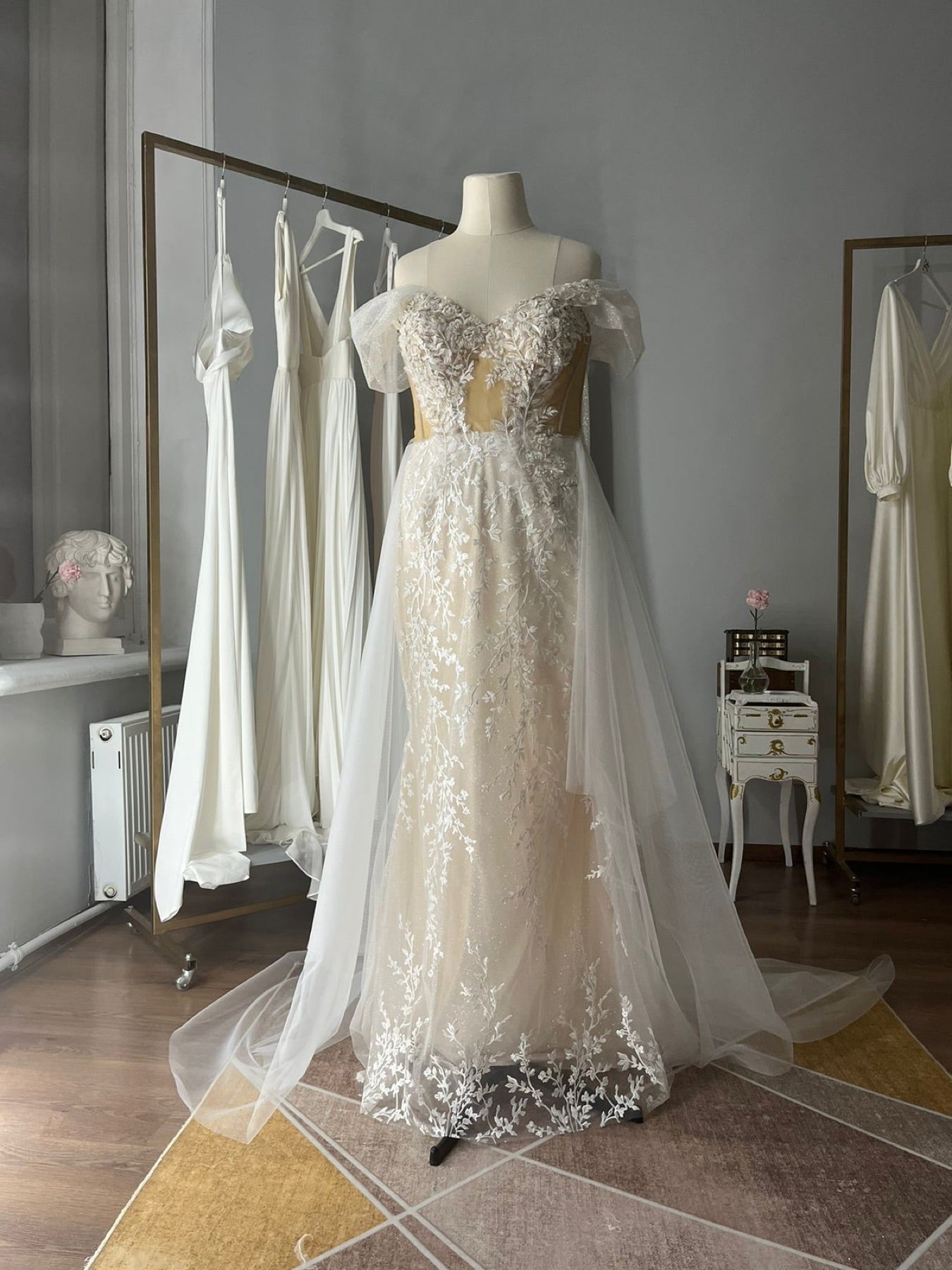

Mermaid and trumpet wedding dresses both fit closely through the torso and hips, then flare out toward the hem. The difference is where the flare begins. A mermaid flares low, at or below the knee. A trumpet flares higher, around mid-thigh.
That single difference changes how the dress moves, how far you can step, and how the fit has to be engineered. Both silhouettes are the most fitted of the traditional shapes, which means the pattern and the internal structure carry most of the responsibility for how the dress feels.
Key Takeaways
- A mermaid flares at or below the knee. A trumpet flares around mid-thigh and gives more walking room.
- Both silhouettes need an internal structure, usually a boned bodice or full inner corset, so the dress stays in place without being pulled tight.
- Fit accuracy matters more here than in any other silhouette. Small measurement errors show immediately on a close-fitted shape.
- Stride is limited by where the flare starts. A godet or a soft kick pleat can restore step room without changing the look.
- As a custom order, the flare point, the internal support, and the stretch of the fabric are all set to your body and your movement needs.
Mermaid vs. Trumpet: The Real Difference
Both shapes share the same top half. They are fitted through the bust, waist, hips, and upper thigh. The contrast is the flare point.
- Mermaid. The dress stays close to the leg to at least the knee, often lower, then releases into a defined flare. The effect is dramatic and sculptural. The close section is longer, so the walking restriction is more noticeable.
- Trumpet. The dress releases around mid-thigh into a gentler, more gradual flare. It reads as fitted but gives more room to move. It is often described as the midpoint between a mermaid and an A-line.
Neither term is rigidly standardized across the industry, so the label matters less than the drawing. In a custom process we mark the exact flare height on your sketch and confirm it at your first fitting. Our full silhouettes guide sets both shapes against every other option.
Why the Fit Has to Be Exact
On a fuller skirt, a centimeter of difference disappears into the volume. On a mermaid or trumpet, it does not. The fabric sits directly against your body from the bust to the thigh, so every measurement point is visible.
This is why we do not fit these silhouettes from a size chart. We work from a full set of measurements taken by a tailor, following the same method described in our guide to what measurements we need. We also need to know your posture, how you carry your weight through the day, and whether you want the fit firm or closer to comfortable.
A fitted silhouette is also less forgiving of body changes between measurement and wedding day. We build in small seam allowances at key points so the dress can be adjusted at a final fitting rather than remade.

The Internal Structure You Do Not See
A close-fitted dress that relies only on the outer fabric to stay up will shift as you move. The structure is what keeps it in position.
Most mermaid and trumpet gowns are built over a boned bodice or a full inner corset that extends past the waist toward the hip. This inner layer holds the shape and takes the tension, so the outer fabric can sit smoothly without being pulled tight against your skin. The construction principles are the same ones covered in our article on corset construction and fit.
For strapless versions, the internal structure does even more work, because there are no straps sharing the load. A well-built inner corset lets a strapless mermaid stay up through a full day without being uncomfortably compressive.
How Each Silhouette Moves
Your stride length is set by the narrowest point of the skirt and where the flare begins.
- A mermaid with a knee-or-lower flare point limits a full walking stride. Stairs, especially climbing, need a hand to lift the front hem slightly. Kneeling is restricted.
- A trumpet with a mid-thigh flare allows most of a normal stride and handles stairs more easily.
Both can be adjusted for movement without losing the look. A godet, a triangular fabric insert set into a seam, adds hidden width low in the skirt that opens only when you step. A soft kick pleat at center back does the same. We plan these in from the start based on your venue. If you have a long walk down an aisle, a first dance, or an outdoor path, we account for it.
The train adds its own consideration. A fitted silhouette with a long train benefits from a bustle so the train lifts off the ground for the reception. Our guide to train lengths covers the options.
Fabric and Stretch
Fabric choice affects both the look and the wearability of a fitted silhouette.
| Fabric | Behavior on a mermaid or trumpet |
|---|---|
| Crepe | Matte, fluid, skims the body. Forgiving of small movement. A common choice for a clean fitted look. |
| Satin | Glossy and structured. Shows the line of the body clearly and holds a sharp flare. Less give. |
| Stretch crepe or stretch satin | Contains elastane. Moves with you and eases the stride restriction. Needs careful pattern work so it does not cling. |
| Lace over lining | Adds texture. The lining underneath determines the fit and stretch, not the lace. |
Our fabric guide for custom gowns explains each of these in more depth. For a fitted dress, a small percentage of stretch in the fabric is often the difference between a dress you manage and a dress you forget you are wearing.
Who These Silhouettes Suit
A mermaid or trumpet works well if you want:
- To show the shape of your figure through the waist and hips rather than skim over it.
- A defined hourglass or curved line emphasized rather than softened.
- A dramatic silhouette from the side and back, where the flare is most visible.
They ask more of the fit and the planning than a skimming shape does. If you want a fitted top half without the movement restriction, a sheath or column gives a straight, close line with a full stride. If you want drama in the skirt without the close fit, a ball gown is the opposite trade.
Planning a Mermaid or Trumpet as a Custom Order
The decisions that shape a fitted gown are:
- Flare point. Marked in centimeters from the floor or from your knee on the sketch.
- Flare volume. From a slim, quiet release to a wide, sculptural one.
- Internal structure. Boned bodice or full inner corset, and how far past the waist it extends.
- Movement features. Godet, kick pleat, or stretch content, chosen for your venue.
- Fabric. With or without stretch, matte or glossy, plain or lace-covered.
We begin with a conversation about the effect you want and how you will move on the day, then translate it into a sketch you approve before any fabric is cut. The fit is refined across your fittings. The design process walks through each stage.
Every dress is made to your measurements over 10 to 12 weeks, with UPS shipping to the US in 3 to 5 days. Pricing starts at 1,490 euros. Our price breakdown explains what changes the cost.
FAQ
Can you walk normally in a mermaid dress? Not with a full stride if the flare starts at or below the knee. A shorter step is natural. A hidden godet or kick pleat restores most of the walking room without changing how the dress looks, and we plan these in based on your venue.
What is the difference between mermaid and trumpet? The flare point. A mermaid stays close to the leg to the knee or lower before flaring. A trumpet releases around mid-thigh into a softer flare, which gives more room to move.
Do mermaid dresses need a corset inside? Most do. A boned bodice or full inner corset holds the close-fitted shape in place so the outer fabric does not have to be pulled tight against your body. Strapless versions rely on this structure even more.
Is a fitted silhouette a bad choice for an outdoor wedding? Not necessarily. It needs planning for uneven ground and any long walk, usually through a stretch fabric or a hidden godet. A long train on grass benefits from a bustle for the reception.
How far in advance should I be measured for a fitted dress? Follow the same schedule as any custom gown, but expect the final fitting to matter more. We build small seam allowances into a fitted silhouette so it can be adjusted close to the wedding rather than remade.
Planning a fitted silhouette that still lets you move through your day? Start with a free sketch consultation at Lutien Bridal.
About the author: Vlad Ivanov is the Director of Business Development at Lutien Bridal Atelier in France, home to the design team behind more than 1,000 custom wedding gowns delivered to brides across the US and Europe.