Atelier · France

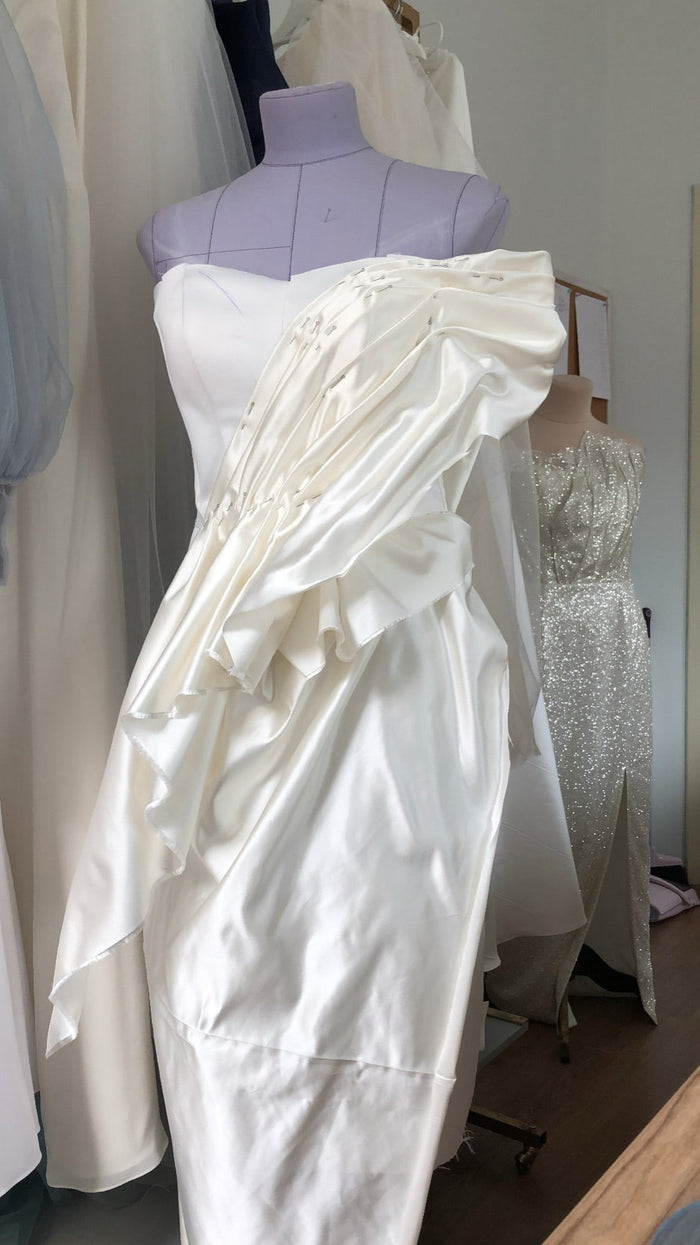
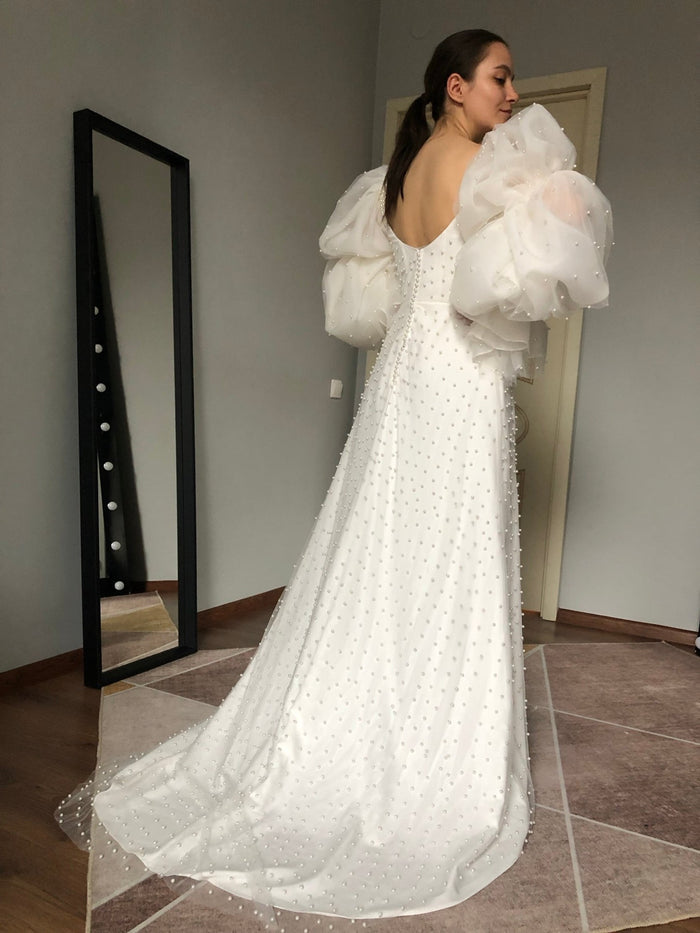
A high-low hemline is short at the front and long at the back, so it shows the feet and ankles while keeping length and, often, a train behind. An asymmetric hemline is uneven by design in another way: a diagonal sweep, one side shorter than the other, or a handkerchief hem with pointed dips.
Both are a way to have a shorter dress and a formal one at the same time. They also demand precise cutting, because an uneven hem shows every error in balance, and the transition from short to long has to look intentional from every angle.
Key Takeaways
- High-low is short at the front, long at the back. Asymmetric covers diagonal, one-sided, and handkerchief hems.
- It lets you show your shoes and move freely while keeping a formal length and often a train at the back.
- The front length is set to your shoe and how much leg you want shown; the back to the train length you want.
- The side transition points are where a high-low hem succeeds or fails. They must curve smoothly, not jump.
- On a custom order every point of the hem is set on you in the real shoes, then trued so it hangs level to the floor at each height.
High-Low vs Asymmetric
- High-low (hi-lo). A continuous hem that rises to the front, often to knee or mid-shin, and drops to floor length or a train at the back. Symmetrical left to right.
- Diagonal asymmetric. The hem runs on a slant, long on one side, short on the other.
- Handkerchief hem. The skirt is cut so the hem falls in points, dipping and rising around the circle.
- Layered asymmetric. A short lining hem under a longer, uneven overskirt, sometimes detachable like a convertible design.
Why Choose an Uneven Hem
- Show the shoes. If you have chosen a shoe you love, a high-low hem features it.
- Move freely. A short front means no skirt underfoot when walking, climbing steps, or dancing, useful for a garden or beach wedding.
- Two effects in one dress. Formal and floor-length from behind, playful and short from the front.
- A modern line without going fully tea-length or short.
How It Is Cut and Balanced
The hem is not drawn on paper and cut once. It is:
- Marked on you, in the real shoes, at the front, the sides, and the back.
- Trued, so the hem hangs parallel to the floor at every point once the fabric has relaxed.
- Checked for smooth transitions. The rise from short front to long back must curve, with no visible step or kink at the side seams.
- Re-hung and re-checked after the fabric has hung for a day, because bias and cross-grain sections drop unevenly.
An uneven hem is one of the clearest tests of careful finishing: a symmetrical floor hem hides small errors, this one does not.
Front Length and Back Length
- Front: set to your shoe height and preference, commonly knee, mid-shin, or ankle. Higher shows more leg and reads more playful.
- Back: anything from floor length to a chapel or cathedral train. A longer back balances a shorter front.
- Sides: the pivot points, usually set near the side seams, where the hem turns from rising to falling.
We set all of these on you and photograph them before cutting the real fabric.
Fabrics That Suit It
- Soft, flowing fabrics (chiffon, georgette, soft crepe) give a fluid high-low that moves.
- Light satin gives a cleaner, more defined edge.
- Tulle and organza layers suit a handkerchief or layered asymmetric hem.
- Stiff structured fabrics are the wrong choice; they hold the uneven edge as a hard shape rather than letting it fall.
Shoes, Venue, and Movement
- The front hem shows your shoes all day, so choose them before the final fitting.
- Uneven ground (grass, sand) is easier in a short front; see the garden and beach dress guides.
- The long back still needs a bustle if it is a train, so it is off the ground for the reception.
- Sitting is easy because the front is short; the back drapes behind the chair.
Setting the Hem on a Custom Order
Steps:
- Choose your wedding shoes and bring or send their exact heel height.
- Mark the hem on you, front, sides, back, in those shoes, at a fitting.
- True and re-hang after the fabric settles.
- Final check walking, on steps, and seated.
For a remote order the hem is set to your measurements and heel height, and the finished hang is shown from every angle in photos and video during the remote fitting process. Every dress is made to measure over 10 to 12 weeks, with UPS shipping to the US in 3 to 5 days. See the price breakdown for what affects cost.
FAQ
What is a high-low wedding dress? A dress with a hem that is short at the front, usually knee to ankle, and long at the back, often to floor length or a train. It shows the feet and allows free movement while keeping a formal length and silhouette from behind.
Is a high-low hem hard to make? It takes more care than a level hem. The hem is marked on the body in the real shoes, trued so it hangs parallel to the floor at every point, and the side transitions must curve smoothly. It is re-hung after the fabric settles because different grain directions drop unevenly.
Can a high-low dress have a train? Yes. The back can be floor length, chapel, or cathedral train length. A longer back balances a shorter front. If it is a train, it still needs a bustle to lift it off the ground for the reception.
What fabrics work for an asymmetric hem? Soft, flowing fabrics like chiffon, georgette, and soft crepe for a fluid, moving hem. Light satin for a cleaner edge. Tulle and organza layers for a handkerchief or layered hem. Stiff structured fabrics are the wrong choice.
How do I decide the front length? It is set to your shoe height and how much leg you want shown, commonly knee, mid-shin, or ankle. Choose your wedding shoes before the final fitting, because the front hem shows them all day and the length is set in those shoes.
Considering a high-low or asymmetric hem? Start with a sketch consultation at Lutien Bridal.
About the author: Vlad Ivanov is the Director of Business Development at Lutien Bridal Atelier in France, home to the design team behind more than 1,000 custom wedding gowns delivered to brides across the US and Europe.