Atelier · France

A convertible wedding dress is one gown built to change on the day. A detachable overskirt, train, cape, or sleeves come away after the ceremony to leave a lighter, movement-friendly dress for the reception. It is one purchase, one fitting process, and one base garment that carries two moods.
The engineering is in the attachment points. They have to be invisible when the piece is on, secure through hours of standing and photos, and quick to release without a full change of clothes. That is a design decision made at the sketch stage, not an alteration added later.
Key Takeaways
- A convertible gown has removable elements: overskirt, train, cape, or sleeves, planned from the start.
- It gives you a formal ceremony look and a lighter reception look from one dress.
- Attachment is by covered hooks, buttons, a hidden zip, or a waistband seam, chosen for the piece and the fabric.
- It is usually less expensive and less complex than two separate dresses, and simpler to fit.
- A helper should practice the removal once before the day, especially for a long train.
What Can Be Made Removable
The most common convertible elements:
- A detachable overskirt. A voluminous layer, often tulle or organza, clips over a slim base skirt for the ceremony and comes off for dancing. The base dress is a sheath, column, or slim A-line.
- A detachable train. The base dress is floor or sweep length; a separate train attaches at the waist or shoulders for the ceremony and portraits.
- A cape or capelet. Attaches at the shoulders or neckline and lifts away entirely. Covered in our cape wedding dress guide.
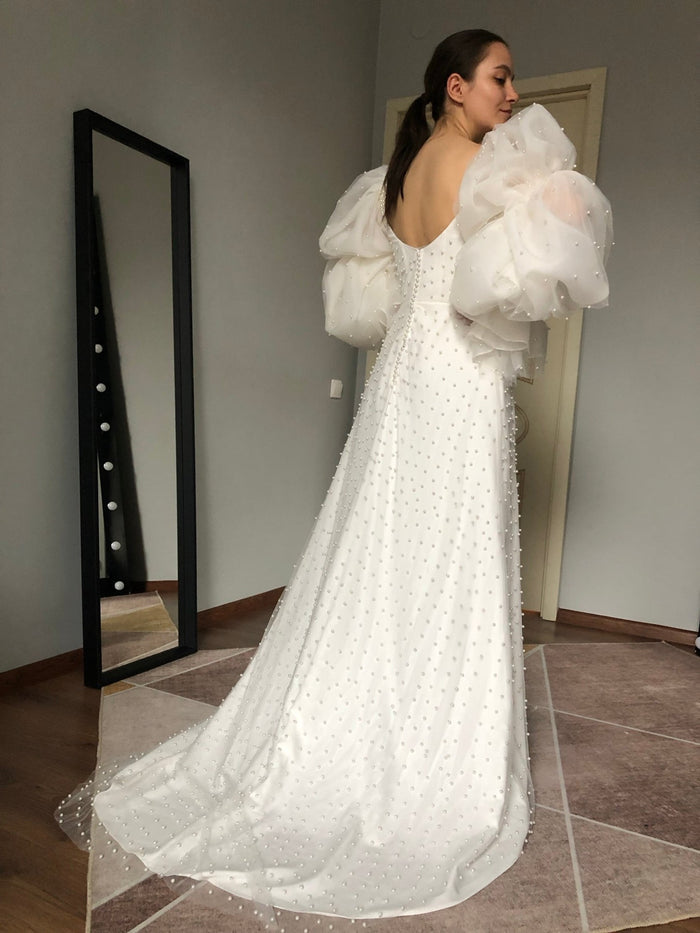
- Sleeves. Long or statement sleeves that unbutton or unhook at the shoulder, leaving a strapless or thin-strap bodice.
- A bow, sash, or peplum at the waist or back that ties or clips on.
You can combine these. A common request is a slim gown with both a detachable overskirt and detachable sleeves, giving three or four configurations from one base.
How the Attachment Points Work
The method is matched to the piece and the fabric:
| Element | Typical attachment |
|---|---|
| Overskirt | A covered waistband that hooks or buttons over the base skirt's waist, hidden under a belt or seam. |
| Train (from waist) | Covered hooks and bars, or a concealed zip, along the natural waist seam. |
| Train (from shoulders) | Covered buttons or snaps at the shoulder seams, so the train falls as a Watteau panel. |
| Cape | Covered hooks at the shoulders or a button at the neckline. |
| Sleeves | Small covered buttons or hooks at the armhole seam. |
Every attachment is designed to sit flat and out of sight when the piece is on. We test the release during fittings, with the base dress on, so we know it comes away cleanly and the base garment underneath is fully finished on its own.
Convertible vs. Two Dresses vs. Separates
- Convertible gown. One base dress, one or more removable pieces. Lowest cost and complexity of the three. One core fitting process.
- Two separate dresses. A full ceremony gown and an independent reception dress. The most flexible, and the most expensive, since it is effectively two custom orders.
- Separates. A top and skirt worn as one look, with the option to swap the skirt. Sits between the two.
If the goal is one strong ceremony image and freedom to move at the reception, a convertible gown usually gives the best value.
Planning the Two Looks
Design both states deliberately:
- The full look should be complete and balanced with the detachable piece on. It is what you walk down the aisle in and what most portraits capture.
- The base look has to stand on its own. A base dress that only makes sense with the overskirt is a design that has not been finished. The waist seam, the back, and the hem of the base are all fully resolved.
- The transition should be a moment, not a struggle. Plan where it happens (a quiet room, not the dance floor) and who helps.
The Practical Details
- Where the removed piece goes. Someone needs to take it and hang or box it. Decide this in advance.
- A practice run. Your helper should remove the train or overskirt once before the day. A cathedral train with several hooks is not intuitive the first time.
- Weight. Removing a heavy overskirt or train is often the difference between enjoying the reception and counting down to sitting. This matters most with a full ball gown overskirt.
- Travel. A convertible gown packs as one dress plus separate pieces, which can be easier to carry for a destination wedding.
Planning a Convertible Gown as a Custom Order
The decisions:
- Which elements detach. Overskirt, train, cape, sleeves, or a combination.
- The base dress. Fully designed as a standalone gown.
- Attachment method for each piece, matched to the fabric.
- The transition plan. Where and how the change happens, and who assists.
- Configurations. How many distinct looks you want from the set.
We start with a conversation about the two moods you want and how the day is structured, then translate it into a sketch showing both states, which you approve before any fabric is cut. Our design process walks through each stage. Every gown is made to your measurements over 10 to 12 weeks, with UPS shipping to the US in 3 to 5 days, from a starting price of 1,490 euros. Our price breakdown explains what changes the cost.
FAQ
Is a convertible wedding dress cheaper than buying two dresses? Usually, yes. A convertible gown is one base dress plus one or more removable pieces, built in a single fitting process. Two separate dresses are effectively two custom orders. The convertible approach gives you two looks for less than double the cost.
Will the attachment points be visible? No. Covered hooks, buttons, or a concealed zip are designed to sit flat and out of sight when the detachable piece is on, often hidden under a belt or a seam. This is tested during fittings.
Can you take the train off yourself? For a short detachable train or an overskirt, often yes. For a cathedral or royal train with multiple attachment points, a helper is easier and faster. We recommend one practice run before the day.
Does the base dress look finished on its own? It should. In a well-designed convertible gown, the base dress is a complete standalone garment with a fully resolved waist, back, and hem. If it only works with the overskirt, the design is not finished.
What happens to the detachable piece after I take it off? Assign someone to take it and hang or box it. It is part of the plan, along with choosing a quiet spot for the transition rather than doing it on the dance floor.
Want one gown that carries both the ceremony and the reception? Start with a sketch consultation at Lutien Bridal.
About the author: Vlad Ivanov is the Director of Business Development at Lutien Bridal Atelier in France, home to the design team behind more than 1,000 custom wedding gowns delivered to brides across the US and Europe.