Atelier · France

A traditional in-person custom dress usually goes through three or four fittings: one for the mockup, one or two in the real fabric, and a final one close to the wedding. Each has a specific job. Skipping any of them is where fit problems come from.
For a dress ordered remotely, the same checks happen, but through a different set of tools: photos, updated measurements, a shipped mockup, and sometimes a shipped near-final dress. The number of "checkpoints" is similar; only the method changes.
Key Takeaways
- A typical custom dress has 3 to 4 fittings or fitting checkpoints, each with a distinct purpose.
- Fitting 1: the mockup, to prove the pattern. Fitting 2 to 3: the real dress, refining fit and detail. Final fitting: close to the wedding.
- A close-fitted or structured design needs more checkpoints than a soft, forgiving one.
- For a remote order, checkpoints are done with photos, measurements, and shipped garments rather than in a studio.
- Book so the final fitting lands within a few weeks of the wedding, not months before.
The Standard Sequence
For a custom gown, the fittings map onto the production stages in our design process:
- Mockup fitting (plain fabric).
- First real-fabric fitting (dress assembled, not finished).
- Second real-fabric fitting (fit refined, detail added), on more complex designs.
- Final fitting (dress finished, small adjustments only), close to the wedding.
Two of these are always needed. The third is design-dependent. The final is non-negotiable.
Fitting 1: The Mockup
The mockup is a test garment in cheap cotton. This fitting checks:
- The pattern fits: bust darts, waist seam, no pulling or gaping.
- The proportions are right in three dimensions.
- The neckline and back land where the sketch intended.
- The structure works: boning positions, closure.
- How the dress moves: sitting, walking, arms up.
Corrections here cost a length of muslin, not silk. Every change found now is one not made in the real fabric.
Fittings 2 and 3: The Real Dress
Once the dress is cut and assembled in its real fabric:
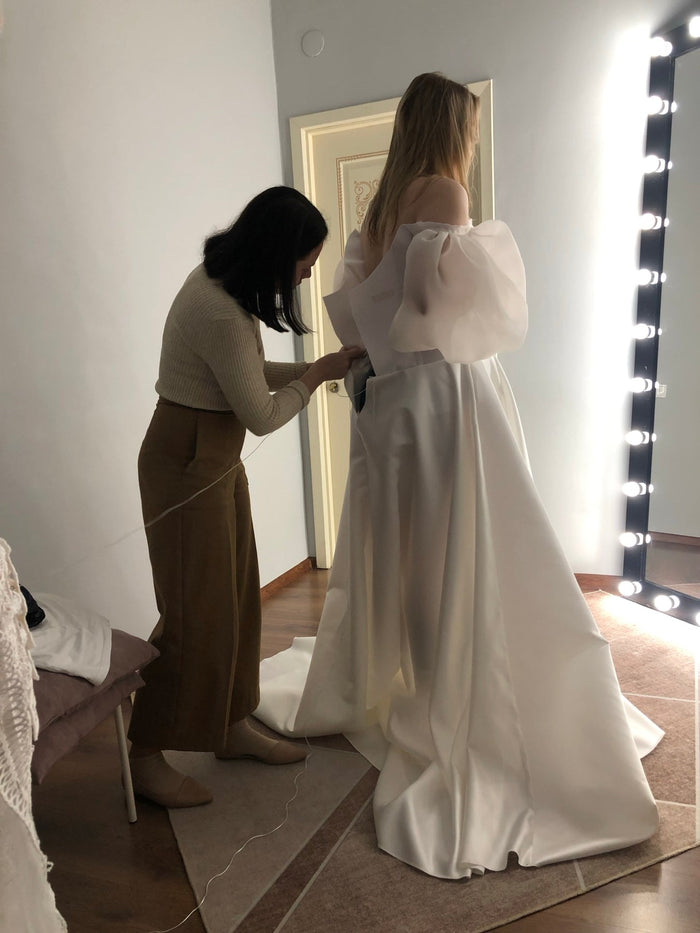
- Fitting 2 checks the fit in the actual fabric, which drapes differently from cotton. The side seams, the closure, and the hem are marked. Sleeve length is set. The skirt is pinned for its final length in your shoes.
- Fitting 3 (on a heavily beaded, lace, or structured dress) confirms the fit after the weight of the embellishment is on, checks the placement of appliqué and beading, and refines anything the added weight changed.
A simple crepe sheath may only need one real-fabric fitting. A structured ball gown with hand beading usually needs two.
The Final Fitting
Scheduled within a few weeks of the wedding. By this point the dress is finished. This fitting:
- Confirms the fit against your body as it is now, not at measurement. Bodies change; the final fitting accounts for it, as our guide to weight changes before the wedding explains.
- Makes only small adjustments: a nip at the side seam, a strap shortened, the hem confirmed.
- Fits the bustle, and shows your helper how to do it.
- Checks the dress with your final undergarments and shoes.
How It Works Remotely
For a US bride ordering from our atelier, the same checkpoints run through our remote fitting process:
- Mockup checkpoint: the mockup is fitted on a form dialled to your measurements, with photos and video from every angle. For a close-fitted or complex design, the mockup is shipped to you to try on, mark, and send back.
- Real-fabric checkpoint: progress photos on the form, plus a request for a fresh set of measurements taken by a tailor.
- Final checkpoint: the near-finished dress is either shipped for you to try on and return with notes, or you provide final photos and measurements, and any small final adjustment is done by a local seamstress with our exact instructions.
The number of exchanges is similar to in-person fittings. The dress does not lose accuracy; it just travels.
What Changes the Number
More checkpoints for:
- A close-fitted mermaid or trumpet or a structured corset bodice, where fit tolerance is small.
- Heavy embellishment, which changes the fit once it is on.
- A convertible or two-piece design, with more parts to check.
- A body expected to change before the wedding.
Fewer for a soft, unstructured A-line or a fluid slip dress with complete, recent measurements.
Scheduling the Fittings
We recommend ordering approximately 10 months before the wedding. That gives room for the mockup, one or two real-fabric checkpoints, and a final fitting placed within a few weeks of the date. Our timeline guide shows where each falls in the 10 to 12 week production window, and shipping to the US adds 3 to 5 days by UPS.
FAQ
How many fittings does a custom wedding dress need? Usually three or four: a mockup fitting, one or two fittings in the real fabric, and a final fitting close to the wedding. A simple design may need only two total; a structured, heavily beaded one needs four.
Do I have fittings if I order a wedding dress online? Yes, as remote checkpoints. The mockup is fitted on a form set to your measurements with photos and video, and for close-fitted designs it is shipped to you to try on. Progress and near-final checks are done with photos, fresh measurements, and sometimes a shipped dress.
When should the final fitting be? Within a few weeks of the wedding, so the dress fits your body as it is then rather than months earlier. The dress is finished by this point, and only small adjustments are made.
Why does a beaded dress need more fittings? The weight of the beading changes how the dress hangs and fits once it is on. An extra fitting checks the fit with the embellishment in place and confirms the placement of the appliqué and beadwork.
Can I reduce the number of fittings if my wedding is soon? The mockup and final checkpoints cannot be skipped without risking the fit. A middle checkpoint can sometimes be combined. If the timeline is tight, we tell you what is safe to compress and what is not.
Want to understand the fitting schedule for your design? Start with a sketch consultation at Lutien Bridal.
About the author: Vlad Ivanov is the Director of Business Development at Lutien Bridal Atelier in France, home to the design team behind more than 1,000 custom wedding gowns delivered to brides across the US and Europe.