Atelier · France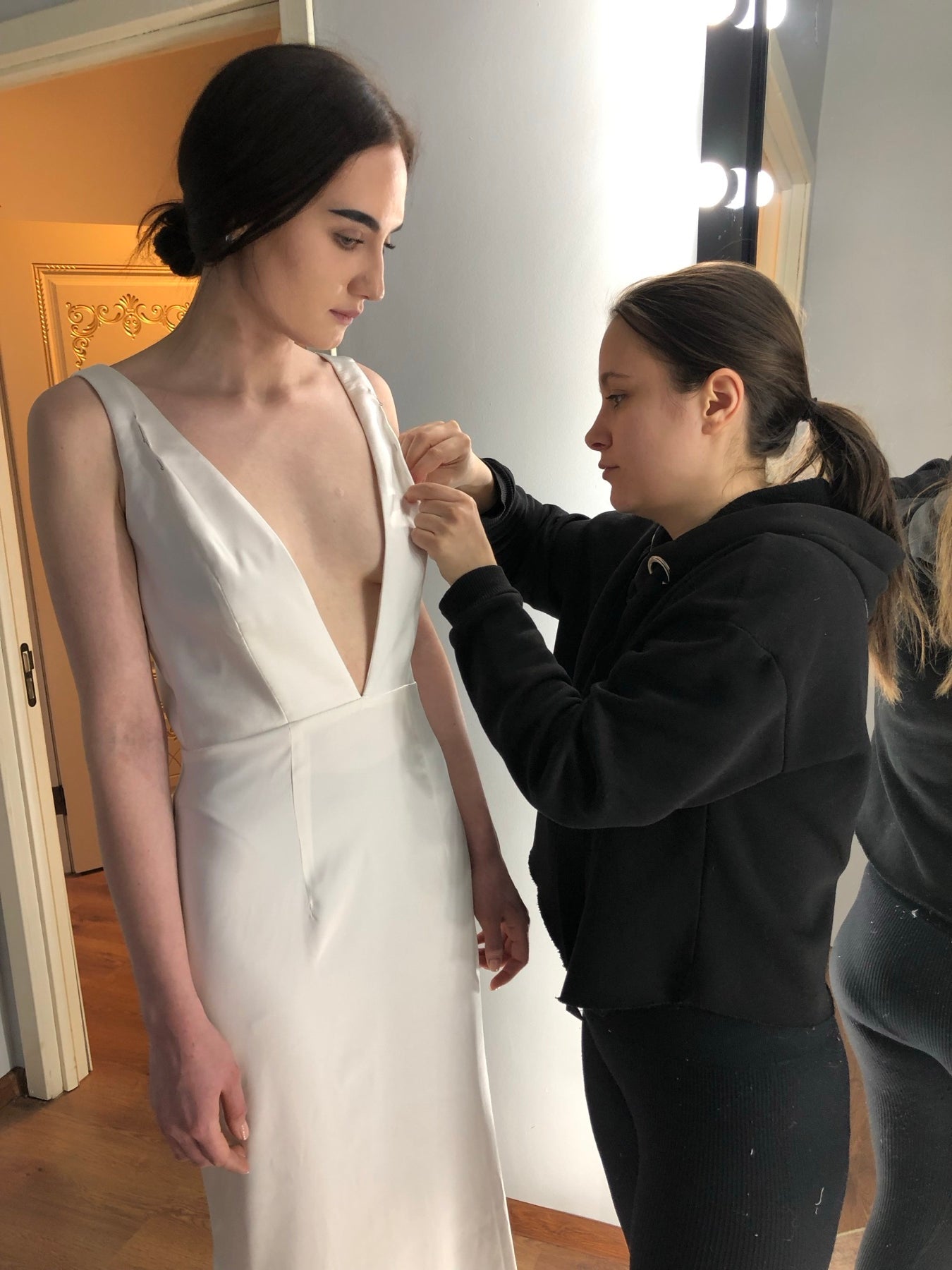

Your body between the day you are measured and the day you get married is not guaranteed to stay the same. That is normal, and a well-run custom process expects it. The dress is built with room to move in the fit, and the final adjustment happens close to the wedding, not months before.
This works up to a point. Small to moderate changes are handled in a fitting. A large change may need more than seam allowances can give. The most useful thing you can do is tell your atelier early if you expect your body to change.
Key Takeaways
- A custom dress is built with seam allowances at key points, so it can be taken in or let out at a fitting.
- The final fitting is scheduled close to the wedding, so it reflects your body then, not at measurement.
- Some designs adjust more easily than others: a corset back and a fitted-but-not-fixed bodice give the most range.
- Moderate changes are routine. A large change may need re-cutting a panel rather than adjusting a seam.
- Tell the atelier at the start if you are on a fitness plan, pregnant, postpartum, or expect your weight to shift.
What the Dress Is Built to Absorb
When we cut a custom dress, we leave extra fabric inside key seams rather than trimming to the exact line. These allowances sit at:
- The side seams through the waist and hip.
- The back seam and the closure.
- The bust seams and dart lines.
At a fitting, the dress can be taken in by moving the stitch line inward, or let out by releasing some of that allowance. The amount of room varies by fabric and design, but a moderate change up or down is within normal range.
This is possible because the dress is made for you from a pattern, not graded from a stock size. Our guide to what measurements we need covers how the starting point is set.
Design Choices That Adjust More Easily
If you know your body may change, some designs give the fit more flexibility:
- A corset or lace-up back. The most adjustable closure. It laces tighter or looser across a range without any sewing. Covered in our corset construction guide.
- A fitted-but-not-fixed bodice. A close fit that skims rather than compresses has more give than a tightly boned strapless.
- A defined waist with a soft skirt. An A-line or empire shape puts the fit at one point, not down the whole body.
- Adjustable straps or a halter.
The hardest to adjust is a fully boned, close-fitted mermaid, because the fit is fixed along the entire torso and thigh.
Why the Final Fitting Comes Late
We schedule the last fitting and adjustment as close to the wedding as the timeline allows, usually within a few weeks of the date. The point is to fit the dress to your body as it is then, not as it was at measurement.
For a remote order, this means a final round of photos, measurements, or a shipped dress for you to try on and mark, described in our guide to what happens during a remote fitting. If a local seamstress makes a small final adjustment, we tell you exactly what is safe to change without affecting the design.
Small, Moderate, and Large Changes
- Small. A few pounds either way. Usually absorbed by the closure or a quick seam adjustment. Often not even noticeable in the dress.
- Moderate. Enough to change your measurements by a size or so. Handled at a fitting by adjusting the side seams and closure. Routine.
- Large. A significant shift across several measurements. Seam allowances may not be enough. This can mean re-cutting a bodice or skirt panel, which needs time in the schedule. It is doable, but it is a bigger job than an adjustment, and the earlier we know, the better.
What to Tell the Atelier
At the start of the process, tell us if:
- You are following a training or nutrition plan aimed at the wedding.
- You are pregnant or recently postpartum, or planning a pregnancy before the date.
- You are on a medication or in a health situation that affects your weight.
- Your weight naturally fluctuates through the year.
None of this changes whether we can make the dress. It changes how we build the allowances, which closure and silhouette we recommend, and when we schedule the fittings. This is part of the same open conversation covered in what to tell your dress designer.
If You Are on a Fitness Plan
Many brides plan to change their body before the wedding. Two practical points:
- Be measured at a realistic point, not an aspirational one. We can build in room to take the dress in, but letting a dress out has limits. It is safer to measure closer to your current body and adjust down.
- Give the schedule a buffer. If you expect to reach your target a month before the wedding, we plan the final fitting after that, with enough time left for the adjustment.
We recommend ordering approximately 10 months before the wedding, which gives room for a fittings schedule that accounts for this.
FAQ
What if I lose or gain weight before my wedding? A custom dress is built with seam allowances so it can be taken in or let out at a fitting, and the final adjustment is scheduled close to the wedding. Small and moderate changes are routine. A large change across several measurements may need a panel re-cut, which needs time in the schedule.
How much can a custom wedding dress be taken in or let out? It depends on the fabric and design, but a moderate change, roughly a size in either direction, is usually within the built-in allowances. A corset back adds more range without any sewing. Letting out has tighter limits than taking in.
Should I be measured at my current weight or my goal weight? Your realistic weight, closer to current. It is safer to build a dress you can take in than to try to let one out. Tell the atelier your plan so the allowances and the fitting schedule account for it.
Which wedding dress style is most adjustable? A corset or lace-up back is the most forgiving. A fitted bodice with a soft skirt, like an A-line or empire, concentrates the fit at one point. A fully boned, close-fitted mermaid is the hardest to adjust.
When is the final fitting? As close to the wedding as the timeline allows, usually within a few weeks of the date, so the dress fits your body then. For a remote order this is done with photos, updated measurements, or a shipped dress you try on and mark.
Expecting your body to change before the day? Tell us at the start. Start with a sketch consultation at Lutien Bridal.
About the author: Vlad Ivanov is the Director of Business Development at Lutien Bridal Atelier in France, home to the design team behind more than 1,000 custom wedding gowns delivered to brides across the US and Europe.