Atelier · France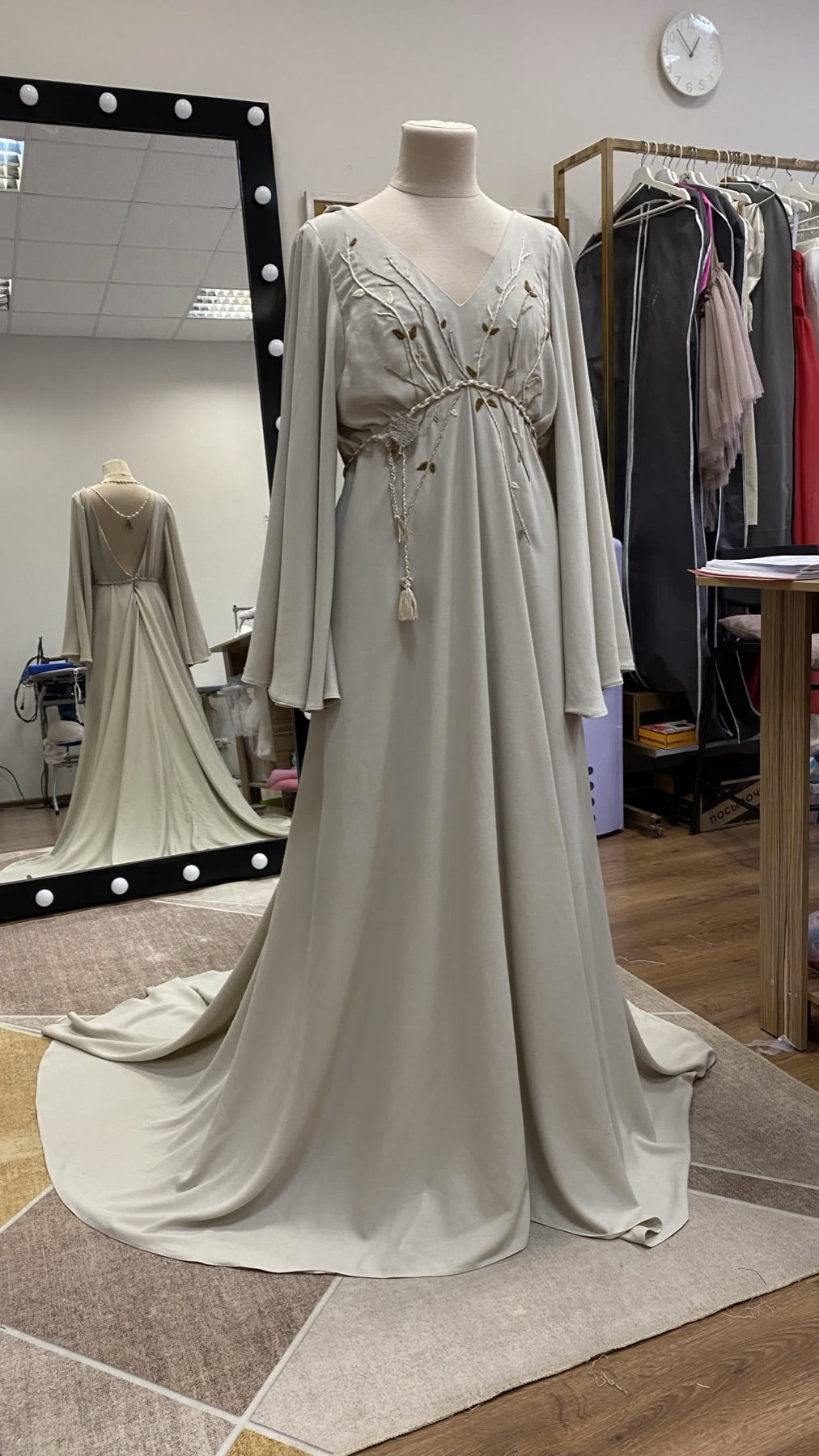

If you are pregnant at your wedding, a custom dress is easier than an off-the-rack one, because it can be designed around where your body will be on the day and built with room to adjust. The key decisions are the cut, when the professional measurements taken before production are taken, and how much adjustment is sewn in.
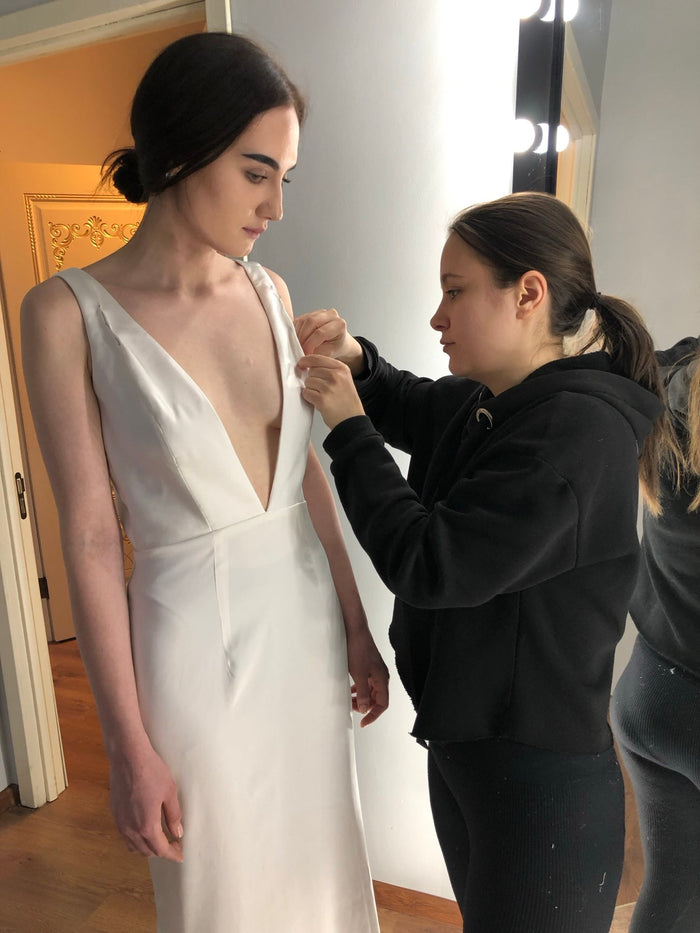
The body may change during pregnancy. We take measurements with a professional tailor before production and make the dress with room for expected growth, based on our atelier's experience. We cannot guarantee the final fit; any alterations needed after delivery are arranged and paid for by the customer.
Key Takeaways
- A custom dress adapts to pregnancy better than off-the-rack because the cut and the adjustment allowance are planned for the day.
- Empire-waist, A-line, and soft column cuts follow a bump without pulling; fitted natural-waist and mermaid shapes do not.
- Measurements are taken by a professional tailor before production. We make the dress with room for expected pregnancy growth based on our experience, but the final fit cannot be guaranteed.
- The dress is planned with room for expected pregnancy growth. We cannot guarantee the final fit or promise that it can be adjusted close to the wedding day.
- Comfort matters more than usual: soft support, breathable fabric, no compressive boning across the bump.
Why Custom Is Easier When Pregnant
An off-the-rack dress is graded to a non-pregnant body and bought months ahead, then altered. If your bump grows past what the alterations planned for, there is often no fabric left to let out.
A made-to-measure dress starts from a pattern drawn for your proportions, with the timing and the adjustment allowance built around the pregnancy from the start.
Cuts That Adapt to a Bump
Cuts that follow a changing midsection without pulling:
- Empire waist. The seam sits under the bust and the skirt falls free from there, so it clears a bump at any stage. The single most adaptable cut.
- A-line. A defined bodice with a skirt that flares from the waist, giving room over the bump.
- Soft column or sheath in a fluid fabric, cut with ease through the middle.
Cuts that do not adapt: a fitted natural-waist bodice, a mermaid, or any close-fitted corset through the waist and hip.
When to Take Measurements
- The body changes most, and fastest, in the third trimester.
- Measurements are taken by a professional tailor before production. The dress is made with room for expected pregnancy growth based on our experience, but we cannot guarantee the final fit.
- Earlier measurements are used to start the pattern; the late set confirms it.
- If your due date is close to or after the wedding, we plan for near-term size and add extra adjustment.
Building In Adjustment
The dress is constructed to be let out, not taken in:
- Generous seam allowance at the side seams and back, so the bodice and waist can be released.
- A lace-up or corset back, or an adjustable panel, giving several inches of range that you or a helper can set on the day.
- An empire seam that is naturally forgiving, so small changes need no alteration at all.
- Elastic or a soft waist stay rather than a rigid waistband.
Comfort and Support
- No compressive boning across the bump. Light boning stays at the sides and back for shape; the front is soft.
- Bust support sized for where you are, since the bust changes early and stays changed. Built-in cups rather than a separate structured bra.
- Breathable fabric. Natural silk, silk crepe, and cotton-backed linings over heavy synthetics, especially for a warm-season or garden wedding.
- A hem set for flat or low shoes if that is what you will be comfortable in.
The Fitting Schedule
The number of fittings is similar to any custom dress, but the timing shifts later:
- Mockup, from your current measurements plus a projection.
- Real-fabric fitting, mid-third-trimester.
- Final fitting, as close to the day as possible, to set the back adjustment and confirm comfort.
For a remote order these run through our remote fitting process, with fresh measurements from a local tailor at each checkpoint.
Ordering as a Pregnant Bride
- Tell us at the consultation. Due date, wedding date, and how far along you will be on the day.
- Choose an adaptable cut, sketched to your projected shape.
- Build in the adjustment, seam allowance plus an adjustable back.
- Measure late and fit late, with the fit after delivery close to the wedding.
Every dress is made over 10 to 12 weeks, with UPS shipping to the US in 3 to 5 days. See the price breakdown; an adjustable back and extra fittings are standard here, not an upcharge for most designs.
FAQ
Can a custom wedding dress be made if I am pregnant? Yes, and it is easier than altering an off-the-rack dress. The cut is chosen to follow a bump, professional measurements taken before production are taken late, and the dress is built with generous seam allowance and often an adjustable back so it can be let out close to the day.
What wedding dress style is best for a pregnant bride? An empire waist is the most adaptable: the seam sits under the bust and the skirt falls free, clearing a bump at any stage. A-line and soft column cuts in a fluid fabric also work. Fitted natural-waist and mermaid shapes do not.
When should my measurements be taken? Measurements are taken by a professional tailor before production. We make the dress with room for expected pregnancy growth based on our experience, but we cannot guarantee the final fit.
How is the dress made adjustable? With generous seam allowance at the sides and back, and often a lace-up or corset back or an adjustable panel that gives several inches of range. An empire seam is naturally forgiving, so small changes may need no alteration.
Will the dress be comfortable? It is built for it: no compressive boning across the bump, soft built-in bust support sized for where you are, breathable natural fabric, and a hem set for the shoes you will actually wear.
Getting married while pregnant and want a dress built around it? Start with a sketch consultation at Lutien Bridal.
About the author: Vlad Ivanov is the Director of Business Development at Lutien Bridal Atelier in France, home to the design team behind more than 1,000 custom wedding gowns delivered to brides across the US and Europe.