Atelier · France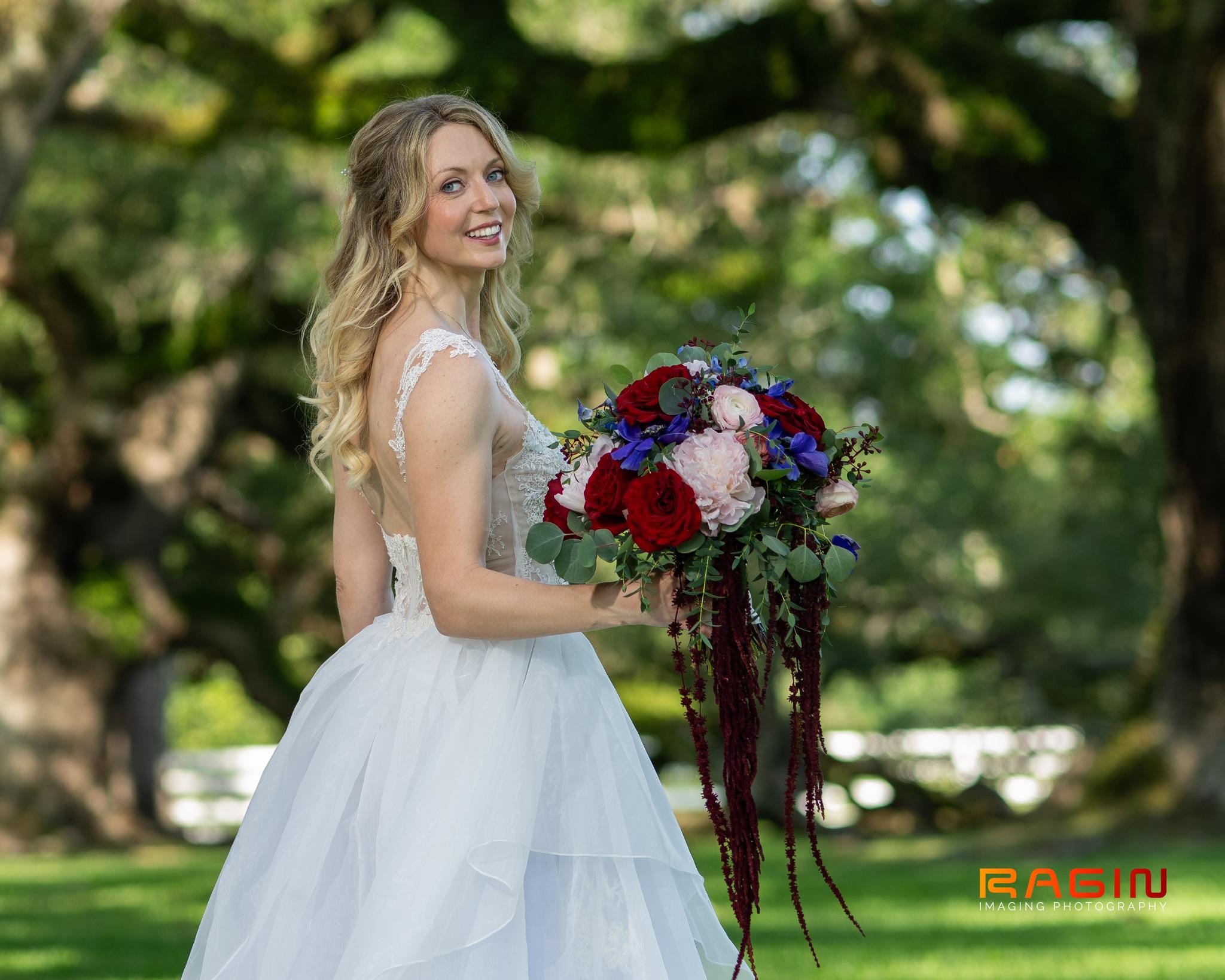

Key Takeaways
- You don't need to know fashion terminology, prepare a formal brief, or send a precise set of references.
- A single image you love is a valid starting point. So is a written description of how you want to feel.
- Your designer reads your references as a set and translates them into construction decisions, that's the job.
- You approve a custom sketch before any fabric is ordered. The sketch is where your vision takes its first real shape.
- You receive photos at every production stage. Nothing proceeds without your sign-off.
One of our recent brides wrote to us with a single sentence about her dress vision: "If it resembled this, I would be very happy even without incorporating the other references." She attached a photo of a lavender gown she'd found on Pinterest.
Over the next several weeks, she sent back shapes she loved, a photo she annotated to explain the skirt construction she had in mind, and, because she couldn't find the right words for what she needed, a hand-drawn diagram of her own neckline.
We built her dress from that. You can see it on her above. Here's how it happened.
How a reference set becomes a finished design
The Brief She Sent
Her primary inspiration was a single dress photo she loved:

A theatrical couture gown, extremely sheer base fabric, white lace appliques, pale lavender 3D flowers, silver sequins and crystals. The appliques grow organically from the bodice toward the shoulders and collarbone, like a vine of flowers. The skirt is multiple cascading layers of sheer fabric.
She loved the aesthetic, but noted the dress was too transparent for a wedding. She needed coverage over the thighs. That tension between the reference and the reality was the design problem to solve.
For the back, she sent another reference:

A deep, open U-back with semi-sheer beaded mesh. She wanted the back as low as the construction would allow while still giving enough support to keep the front stable.
For the neckline, she couldn't find the right reference image, so she drew a diagram instead:

Two torso outlines side by side, "others" and "me", to show that standard necklines sit higher on her chest because of her proportions. Her solution, in her own words: "find necklines that are deeper than average."
This is the kind of body-proportion context that no measurement sheet captures, and exactly the kind of thing that determines whether a neckline looks right on a finished dress.
What Our Designer Did With It
Our designer looked at the reference set as a whole, not image by image.
Recurring elements across every image: sheer layered fabric, organic botanical applique placement, very open back, neckline needing to sit lower than standard. The lavender gown wasn't a dress to copy, it was a direction. The design constraint was clear: the bride wanted that sheer editorial aesthetic, with a dress she could actually wear at a wedding. The solution was layered construction, an inner straight skirt in lace for opacity, multiple layers of ivory tulle that create the flowing cascade effect of the reference.
From that, the first sketch:

Several revision rounds followed. The bride refined the neckline, adjusted the back shape, clarified which elements in the reference she didn't want. Each round the design got closer. No fabric was touched until she approved the final version.
Production: What She Saw Along the Way
Once the design was locked, construction began. She received photos at each stage, the same way our production process works for every order.
The bodice took shape first. Dense lace appliques on a semi-sheer base, layered with pearl clusters, sequins, seed beads, and small ivory floral motifs. The embellishment grows from the center bodice outward, denser at the chest, trailing down into the skirt.

The back: a deep open U-shape, illusion mesh on the back panel, lace appliques continuing through the straps and across the upper back.

The embellishment cascades from the bodice into the front of the skirt, decreasing in density as it moves lower, until the outer tulle layers are clean and flowing.

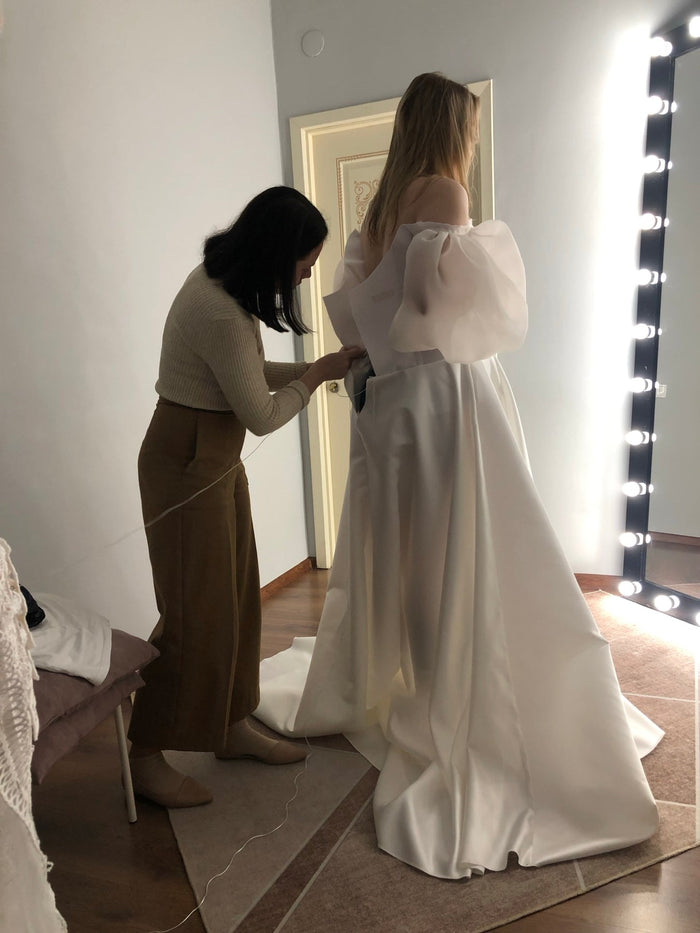
Then the fitting:
The completed dress, on the bride. Every element from the brief is there: the organic lace appliques growing up the bodice, the multi-layer tulle skirt, the coverage she needed. The neckline sits exactly where she drew it in her diagram.
And on her wedding day:

What This Means for You
The brief that produced this dress wasn't a formatted document. It was a Pinterest board, some annotated images, a hand-drawn diagram, and a few weeks of back-and-forth conversation. If that is where you are starting, here is how a Pinterest board becomes a wedding dress.
That's normal. Most brides don't come to us with a complete design specification. They come with a feeling, something they saw and loved, a direction they're drawn toward, something they want to avoid.
Our designer's job is to translate that into construction. You don't need to know what "chiffon" versus "organza" means. You don't need to name your silhouette or identify your neckline style. That's the expertise we bring.
You can start from:
- A single image you love, even if it's a couture piece you couldn't wear as-is
- A written description: "I want to feel like I'm floating in flowers" is a real brief we can work from
- A list of what you don't want
- A photo of yourself in clothes that make you feel great, with no dress references at all
- Any combination of the above, in whatever format makes sense to you
The sketch is where your brief becomes a dress. You review it, revise it until it's right, and approve it before we order a single piece of fabric. Everything after that, fabric selection, production, embellishment, final approval, is documented and visible to you at every stage. For the full picture, read our complete guide to ordering a custom wedding dress online.
What happens during a remote fitting
Start with a free sketch consultation. Send whatever you have, a single image, a Pinterest board, or a sentence about how you want to feel, and we will turn it into a custom sketch. The sketch consultation is free.
FAQ
Do I need to know fashion or dress terminology?
No. If you can describe how you want to feel, or point to an image, that's enough. Our designer handles the translation from feeling to construction.
What if I only have one reference image?
One strong reference is a completely valid starting point. We can build a full brief from a single image through the consultation conversation.
What if my reference is a couture piece that's too sheer or unrealistic for a wedding?
Very common. The reference tells us the aesthetic direction. Our designer identifies which elements are buildable and which need adapting, the translation is part of the design process. The dress in this post was built from a reference that was far too sheer for a real wedding.
How many sketch revisions can I expect?
As many as needed. The sketch stage has no fixed revision limit and no cost for changes. Everything gets resolved before production starts.
When does my input stop and production just happen?
It doesn't. You receive photos at every significant production stage, confirm before each step advances, and give final approval before the dress ships.
Related guides:
- 12 Questions to Ask Before Ordering a Custom Wedding Dress Online
- Custom Wedding Dress Timeline: How Long Does It Really Take?
About the author: Vlad Ivanov is the Director of Business Development at Lutien Bridal Atelier in France, home to the design team behind more than 1,000 custom wedding gowns delivered to brides across the US and Europe.