Atelier · France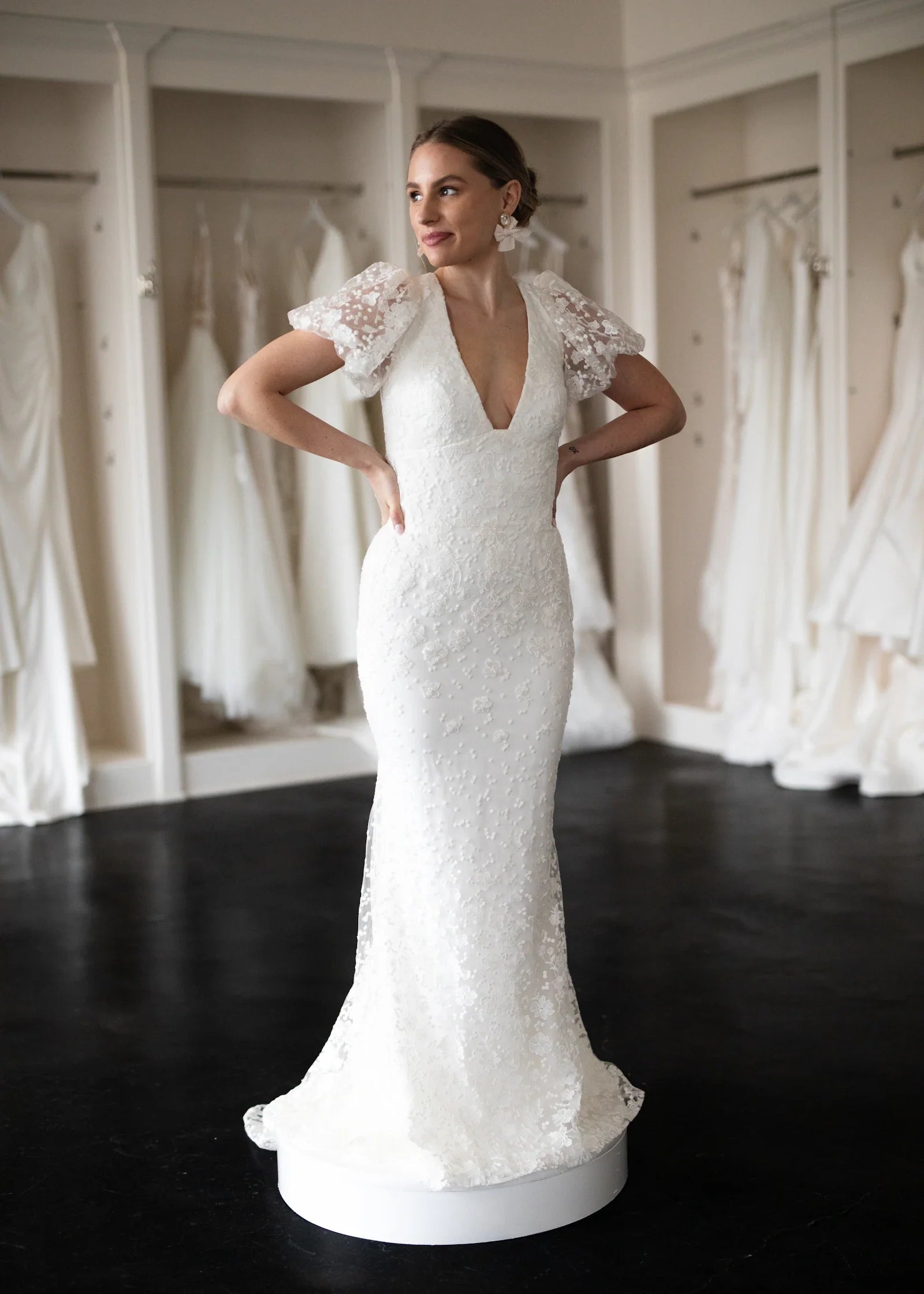

Key Takeaways
- Ask for exact timelines, "a few months" is not an answer.
- Get all costs confirmed in writing before payment.
- Production photos at every stage are a standard expectation, not a premium add-on.
- A custom sketch, approved before cutting, protects you from misunderstandings.
- Order about 10 months ahead; inside that window a fixed rush surcharge applies, down to a three-month floor.
Table of Contents
- 1. How long does production take?
- 2. What's included in the price?
- 3. Will I see photos during production?
- 4. Do you sketch the dress before cutting fabric?
- 5. How do I get measured remotely?
- 6. What if the dress doesn't fit when it arrives?
- 7. Can I make changes after placing the order?
- 8. How many orders do you take at once?
- 9. What fabrics do you work with?
- 10. How much experience do you have?
- 11. How will communication work during the process?
- 12. Do you take rush orders?
Most brides spend hours on Pinterest and months comparing photos. Very few spend the same time asking the right questions before they place an order. That's usually where the problems begin.
A custom wedding dress is one of the most significant purchases you'll make before your wedding. Unlike buying off the rack, you're committing to something that doesn't exist yet. The dress is built around your brief, your measurements, and your trust in whoever is making it. Getting clear answers before you pay protects you, and tells you a great deal about the atelier you're considering. Our complete guide to ordering a custom wedding dress online walks through the whole process; this article is about the questions that come first.
Here are 12 questions worth asking. A serious atelier should be able to answer every one of them clearly, without hesitation.
1. How long does production take? {#q1}
This is the most important question, and the answer should be specific. "A few months" is not an answer. A real atelier knows exactly how long each stage takes.
A well-run custom atelier runs production in 10 to 12 weeks from payment confirmation. That covers design consultation, fabric sourcing, pattern making, construction, finishing, and quality checks. Shipping to the US via UPS adds 3 to 5 business days. From payment to delivery at your door: roughly 3 months.
If your wedding is in October, your latest safe payment date is late June. Our full timeline breakdown explains each stage in detail, including the variables that can extend it.
2. What's included in the price? {#q2}
Get this in writing before you agree to anything. Some ateliers quote labor only. Fabric, shipping, and customs arrive as separate charges, sometimes at delivery.
An all-inclusive price covers: fabric and materials, construction, a personal designer, all production photos, UPS shipping to the US, and any customs duties and taxes. There should be nothing waiting for you when the package arrives.
Before you commit, ask: "Is this the final price? What could change it?" A clear answer is a good sign. Vagueness is a flag.
Our breakdown of what a custom wedding dress costs shows how an all-inclusive price is built, is quoted individually with the final price confirmed before production.
3. Will I see photos during production? {#q3}
You're ordering something that doesn't exist yet. The only way to stay confident during a 10 to 12 week process is to see it happening.
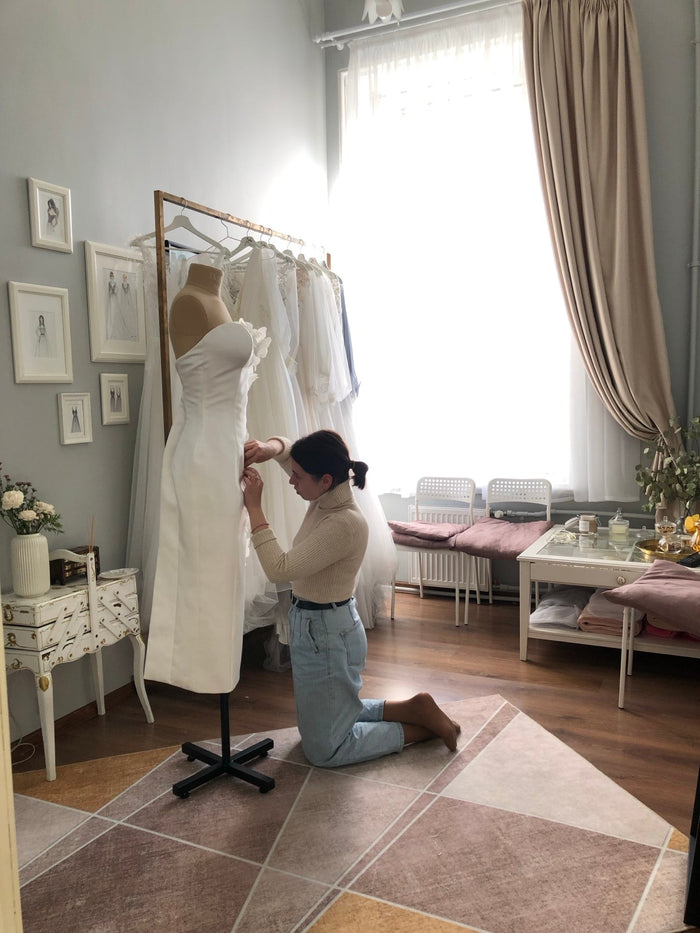
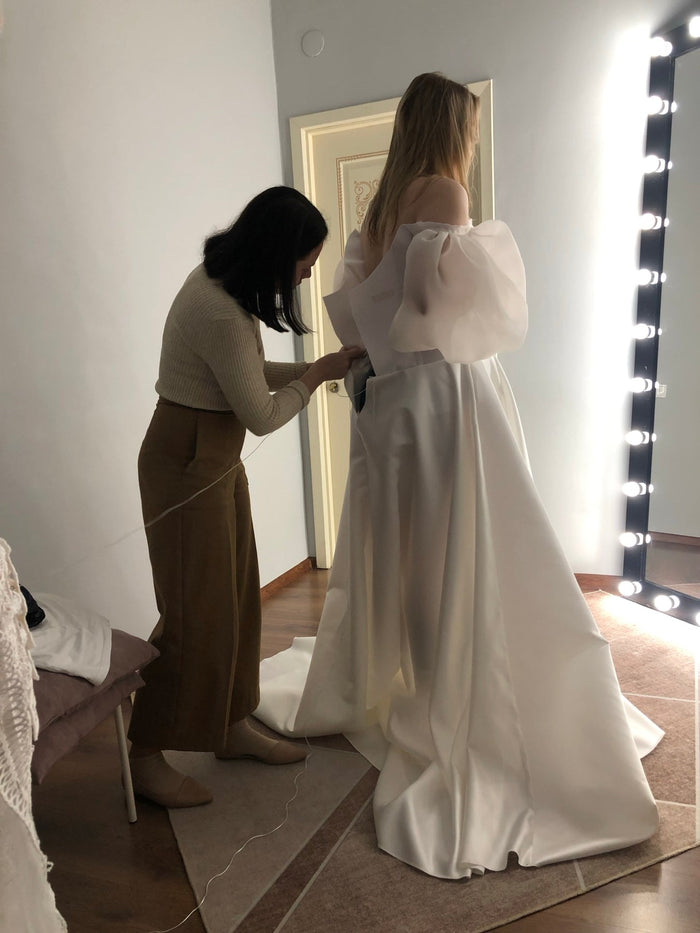
A serious atelier sends photos at every stage: cut fabric, constructed base, boning and structure, embellishments being applied. You should be able to see exactly where your dress is at any point in production, not just a finished photo at the end.
If an atelier says you'll receive photos "when it's done," that's worth noting.

4. Do you sketch the dress before cutting fabric? {#q4}
A custom sketch isn't a courtesy, it's a commitment on paper before anything is built.
Before production starts, you should approve an illustration that shows exactly what's being made: silhouette, neckline, back design, embellishments, fabric. Every detail confirmed in writing. Only then does cutting begin.
Without a sketch approval step, "custom" is just a label. The sketch is what makes the dress genuinely yours.
5. How do I get measured remotely? {#q5}
Taking accurate measurements at home is entirely possible, but only with clear, specific instructions.
You'll need a soft measuring tape and someone to help. A good atelier provides a step-by-step guide for each measurement: bust, waist, hips, height, hollow-to-hem. They should also explain what to do if you're between sizes, or if you're unsure about a measurement.
We cover this in full in our guide to what measurements we need and how they are taken.
6. What if the dress doesn't fit when it arrives? {#q6}
Made-to-measure means the dress is built to your exact measurements. It should fit considerably better than anything off the rack. But minor adjustments after delivery are normal, bodies change, and home measurements have small margins.
The standard approach is to build in seam allowances so a local seamstress can make small final adjustments if needed. Ask whether the atelier does this, and whether they provide guidance on what to expect after delivery.
The goal isn't a perfect fit straight from the box. It's a dress that needs minimal, predictable adjustments, not a full rework.

7. Can I make changes after placing the order? {#q7}
Yes, but there's a window.
Before production starts, while the sketch is still being finalized, changes are straightforward. Once fabrics are ordered and cutting begins, changes may be impossible or carry additional cost.
Ask the atelier where the point of no return is. That's also your motivation to get every detail right during the sketch phase, before any material is purchased.
8. How many orders do you take at once? {#q8}
This question reveals a lot about how your dress will actually be made.
An atelier that limits its order volume per season does so for a reason: each dress receives the time the craft requires. A high-volume operation may still produce excellent work, but it's worth understanding how many dresses are in production alongside yours. See why we only take a limited number of orders each season for the operational reasoning behind our own answer to this question.
You're not ordering from a catalog. Ask how many active orders they typically carry at one time.
9. What fabrics do you work with? {#q9}
Fabric determines how the dress moves, how it photographs, how it holds its shape, and how it feels on your wedding day.
Lutien Bridal uses natural silk for its silk garments. Satin, crepe, and other fabrics are discussed in the proposal so you can choose the material suited to your design.
Ask what fabrics the atelier sources, where from, and what they'd recommend for the silhouette you have in mind. An atelier that can speak to fabric in detail understands the full craft. See the best wedding dress fabrics for a custom gown for how each option actually behaves.

10. How much experience do you have? {#q10}
Bridal construction is specific. Making a suit or an evening dress is a different skill set from wedding dresses, boning, corsetry, layered skirts, and delicate embellishments require years of repetition to do well.
Ask how long the atelier has been making wedding dresses, how many they've completed, and whether you can see a portfolio. Completed dresses across different silhouettes and fabrics tell you more than any marketing copy ever will. You can look through real Lutien brides in their finished gowns to judge the range for yourself.
An atelier with 1,000+ completed orders has worked through every client situation, every fabric challenge, every construction problem. That history shows in how they handle questions.
11. How will communication work during the process? {#q11}
You're committing a significant amount of money to something that takes 3 months to arrive. The communication standard should match that.
Ask: What channels do you use? How quickly do you respond? Who is my main point of contact? What happens if I have a concern mid-production? See why your wedding dress consultation should feel like a conversation, not a sales pitch for what that standard should feel like from the very first message.
The right atelier communicates in writing, email or WhatsApp, responds quickly, and keeps you informed without you having to chase. If there's no clear answer to who handles client communication, you may find out why later.
12. Do you take rush orders? {#q12}
A reputable custom atelier can accommodate a tighter timeline, but not for free and not without a floor.
Custom dressmaking has stages that cannot be compressed: fabric sourcing takes the time it takes, hand embroidery cannot be rushed, quality checks require distance and a fresh eye. What a serious atelier can do is charge a rush surcharge that reflects the real cost of reordering priorities, not simply promise any timeline for the right price.
Here is our answer. We recommend ordering about 10 months before your wedding date. At six months or more, there is no rush surcharge. Inside that window the surcharge is fixed: €500 at five months, €700 at four months, and €1,000 at three months. Three months is the hard floor. We do not take orders inside three months, because fabric sourcing, hand finishing, and final quality checks cannot be shortened any further without compromising the dress.
One More Thing
These aren't trick questions. A serious atelier answers all of them clearly, without deflection. If answers are vague, incomplete, or seem designed to avoid commitment, that tells you something too.
At Lutien Bridal, we answer every one of these before a single detail is agreed. If our answers sound like the standard you want, the first step costs nothing. Start with a free sketch consultation and we will send back a sketch of the dress you have in mind.