Atelier · France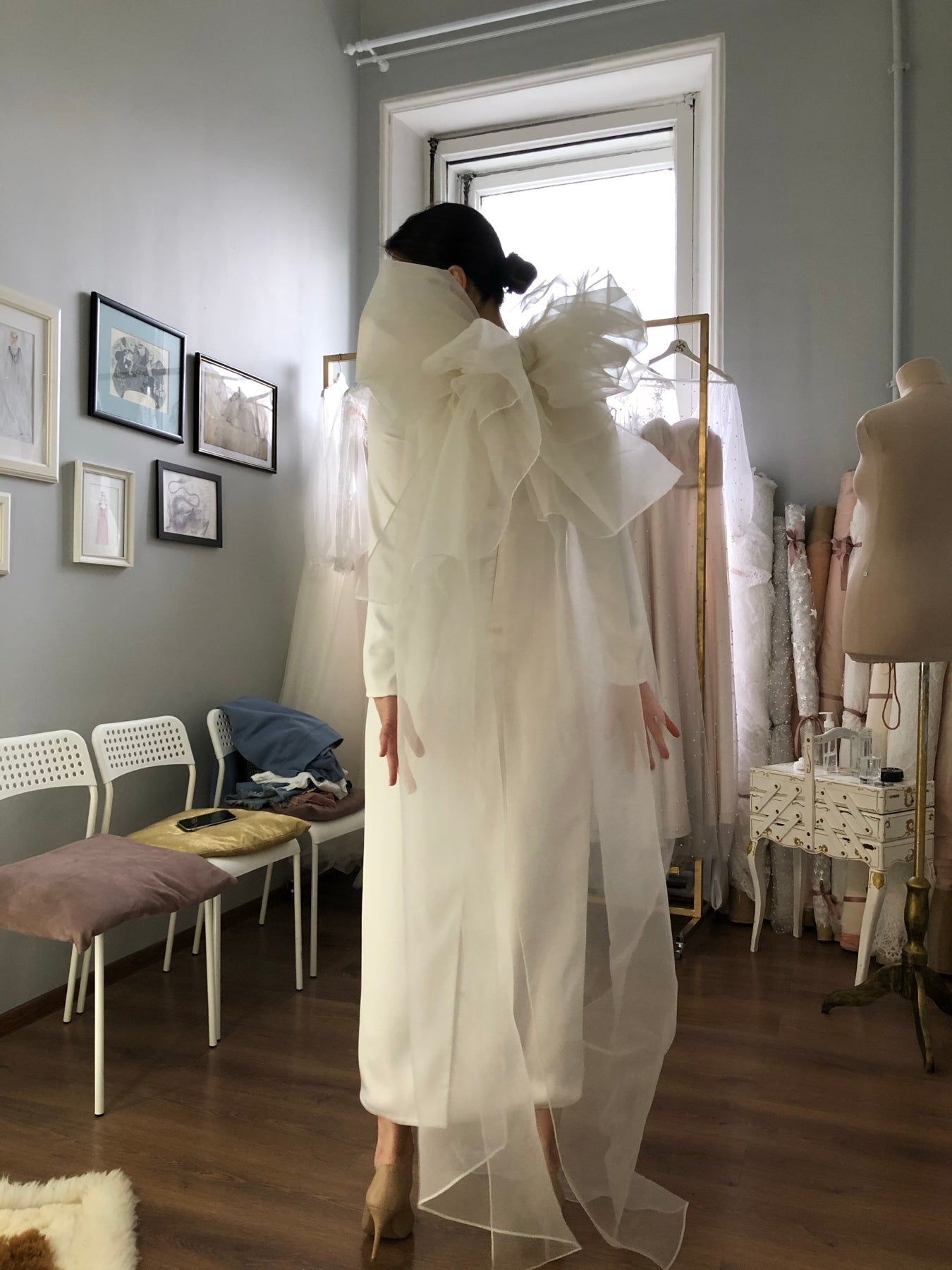

A statement bow is an oversized bow added to a wedding dress as the main decorative feature, most often at the back waist, the shoulder, or the small of the back. It turns a plain dress into a design with a clear focal point, and it photographs strongly from behind.
A large bow that holds its shape is a built object, not a tied ribbon. It has an interior structure, a deliberate fabric choice, and a fixing method. Those decisions are what separate a crisp architectural bow from a limp one.
Key Takeaways
- A statement bow is the dress's focal detail, usually placed at the back waist, the shoulder, or the lower back.
- A bow that stands up is built over an interior structure of stiff interfacing, net, or light boning. It is not a tied sash.
- Structured fabrics like satin and mikado hold sharp loops. Soft fabrics give a looser, draped bow.
- Detachable bows attach with hooks or a covered waistband and can come off for the reception. Sewn-in bows are permanent and cleaner.
- On a custom order the bow is scaled to your frame and the dress, mocked up in calico, then made in the final fabric.
Where a Statement Bow Sits
Common placements:
- Back waist. The classic. Sits at the natural waist or just below, with tails falling over the skirt or train. Reads formal and balanced.
- One shoulder. An asymmetric bow on the shoulder of a sheath or column dress. Modern and sculptural.
- Small of the back. A lower bow, often on a backless design, framing the open back.
- Front waist or hip. Less common, used to break a plain bodice-to-skirt seam.
How a Bow Holds Its Shape
A structured bow is built like a small piece of millinery:
- Interfaced loops. Each loop has a layer of stiff interfacing or buckram inside so it stands rather than collapses.
- Net or crin fill. Larger bows are packed lightly with net to keep volume without weight.
- A hidden knot or center wrap that is sewn, not tied, so it never slips.
- Sometimes a fine wire or light boning along the loop edge for a very architectural look.
A soft, draped bow skips most of this and relies on the fabric's own body.
Detachable or Sewn In
- Sewn in. The bow is stitched permanently to the dress. Cleanest join, no hardware, nothing to come loose. It stays for the whole day.
- Detachable. The bow mounts on a covered hook bar, a button tab, or its own thin waistband that sits under a seam. You can remove it for dancing or for a different look at the reception, similar in spirit to a convertible dress.
Detachable adds a little bulk at the join and needs a tidy way to hide the fixing.
Fabric and Scale
- Structured fabrics. Satin, mikado, and taffeta hold crisp loops and sharp edges. Best for architectural bows.
- Soft fabrics. Chiffon, organza, and tulle give a loose, floating bow with soft tails.
- Scale. A bow should be read against your back width and height. Too large overwhelms a petite frame; too small looks lost on a full ball gown. We size it on you at a fitting.
Matching the Bow to the Dress
- Same fabric as the dress for a tonal, built-in look.
- A contrast fabric (a matte bow on a shiny dress, or the reverse) to make it pop.
- Tail length set so the tails end at a flattering point, usually mid-skirt or at the hem, not trailing unevenly.
- If the dress has a train, the bow tails and the train are planned together so they do not fight.
Planning a Bow on a Custom Order
Steps:
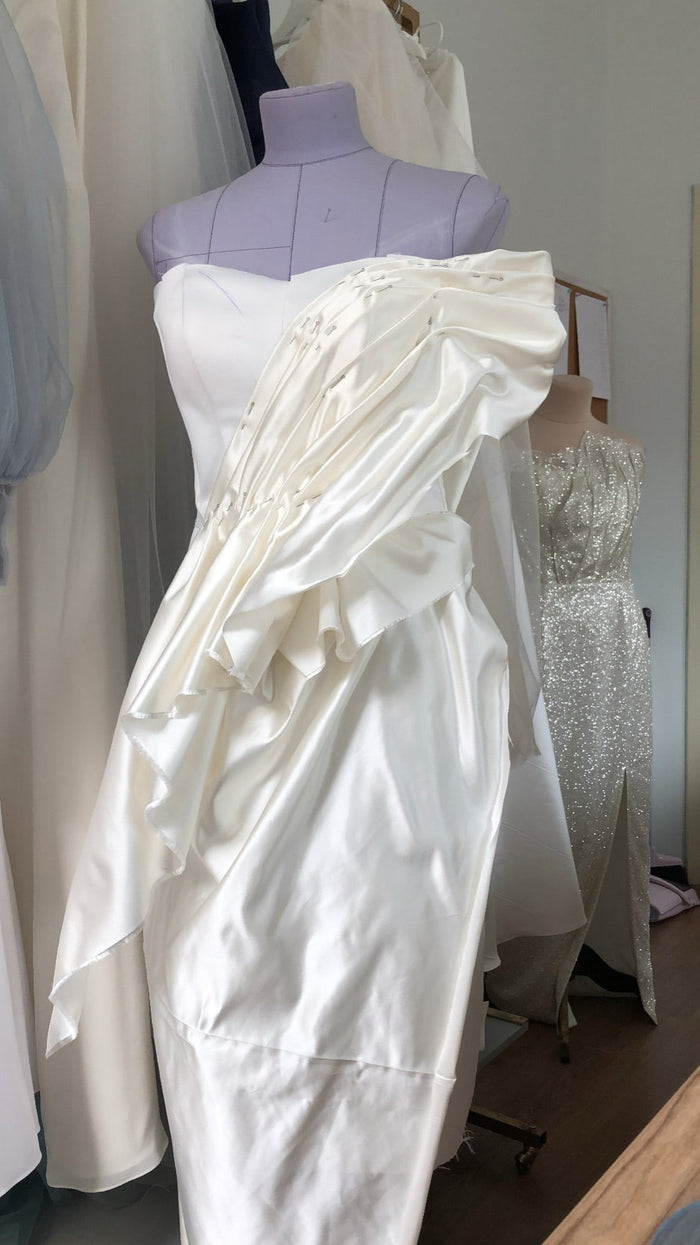
- Placement and size, sketched and then pinned on you or your form at the mockup stage.
- Structure, decided by how crisp you want it: interfaced, net-filled, or soft.
- Detachable or sewn in, with the fixing method hidden under a seam.
- Final fabric bow, made and attached, then checked seated and moving.
For a remote order the bow is built to your measurements, mounted on a form, and shown from every angle in photos and video during the remote fitting process. Every dress is made to measure over 10 to 12 weeks, with UPS shipping to the US in 3 to 5 days. A large structured bow is hand-work, so see the price breakdown for what affects cost.
FAQ
How does a big wedding dress bow stay standing up? It is built over an interior structure: stiff interfacing or buckram inside each loop, sometimes light net fill or a fine wire along the edge, and a center wrap that is sewn rather than tied. A bow that just relies on tied fabric will collapse.
Can the bow be removed for the reception? Yes, if it is made detachable. It mounts on a hidden hook bar, button tab, or a thin waistband under a seam, so it lifts off for dancing or a second look. A sewn-in bow is permanent and has a cleaner join.
Where is the best place for a statement bow? The back waist is the classic, balanced placement. A one-shoulder bow suits a column dress and reads modern. A low bow at the small of the back frames an open back. Placement is chosen against your frame and the dress shape.
What fabric makes the best bow? Structured fabrics like satin, mikado, and taffeta hold crisp, architectural loops. Soft fabrics like organza and tulle give a loose, floating bow. The bow fabric can match the dress or contrast with it.
How big should the bow be? It is scaled to your back width and height and to the dress. Too large overwhelms a smaller frame; too small is lost on a full skirt. On a custom order it is pinned and sized on you at a fitting before it is made.
Want a statement bow as the focal point? Start with a sketch consultation at Lutien Bridal.
About the author: Vlad Ivanov is the Director of Business Development at Lutien Bridal Atelier in France, home to the design team behind more than 1,000 custom wedding gowns delivered to brides across the US and Europe.