Atelier · France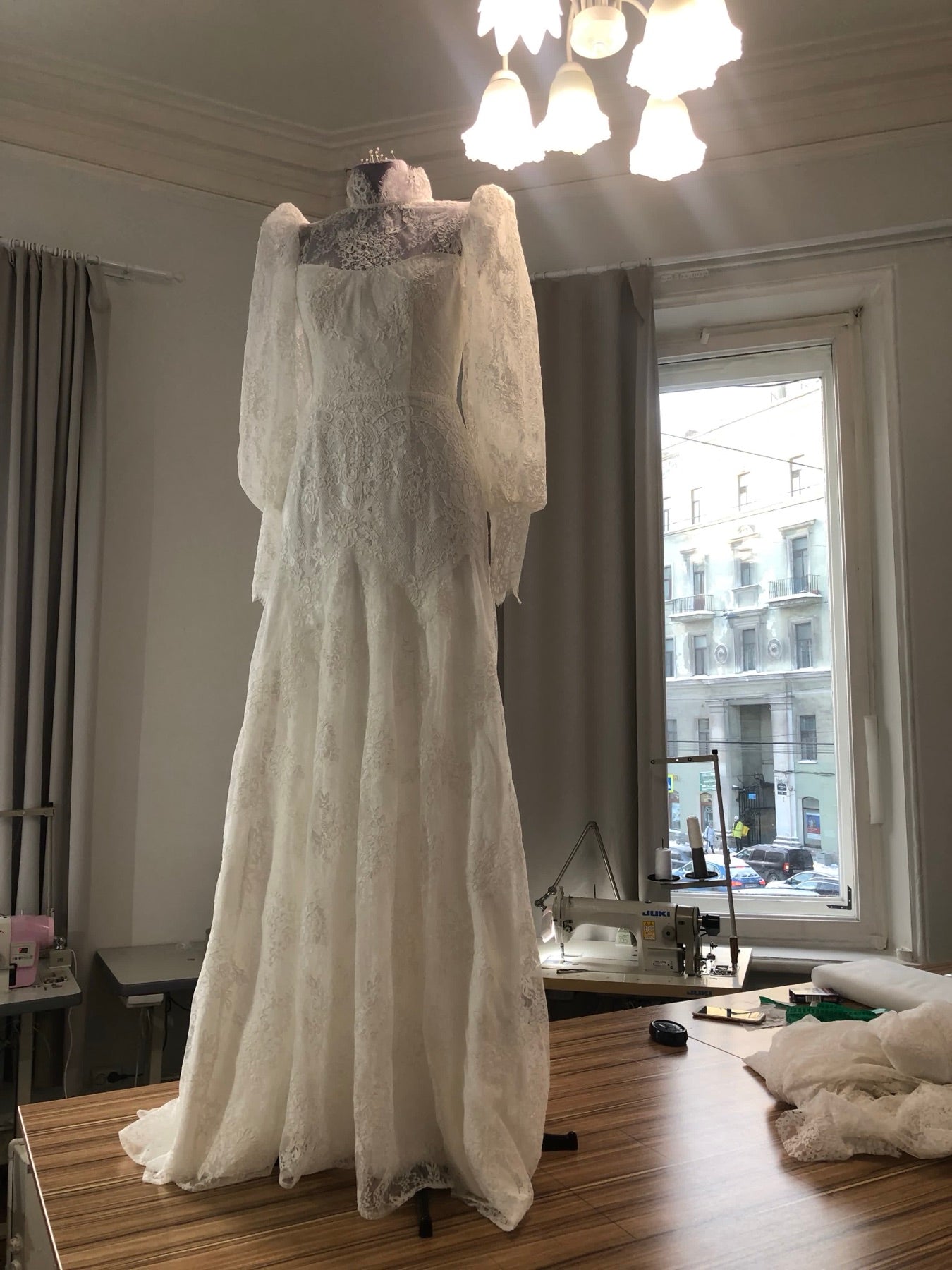

A modest wedding dress covers more of the body: sleeves to the wrist or elbow, a neckline at or near the collarbone, a closed back, and a full-length skirt. Brides choose it for religious reasons, cultural ones, a cold venue, or simply a preference for less skin on show.
Coverage does not mean a shapeless dress. The line still comes from a bodice fitted to your ribcage and a skirt cut for your proportions. A made-to-measure approach lets you set exactly how much coverage you want, inch by inch, without compromising fit.
Key Takeaways
- Modest usually means sleeves, a neckline near the collarbone, a covered back, and a full-length skirt. You decide how much of each.
- Coverage and shape are independent. A modest dress is still fitted through the bodice and cut to your proportions.
- Sleeves need their own fitting for arm movement. This is set at a mockup with your arms raised and crossed.
- Lace, crepe, and mikado all work. Sheer lace or a lined illusion panel gives coverage that still feels light.
- On a custom order every coverage point is a number you set: sleeve length, neckline height, back rise, hem length.
What Counts as Modest
There is no single rule. Common elements:
- Sleeves: cap, elbow, three-quarter, or full-length.
- Neckline at or above the collarbone: high neck, bateau, or jewel.
- Covered back, or a modest keyhole rather than an open back.
- Full-length skirt, no high slit.
- Sometimes a lined bodice with no sheer sections over the torso.
You can apply all of these or just the ones that matter to you.
Coverage Points You Control
On a made-to-measure dress each of these is a measurement, not a style category:
- Sleeve length, measured down your arm to the exact point.
- Neckline height, front and back, set against your collarbone.
- Back rise, how high the dress closes at the shoulder blades.
- Hem length, full to the floor with no slit.
- Lining, opaque where you want no skin showing through.
We set these with you at the mockup stage, on your body or your form, so the coverage is exact.
Sleeves and Arm Movement
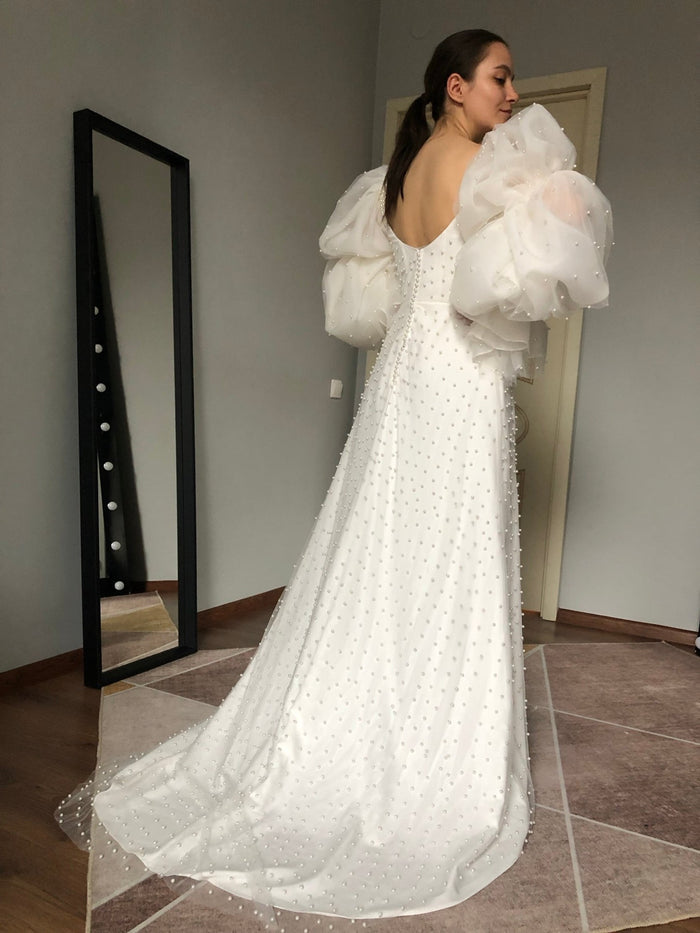
Sleeves are the part that most affects comfort. A long sleeve has to let you raise your arms, hug guests, and eat without pulling the bodice.
We fit the sleeve with:
- Enough ease at the bicep and elbow for a full range of motion.
- A sleeve cap set so a raised arm does not drag the neckline down.
- A cuff or hem that clears your wrist bone.
This is checked at a mockup with your arms up, forward, and crossed.
Necklines for Coverage
- Bateau (boat). A wide, straight line across the collarbones. Elegant and fully covered.
- High neck / band collar. Sits at the base of the throat. The most covered, and striking with lace.
- Jewel. A rounded neckline at the collarbone. Simple and classic.
- Sheer high neck. An illusion lace panel to the throat over a lower lined neckline, so the coverage is there but light.
Fabrics for a Modest Dress
- Lace over lining: coverage with texture and softness. See the lace types guide.
- Crepe: matte, fluid, and covering, good for clean sheath and column lines. See the crepe guide.
- Mikado or satin: structured, opaque, and formal.
- Illusion tulle for sleeves and neckline panels: coverage that reads as light and airy.
Keeping the Shape
A modest dress still gets its line from:
- A boned bodice fitted to the ribcage, exactly as an open-back or strapless dress would.
- A skirt cut for your proportions, whether that is an A-line, a column, or a ball gown.
- A defined waist seam, so coverage does not turn into a straight tube.
Designing a Modest Dress Custom
Process:
- List your coverage points and how firm each one is (a fixed requirement or a preference).
- Sketch, with sleeve, neckline, back, and hem drawn to your spec.
- Mockup fitting with arms raised, to confirm sleeve and neckline comfort.
- Final fabric fitting, checked seated, walking, and with arms up.
For a remote order this is fitted on a form to your measurements and confirmed with photos and video during the remote fitting process. Every dress is made to measure over 10 to 12 weeks, with UPS delivery to the US in 3 to 5 days. See the price breakdown; sleeves and lined lace add hand-work.
FAQ
Does a modest wedding dress have to be loose? No. Coverage and fit are separate. A modest dress is still built on a boned bodice fitted to your ribcage and a skirt cut to your proportions, with a defined waist. It covers more skin without becoming shapeless.
Can I raise my arms in a long-sleeve wedding dress? Yes, if the sleeve is fitted for it, with enough ease at the bicep and elbow and the sleeve cap set correctly. It is tested at a mockup fitting with your arms raised, forward, and crossed before the final fabric is cut.
What is the most covered neckline? A high neck or band collar, sitting at the base of the throat. A bateau (boat) neckline is a wide, fully covered alternative. A sheer illusion high neck over a lower lined neckline gives the coverage while feeling lighter.
Which fabrics work for a modest dress? Lace over opaque lining, matte crepe, structured mikado or satin, and illusion tulle for sleeves and neckline panels. Lining is made opaque wherever you do not want skin showing through.
Can I set exactly how much coverage I want? Yes. On a made-to-measure dress each coverage point is a number you set: sleeve length, front and back neckline height, how high the back closes, hem length, and where the lining is opaque.
Planning a covered or modest design? Start with a sketch consultation at Lutien Bridal.
About the author: Vlad Ivanov is the Director of Business Development at Lutien Bridal Atelier in France, home to the design team behind more than 1,000 custom wedding gowns delivered to brides across the US and Europe.