Atelier · France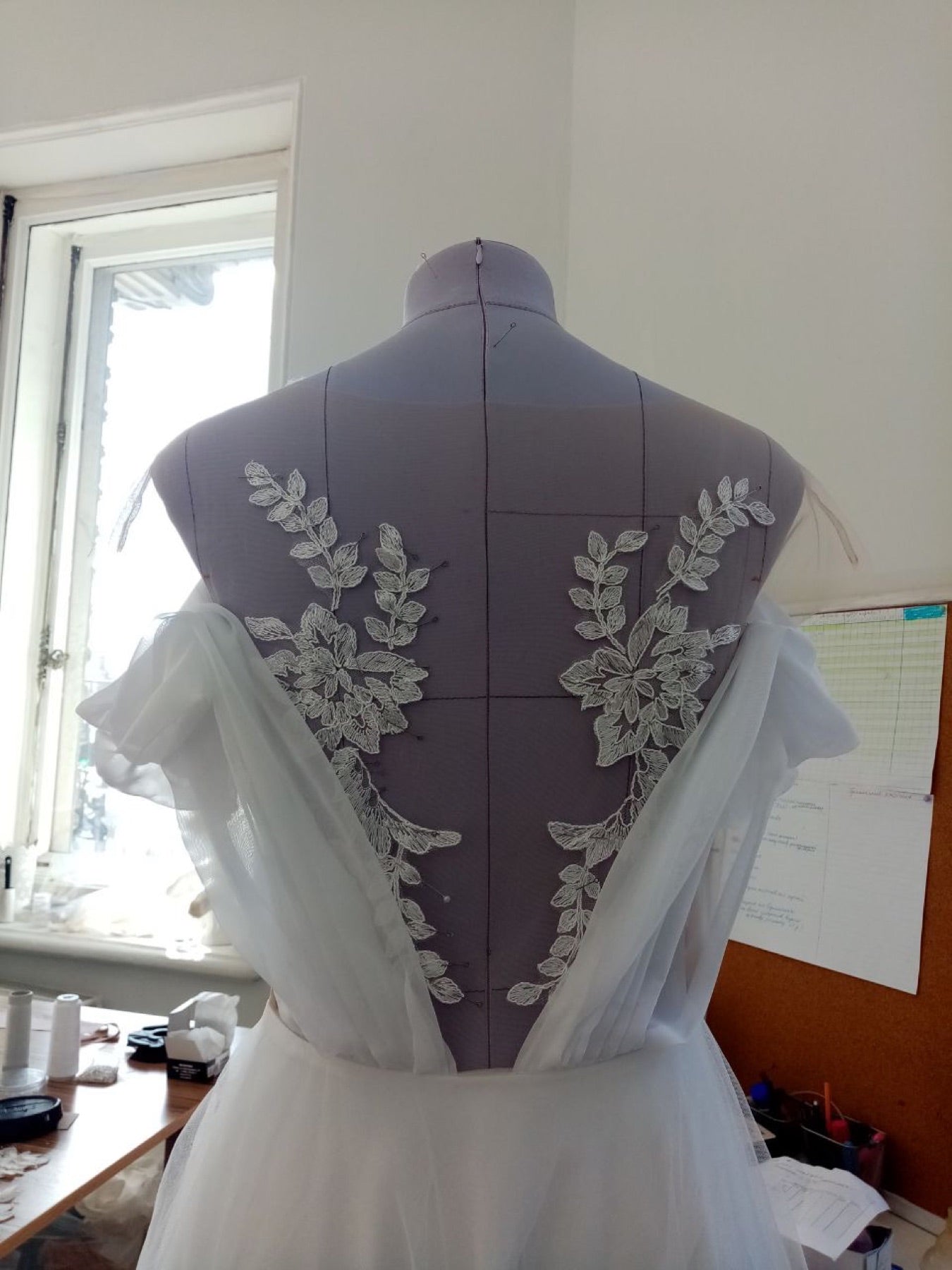

An illusion panel is fine tulle or net, so sheer that it almost disappears against the skin, used to hold lace, beading, or a neckline in place where there is no solid fabric. It is what makes lace appear to float on the shoulders, a plunging neckline stay put, or an open back have a delicate tracery across it.
The effect depends on one thing being right: the tulle has to be close enough to your skin tone to read as skin, not as fabric. Get that wrong and the "floating" lace looks like it is sitting on a visible layer. On a custom gown the illusion tulle is matched to you.
Key Takeaways
- Illusion tulle is a near-invisible net used to carry lace or beading where there is no solid fabric.
- It creates the "floating lace" look on necklines, backs, sleeves, and side panels.
- The tulle colour must match your skin tone closely, or the effect fails. Custom means it is matched to you.
- Sheer panels also give structured coverage: they hold a deep V, a low back, or a cut-out in place.
- Comfort depends on the tulle quality and a smooth join to the solid fabric.
What an Illusion Panel Is
Illusion is not a fabric type of its own; it is a technique. A very fine, matte tulle or net is used as a transparent base. Lace motifs, beading, or embroidery are applied to it, and the tulle between the motifs is either left in place (for a veiled effect) or trimmed close to the design (for a true floating effect).
The tulle carries the design across areas with no structural fabric: above a strapless bodice, across an open back, between cut-outs. Our guide to wedding dress lace types covers how the lace itself is chosen.
Where Illusion Panels Are Used
- Necklines. An illusion panel above a sweetheart or straight bodice creates a higher, softer neckline (a bateau, a high round, a sheer V) without a solid fabric line. See our necklines guide.
- Backs. Lace tracery across an otherwise open back, or a full sheer panel that closes a low back with a delicate look.
- Sleeves. Long illusion sleeves with scattered lace, which read as bare arms with a pattern on them. Covered in our sleeve styles guide.
- Side panels and cut-outs. A sheer inset at the waist that connects a two-piece look, or a cut-out held together with tulle.
- A full illusion bodice over a lined or corseted underlayer, common on a ball gown.
Why the Tulle Colour Decides the Effect
The illusion effect works only if the tulle reads as skin. Options:
- Skin-tone tulle, matched to your complexion. The lace or beading appears to sit directly on you. This is the true "floating" look.
- Ivory or white tulle, which is visible as a soft layer. This gives a veiled, romantic effect rather than a floating one, and reads clearly as fabric.
Off-the-rack dresses use one or two standard "nude" tones, which match some complexions and not others. On a custom gown we match the tulle to your skin, checked in daylight, so the effect holds in photos.
Coverage and Support
A sheer panel is not only decorative. It does structural work:
- It holds a deep V or plunge closed and stable, so the neckline does not shift.
- It connects a low or open back to the rest of the bodice, adding security without a solid strap.
- It bridges a cut-out, so a design with bare sections still stays in place when you move.
The support behind the panel (an inner corset, cups, boning) is still there, planned as in our guide to what to wear under a custom wedding dress. The illusion tulle sits over or beside it.
Comfort and Durability
- Quality matters. A soft, fine tulle is comfortable against the skin for a full day. A stiff or coarse net can itch, especially at the neck.
- The join. Where the illusion panel meets the solid fabric, a smooth seam or a bound edge keeps it from digging in.
- Snags. Fine tulle can catch on jewellery or rough surfaces. Hand-secured lace on the tulle survives better than glued motifs.
- Warmth. Illusion panels are barely there, so they add almost no warmth, which suits a summer or beach wedding and needs planning for a winter one.
Illusion vs. Truly Bare
An illusion panel and a genuinely bare section look different in person and in photos:
- Bare (a real plunge, a real open back) reads as skin and shadow, with a hard fabric edge.
- Illusion reads as a soft, continuous surface with the pattern floating on it, and no hard edge.
Many brides want the drama of bare with the security and modesty of a panel. That is exactly what illusion delivers, and why it is on so many modern gowns.
Planning Illusion Panels as a Custom Order
The decisions:
- Where the panels go: neckline, back, sleeves, sides, or a full bodice.
- The tulle: skin-tone for a floating effect, or ivory for a veiled one.
- The colour match, checked against your skin in daylight.
- The lace or beading on the tulle, and whether the net is trimmed close.
- The support behind it, and a smooth join to the solid fabric.
We start with a conversation about the effect you want, then translate it into a sketch you approve before any fabric is cut. Our design process walks through each stage, and the colour and texture are confirmed on samples and a mockup. Every dress is made to your measurements over 10 to 12 weeks, with UPS shipping to the US in 3 to 5 days, from a starting price of 1,490 euros.
FAQ
What is an illusion neckline on a wedding dress? A neckline created with fine, near-invisible tulle above a lower solid bodice, usually carrying scattered lace or beading. It gives a higher, softer neckline (bateau, high round, sheer V) without a hard fabric line, so the design appears to sit on the skin.
Why does illusion tulle sometimes look like a visible layer? Because the tulle colour does not match the wearer's skin. Off-the-rack dresses use one or two standard nude tones. If yours is off, the "floating" lace looks like it is sitting on fabric. A custom gown matches the tulle to your skin, checked in daylight.
Is an illusion panel see-through? The tulle itself is nearly transparent, which is the point. It is used where there is no solid fabric, over a lined or corseted underlayer that provides the actual coverage and support. A full illusion bodice always sits over an opaque inner layer.
Are illusion sleeves comfortable? With good-quality soft tulle and a smooth seam where the sleeve joins the bodice, yes, for a full day. A stiff or coarse net can itch, especially at the underarm, so the tulle quality matters.
What is the difference between an illusion back and a real open back? A real open back is bare skin with a hard fabric edge. An illusion back has a soft, continuous tulle surface with lace or beading floating on it, and no hard edge. Illusion gives the drama of bare with more security and coverage.
Want lace that appears to float, matched to your skin? Start with a sketch consultation at Lutien Bridal.
About the author: Vlad Ivanov is the Director of Business Development at Lutien Bridal Atelier in France, home to the design team behind more than 1,000 custom wedding gowns delivered to brides across the US and Europe.