Atelier · France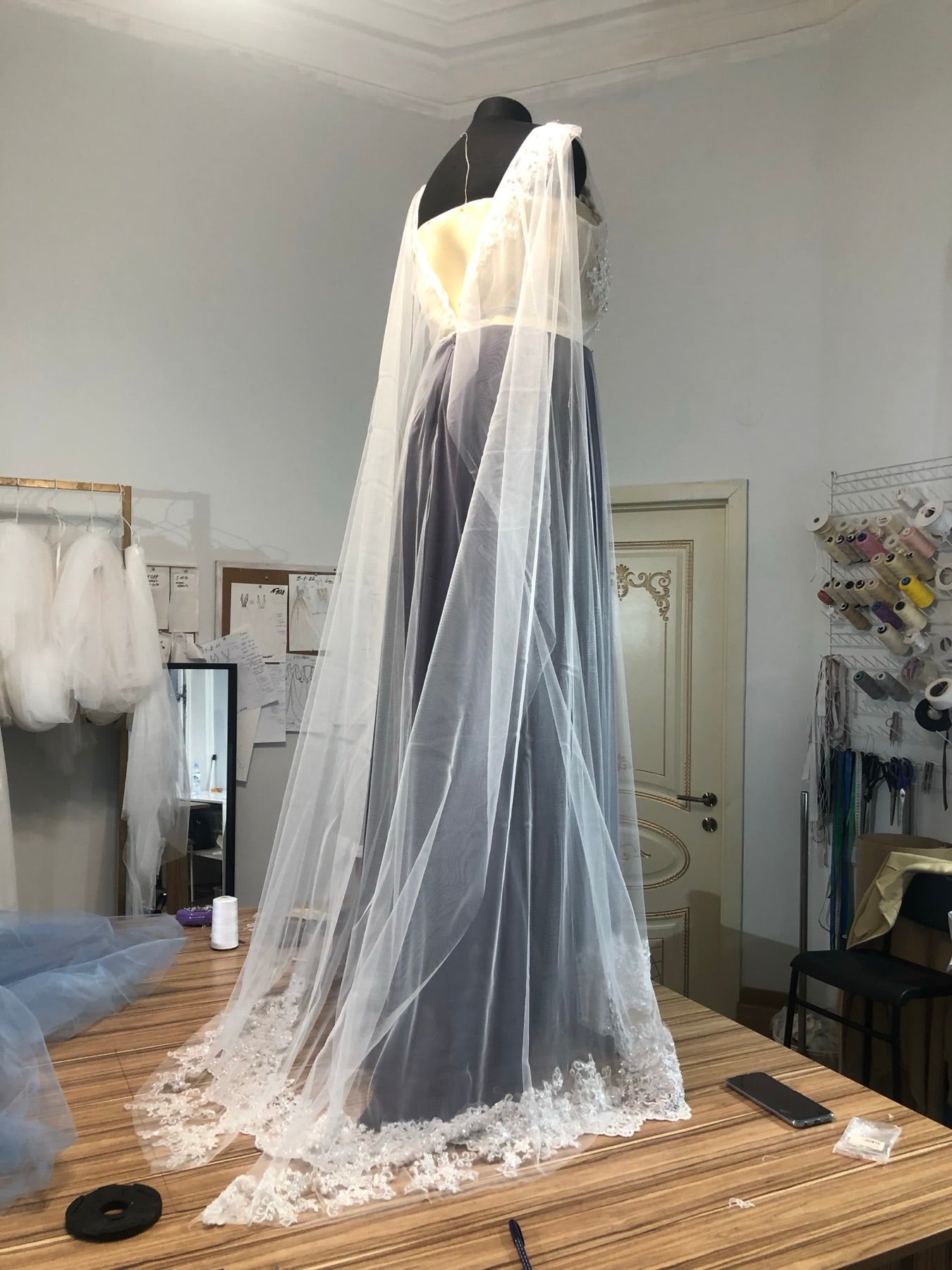

A bridal cape is a length of fabric that falls from the shoulders or the back of the neckline, down the back of the dress. It gives movement and drama from behind, like a veil, but it frames the face rather than covering it and it stays put in wind far better.
Capes range from a short capelet that just covers the shoulders to a full-length sheer panel that trails past the hem. The right one depends on your dress, your venue, and whether you want it on for the whole day or just the ceremony.
Key Takeaways
- A cape falls from the shoulders or neckline down the back, framing the face instead of covering it.
- A capelet covers the shoulders and upper back; a full-length cape trails to or past the hem.
- Sheer tulle capes read light and float; opaque satin or crepe capes are structural and formal.
- A cape can be permanently attached or detachable for the reception, decided at the sketch stage.
- It suits a clean, minimal dress that has room for a strong back detail, and it handles wind better than a veil.
Capelet vs. Full-Length Cape
- Capelet. A short cape that covers the shoulders and stops around the elbow or upper back. It adds a soft frame to the neckline and a little coverage, without a train effect. Practical for a winter ceremony, covered in our winter wedding dress guide.
- Mid-length cape. Falls to the waist or hip. A visible statement from behind without a full trailing effect.
- Full-length cape. Falls to the hem or trails past it like a cathedral train. The most dramatic option, and the one that most often replaces a long veil.
Sheer vs. Opaque
The fabric decides the character.
| Type | Effect |
|---|---|
| Sheer tulle or organza | Light, floating, ethereal. Moves in the slightest breeze. Can carry a lace or beaded edge. |
| Lace | Textured and romantic. Reads as an heirloom detail. Heavier than tulle. |
| Opaque satin or crepe | Structural, formal, architectural. Holds a defined edge and a strong line. Best on a clean dress. |
| Chiffon | Between the two: soft and fluid, with more presence than tulle. |
Our fabric guide for custom gowns covers how each behaves. A sheer cape floats; an opaque cape sculpts.
Where a Cape Attaches
- Shoulder seams. The most common. The cape falls from the shoulder points as two panels down the back, like a Watteau panel. Covered buttons or hooks.
- The back of the neckline. The cape rises from a high back or a collar and falls from there. Creates a stronger vertical line.
- A collar or choker. The cape attaches to a band at the throat and falls from the shoulders, framing the face closely.
- The wrists on some designs, so the cape moves with the arms.
The attachment is designed to sit flat and be invisible when the cape is on.
Attached or Detachable
- Permanently attached. Simplest. The cape is part of the dress and stays on all day. Best for a capelet or a short cape that does not interfere with dancing.
- Detachable. The cape comes away after the ceremony and portraits, using covered hooks or buttons. Best for a full-length cape. This is the same engineering as a convertible gown.
If the cape is detachable, the dress underneath is fully finished on its own, with a resolved back and neckline.
Cape or Veil
Both create movement from behind. The differences:
- A veil covers the face and hair; a cape frames them.
- A cape handles wind far better. A long veil in an outdoor or coastal setting is a constant management task; a cape attached at the shoulders mostly stays where it is put.
- A veil reads as traditional; a cape reads as modern or editorial.
- A cape can be opaque and warm; a veil is always sheer.
Some brides wear both, a short veil for the ceremony and a cape for the portraits and reception.
Which Dresses a Cape Suits
A cape works best over:
- A clean sheath, column, or minimalist dress, where it provides the drama the dress deliberately leaves out.
- A backless design, where a sheer cape covers the open back for the ceremony and comes off after.
- A dress with a high or interesting neckline that the cape can attach to.
A heavily embellished or full-skirted gown often does not need a cape, and a full-length one can compete with the skirt.
Planning a Cape as a Custom Order
The decisions:
- Length. Capelet, mid-length, or full-length.
- Fabric. Sheer tulle, lace, chiffon, or opaque satin or crepe.
- Attachment point. Shoulders, back neckline, collar, or wrists.
- Attached or detachable.
- Edge finish. Raw, rolled, lace-trimmed, or beaded.
We start with a conversation about the effect you want and your venue, then translate it into a sketch you approve before any fabric is cut. Our design process walks through each stage. Every dress is made to your measurements over 10 to 12 weeks, with UPS shipping to the US in 3 to 5 days, from a starting price of 1,490 euros. Our price breakdown explains what changes the cost.
FAQ
What is the difference between a cape and a capelet? A capelet is short, covering the shoulders and stopping around the elbow or upper back. A cape is longer, falling to the waist, the hem, or trailing past it. Both attach at the shoulders or the back of the neckline.
Can you wear a cape instead of a veil? Yes. A cape creates movement from behind like a veil but frames the face instead of covering it, and it handles wind much better. It reads as more modern or editorial. Some brides wear a short veil for the ceremony and a cape afterward.
Does a wedding dress cape come off for the reception? It can. A full-length cape is usually made detachable with covered hooks or buttons, so it comes away after the ceremony and portraits. A short capelet is often left permanently attached.
What dress works best with a cape? A clean, minimal dress: a sheath, column, or unembellished A-line. The cape provides the drama the dress leaves out. A heavily embellished or full-skirted gown often does not need one.
Is a cape warmer than a veil? It can be. A cape in opaque satin, crepe, or lined lace adds real coverage and warmth, which a sheer veil never does. This makes a capelet a practical choice for a winter ceremony.
Considering a cape instead of, or alongside, a veil? Start with a sketch consultation at Lutien Bridal.
About the author: Vlad Ivanov is the Director of Business Development at Lutien Bridal Atelier in France, home to the design team behind more than 1,000 custom wedding gowns delivered to brides across the US and Europe.