Atelier · France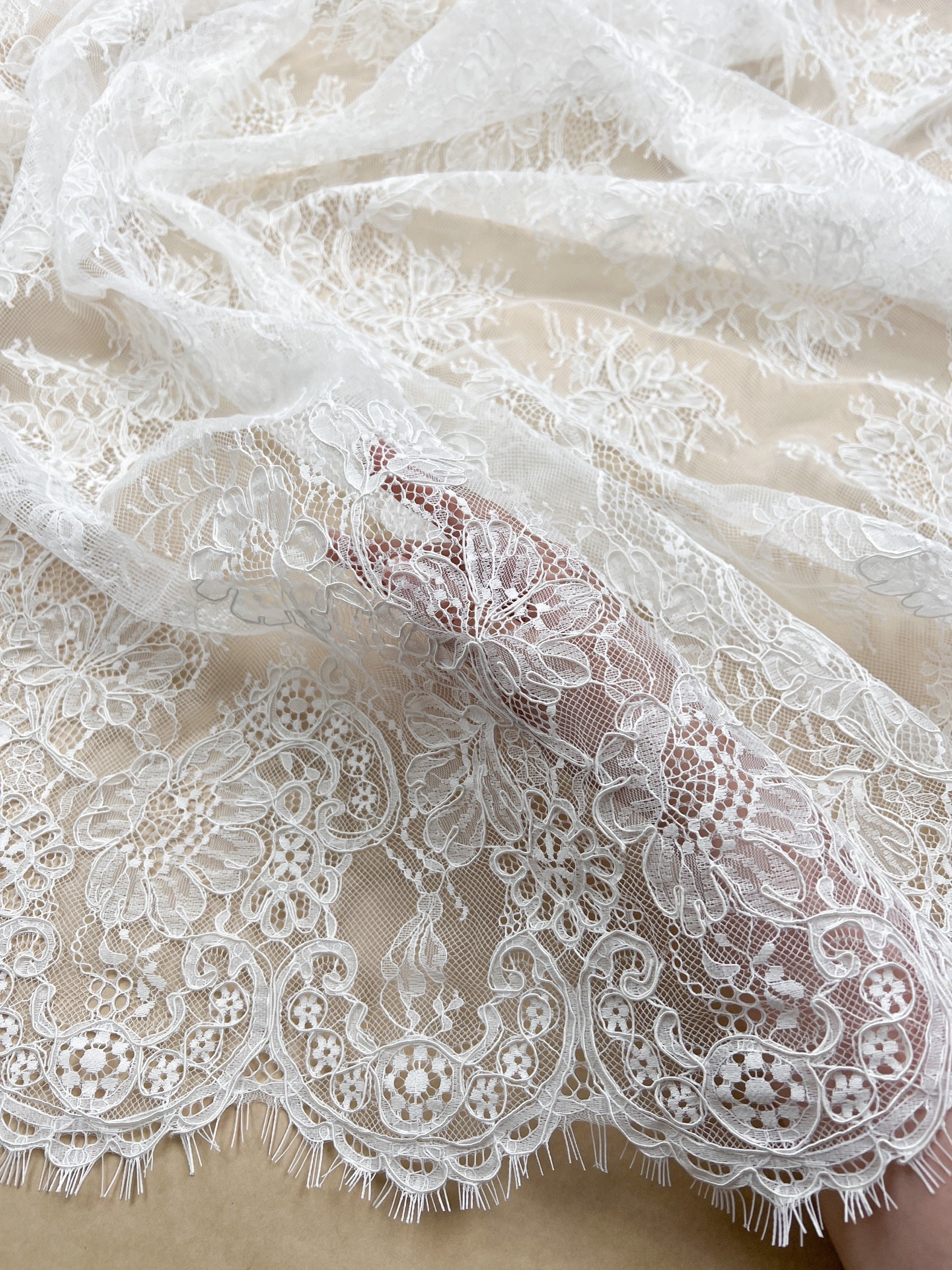

Key Takeaways
- Most ready-to-wear bridal gowns are made from polyester, even when marketed as "satin" or "silk."
- Bulk production generates large volumes of fabric scraps that mostly end up in landfill, and annual collections mean showroom samples are discarded every season.
- Made-to-order means no inventory: every yard of fabric is purchased for one specific dress, after the design is confirmed.
- What happens after the wedding matters as much as how the dress was made: construction quality decides whether it can be preserved, altered, or worn again.
- We don't market ourselves as an eco-brand. Made-to-order is just how a small atelier that builds one dress at a time actually operates.
Table of Contents
- What's Actually in That Dress?
- The Waste Nobody Talks About
- Made-to-Order Has No Warehouse
- Why 10 to 12 Weeks Isn't Slow. It's Just Right
- We Don't Call Ourselves an Eco-Brand
- FAQ
Every year, more brides pay attention to how things are made. They read labels, choose ethical clothing brands, and think twice before buying something that'll wear out in a season. And then, for the most significant garment purchase of their life, many end up ordering a dress made on a factory floor, in a standard size, from polyester.
We're not judging. The bridal market is structured to make that outcome easy. But if you care about how things are made, it's worth understanding what actually happens when a wedding dress gets produced at scale, and what a genuinely different approach looks like. If you are weighing a custom order more broadly, the complete guide to ordering a custom wedding dress online covers the process end to end.
What's Actually in That Dress? {#whats-in-it}
Walk into any bridal boutique or scroll through any mass-market bridal site, and you'll see words like "satin," "chiffon," and "organza" everywhere. What you won't always see stated clearly: the fiber content.
Polyester is the most widely used fiber in clothing, at roughly 54% of global fiber production, according to Textile Exchange, and bridal is no exception. Most ready-made gowns, including from well-known names, are cut from polyester: polyester satin, polyester chiffon, polyester organza. These fabrics look beautiful in photographs, feel decent in a showroom, resist creasing, and survive the journey from factory to boutique without damage. They are also far cheaper to produce than natural alternatives.

There's nothing inherently wrong with polyester as a material. But it matters for one specific reason: it is petroleum-based, and it does not biodegrade. A Scripps Institution of Oceanography study found that the oil-based portions of textile blends showed no sign of breakdown after more than a year submerged in the ocean, while natural cellulose fabrics degraded within about a month. When polyester is cut into scraps and discarded, or a dress ends up in landfill after one wear, that material persists for decades. It is also part of why so many ready-to-wear gowns cannot be preserved or worn again years later; what happens to a wedding dress after the wedding covers what that means for a dress's second life.
Lutien Bridal uses natural silk for silk garments. The specific fabric for each gown is confirmed in your individual proposal.
The Waste Nobody Talks About {#waste}
Here's what happens when a wedding dress gets produced in a factory.
First, pattern pieces get cut from large rolls of fabric. On any complex silhouette, a fitted bodice, a flared skirt, a layered train, cutting leaves significant scraps. A long ballgown or a full A-line dress uses a lot of fabric, and the shapes required mean a meaningful portion of every roll ends up as offcuts. In a factory producing hundreds or thousands of units, those scraps accumulate fast.
When the fabric is polyester, recycling those scraps is rarely economically viable for the manufacturer. The pieces are too small, the sorting too labor-intensive. Most of it is landfilled or incinerated, the fate of roughly 73% of textile waste worldwide, according to a 2024 Science Advances paper.

Then there's the collection cycle. Like most fashion companies, bridal brands release new collections on an annual or semi-annual schedule. Each new collection means the previous one is retired. Showrooms carry physical sample dresses in every style, and when a style is discontinued, those samples have to go somewhere. Some get discounted. Many get discarded.
Think about the scale: a bridal chain with dozens of locations, each carrying dozens of samples. Multiply that across the US market, and the volume of disposed sample dresses is significant. These are full-length gowns, often made from synthetic fabrics, produced specifically to be tried on and eventually thrown away.
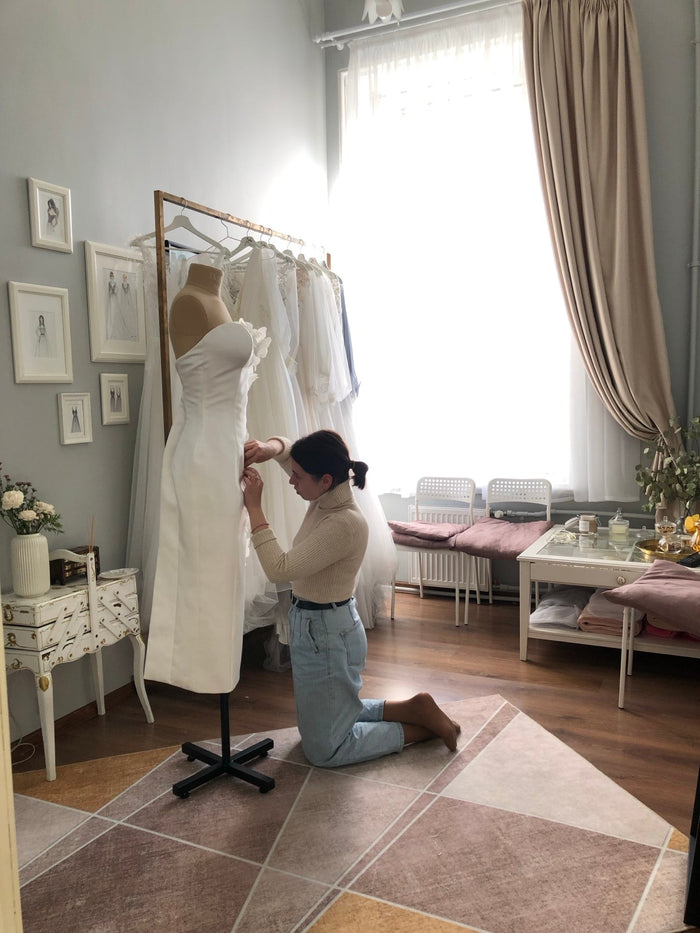
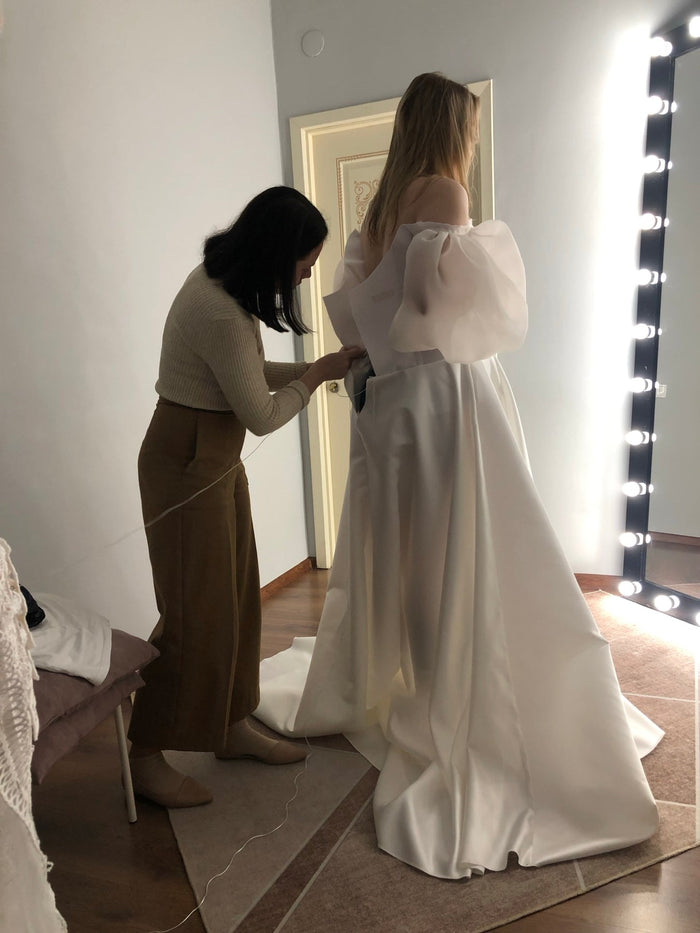
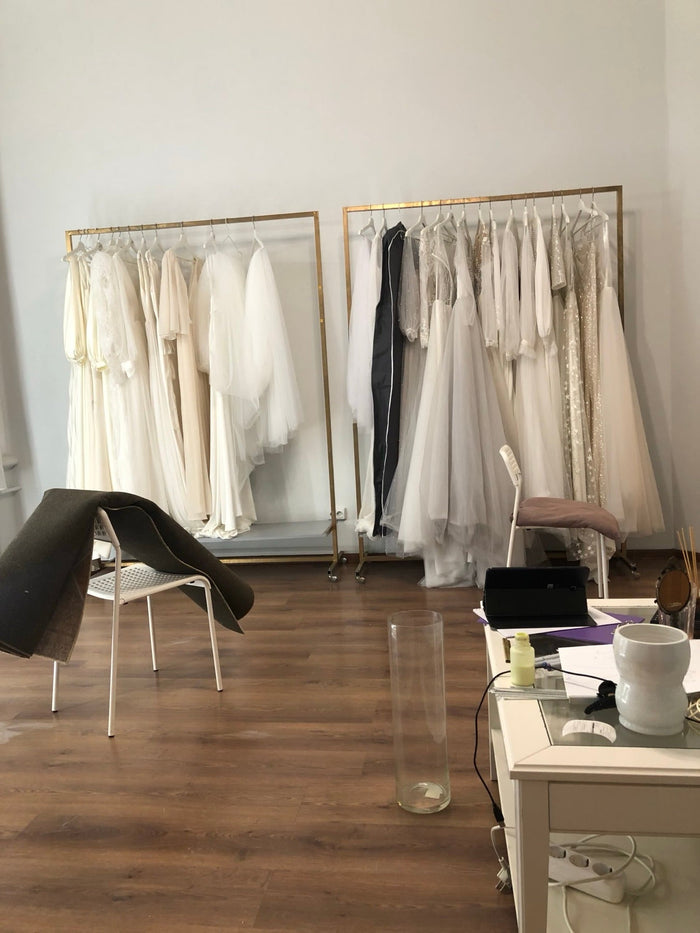
We don't have a showroom. We've never had sample dresses. We don't release seasonal collections. Every dress we've made since we started has been made because a specific bride ordered it. That's not a model we adopted for branding reasons, it's just how a small atelier that focuses on one order at a time naturally operates, entirely from our workshop in France. For more on what "Made in France" actually guarantees (and what it doesn't), see what "Made in France" actually means.
Made-to-Order Has No Warehouse {#no-warehouse}
When you order a dress from us, here's what happens on our end.
After your design consultation, sketch approved, measurements confirmed, every detail agreed, we source your fabric. Not from stock. Not from a shelf in the back. We go and buy the fabric that your specific dress requires.

We buy what your dress needs. We cut what your pattern requires. What's left over is the unavoidable minimum for one dress, not the accumulated waste of thousands of orders. There's no warehouse with finished gowns waiting for buyers, no end-of-season markdowns because we overproduced, no sample inventory to eventually dispose of.
Each order is its own discrete project from sourcing through shipping. This is also why hand-finished detailing, like hand embroidery and hand-applied beading, holds up differently over the life of the dress than mass-produced decoration. See hand beading versus machine beading for how to tell the difference before you buy, from any atelier.
If you want to see how the full production sequence works, from first message to finished dress, our 10 to 12 week production timeline walks through every stage.
Why 10 to 12 Weeks Isn't Slow. It's Just Right {#timeline}
One of the first things brides notice when they start looking into custom dressmaking is the timeline. Ten to twelve weeks. That can feel like a long time when you're used to things arriving in two days.
Here's what that time actually covers.
After your design is finalized and payment confirmed, we source fabric, two to four weeks, depending on your dress. Standard satin and crepe take about two weeks. Specialty fabrics (rare silk blends, specific lace, jacquard with a particular pattern) can take four. We don't rush this step because the fabric is the foundation of everything that follows.
Pattern drafting takes about two weeks. Construction, cutting, sewing, building the structure, takes three to four weeks depending on complexity: a clean A-line takes less time than a corseted bodice with a layered skirt. Finishing and final checks complete the dress. If your design includes hand embroidery from the waist to the hem, allow 2–3 months; we confirm the overall schedule for your design before you order. Then UPS delivers it to your door in three to five days.
That's 10 to 12 weeks for a dress made to your exact measurements, in your chosen fabric, by the same hands from start to finish.
A rush surcharge applies inside six months (€500 at five months, €700 at four months, €1,000 at three months), and three months is the hard floor. Even then, we don't compress construction quality; a dress made faster than the craft allows isn't the same dress. This same discipline is why we cap how many orders we take on each season rather than accepting more than our team can build to this standard.
If your wedding is in six months, the right time to start is now. If it's in four months, get in touch and we'll tell you honestly whether your design is feasible. We'd rather give you a straight answer early than take your order and deliver something that didn't have enough time to be done right.
We Don't Call Ourselves an Eco-Brand {#not-eco-brand}
We're not going to tell you that ordering from us saves the planet. We're a small atelier in France. We've completed over 1,000 dresses. We work on a made-to-order model because that's how a proper atelier operates, not because we built a marketing strategy around sustainability.
What we can say honestly: nothing we make sits in a warehouse. No fabric gets bought speculatively. No collection gets retired and no samples get discarded because a season changed. The production footprint of a dress from us is the production footprint of one dress, which is a different number than one dress produced inside a system that generates thousands of discarded samples and tons of polyester scraps each year.
Made-to-order also changes what is possible after the wedding. A dress built once, properly, with quality fiber and hand-finished construction, can be cleaned, preserved, and in some cases worn again years later: at an anniversary, a vow renewal, or passed on to someone else. If a second wedding dress for a vow renewal is something you might want down the road, construction quality now is what makes it possible.
If that matters to you when you're choosing where to order, it's worth knowing. If what matters is a dress made exactly the way you want it, that's the same answer.
A dress that fits your body perfectly, in the fabric you chose, with every detail agreed before a single stitch is placed. is quoted individually, all-inclusive, no customs fees, no hidden charges. See how our pricing works, tier by tier if you want to understand what goes into each before reaching out.
Start with a free sketch consultation
FAQ {#faq}
Are made-to-order wedding dresses more sustainable than ready-to-wear?
Made-to-order eliminates overproduction and showroom sample waste by definition, nothing is made until there's a confirmed order. The environmental impact also depends on the fabric: natural fibers biodegrade, polyester does not. The combination of made-to-order production and a considered fabric choice makes the biggest practical difference.
What fabric does Lutien Bridal use?
Lutien Bridal uses natural silk for silk garments. The specific fabric for each gown is confirmed in your individual proposal.
Why do most bridal brands use polyester?
Polyester is significantly cheaper than natural silk, resists creasing during shipping and storage, and is easier to work with at high production volume. It's a practical industrial choice. It also doesn't biodegrade when the dress is eventually discarded, which is the tradeoff most ready-to-wear brands don't advertise prominently.
Is a custom wedding dress more expensive than off-the-rack?
It depends on how you calculate total cost. Off-the-rack dresses in the US are typically purchased in standard sizes and then altered, and The Knot puts alterations on a preexisting gown at $1,000 to $3,000. A custom dress from Lutien Bridal is quoted individually, made for an adapted fit based on measurements taken by a professional tailor. Small alterations may be needed after delivery and are paid for by the customer. If you are comparing against renting rather than buying, how renting compares with commissioning a custom gown covers that trade-off.
How do I start the process?
Reach out through our contact form. We'll schedule a consultation where you share your ideas, references, and measurements, and it's a conversation first, not a sales pitch. See what that first conversation actually looks like. We'll sketch your dress and send the design before anything is confirmed or paid for. There's no commitment until you've seen the sketch and agreed on the final price.
Production details in this guide reflect Lutien Bridal's experience completing 1,000+ custom orders from our atelier in France.