Atelier · France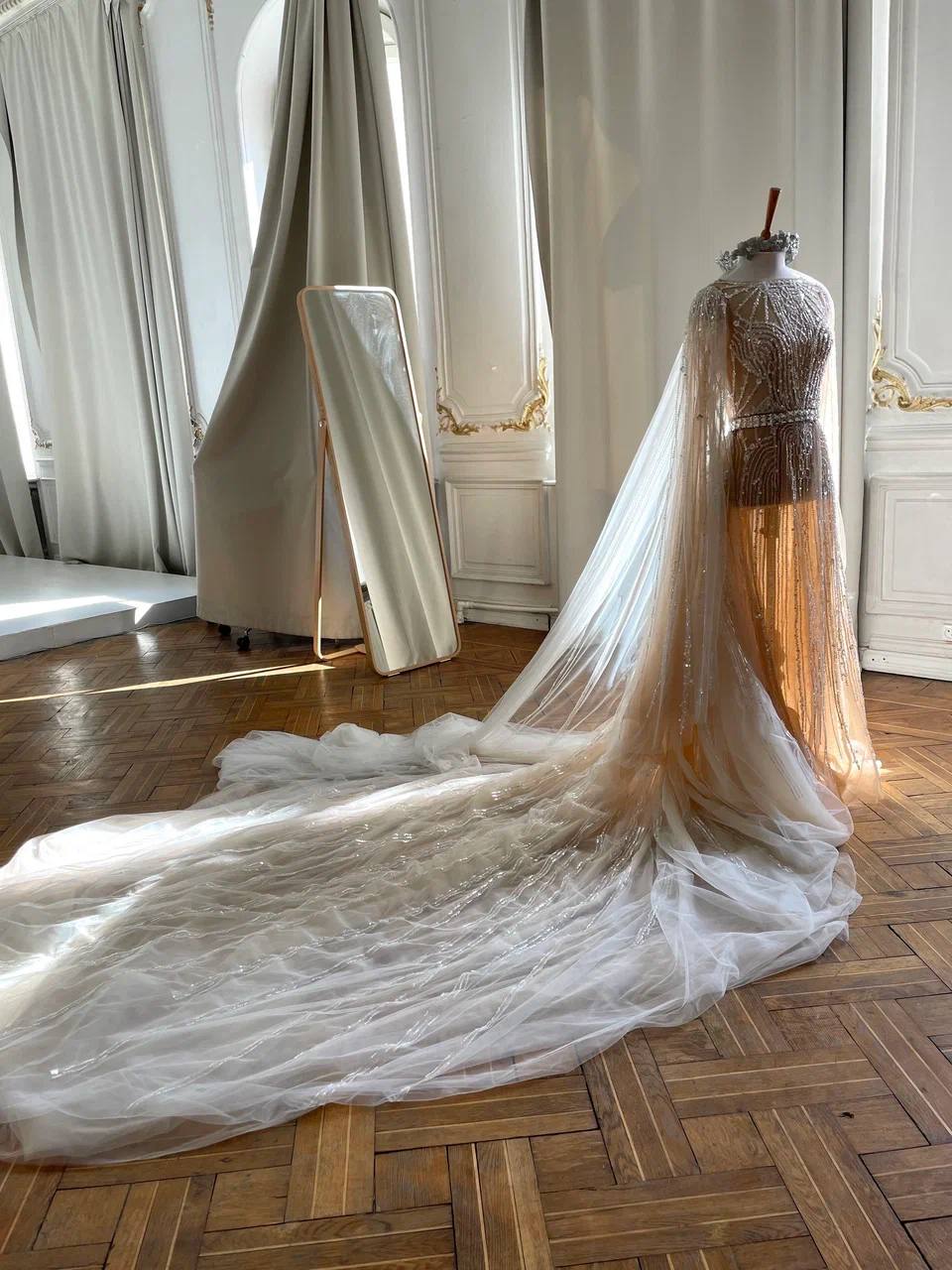

Key Takeaways
- Train length is measured from the natural waist to the trailing edge. Cathedral (6-8 feet) is the standard for “extra long.” Extended cathedral (8-10 feet) and royal (10+ feet) go further.
- Ballgown and A-line silhouettes carry extra long trains most naturally. Mermaid works when the train extends from the trumpet flare. Sheath rarely pairs well with dramatic train lengths.
- Long trains require venue-appropriate surfaces, a bustle plan for the reception, and typically a designated helper for the processional. These logistics are manageable, but they’re real.
- In a custom dress, the train length is a design specification set before production begins. You’re not limited to what a boutique happens to carry.
- At Lutien Bridal, every gown is sketched and approved before any fabric is cut. Production runs 10 to 12 weeks. US delivery is 3 to 5 days via UPS. Pricing is all-inclusive and depends on train length, structure, and embellishment.
Table of Contents
- What Counts as an Extra Long Train?
- Which Silhouettes Carry a Long Train Best?
- The Ballgown and the Extra Long Train
- Venue and Surface: Where Long Trains Work
- Managing the Train on the Day
- Ordering an Extra Long Train Custom
- FAQ
There’s a photograph that stays with you after a wedding is over: the train spread fully across the aisle, wide and uninterrupted, visible to every seated guest before the bride has even reached the altar. That image isn’t a styling accident. It’s a deliberate construction decision, one that starts with knowing what you want and commissioning it precisely.
An extra long train wedding dress requires planning that a standard floor-length gown doesn’t. Train length affects which silhouette works, what venue makes sense, how the dress moves, and what you’ll need on the day to manage it. This guide covers all of it, from how lengths are actually measured to why some silhouettes carry a long train better than others.
An extra long train isn’t a boutique decision, it’s a construction decision. Understanding what you’re specifying before you commit is the difference between getting exactly what you pictured and making do with what was available.
What Counts as an Extra Long Train?
Train length is measured from the natural waist, along the back of the dress, to the farthest point of fabric on the floor. There are six recognized lengths, though the terminology isn’t fully standardized across designers. Bridal editors at The Knot publish a similar scale, running from a sweep train that barely grazes the floor up to a monarch train of 10 to 12 feet or more.
Sweep train: 6-12 inches behind the hem. The shortest formal option. It barely extends past the dress and photographs as a subtle finishing detail rather than a statement.
Chapel train: approximately 3-4 feet from the waist. Visible in motion and present in photographs without requiring a dedicated train-bearer. This is the threshold most brides cross from “floor-length” into “train.”
Semi-cathedral train: approximately 4-5 feet. Noticeable in motion, present in photographs, and beginning to require some thought about floor surface and venue layout.
Cathedral train: 6-8 feet from the waist. This is the length most brides picture when they say “extra long.” A cathedral train is a visual statement, it’s striking in motion and impossible to photograph from any angle without being the primary subject.
Extended cathedral train: 8-10 feet. This length requires active management and a designated helper during the processional. The visual effect in a formal venue is significant.
Royal or monarch train: 10 feet or longer. This is theatrical by design. Most commissions in this range land between 10-14 feet. It requires the right venue, the right surface, and a clear plan for managing the dress through the entire day.

When brides search for an extra long train wedding dress, they’re typically describing the cathedral or extended cathedral range: long enough to be a visual statement at the altar and present in every photograph taken from behind. That’s the range this guide focuses on.
Which Silhouettes Carry a Long Train Best?
Not every silhouette supports an extra long train equally well. The train is attached at the waist, or at a lower seam in some designs, and the structure of the dress above it determines how the train moves, how weight is distributed, and whether the transition between skirt and train reads as intentional or awkward.
Ballgown is the most natural pairing for an extra long train. The full skirt volume creates a gradual visual transition, you’re moving from mass to sweep, not from fitted to pooling fabric. The structured bodice also distributes the weight of a long train without straining the construction. More on this pairing below.
A-line carries a long train well because the gradual flare naturally leads the eye toward the floor. An A-line gown with a cathedral train flows as a single visual unit, the flare and the trailing train read as continuous rather than contrasting. For brides who want the visual impact of an extra long train without the full volume of a ballgown, A-line is the strongest alternative. Our guide to the A-line silhouette covers how that flare behaves on different figures.
Mermaid and trumpet can work, but the construction logic is different. In a mermaid silhouette, the train works best when it extends from the trumpet flare rather than pooling directly from the fitted waist. A cathedral train attached at the waist of a tight mermaid can create a visual discontinuity between the body-skimming upper silhouette and the spreading fabric behind it. This is solvable in custom construction, but it requires specific pattern decisions, and it’s worth discussing with your designer before anything is sketched.
Sheath and column are less natural pairings for dramatic train lengths. The clean, uninterrupted vertical line of a sheath tends to be visually disrupted by a long train attached at the waist. Exceptions exist, a sheath with a draped overskirt that extends into a train can work beautifully, but these are specialty constructions that need to be designed from the ground up.

For a detailed look at how each silhouette behaves in construction and on the body, our wedding dress silhouettes guide covers each one with specifics about fit, movement, and venue suitability.
The Ballgown and the Extra Long Train
The ballgown with an extra long train is one of the most formally theatrical choices in bridal. It’s also technically demanding to execute well. Here’s why the combination works when it’s built correctly, and what goes wrong when it isn’t.
A ballgown’s skirt volume, created through layers of tulle, structured petticoats, or both, sets up a visual mass that makes a long trailing train feel proportional rather than excessive. On a fitted silhouette, a 7-foot train can look appended. On a ballgown with substantial skirt volume, that same train reads as a natural extension of the scale already established. The eye moves from full volume to sweep without interruption.
The bodice does structural work too. A properly built ballgown bodice has boning and interior construction designed to support the weight of the skirt. That same structure also manages the weight of a long train without allowing it to pull at the waist or distort the dress’s silhouette as the bride moves. When the bodice construction is insufficient for a heavy train, the dress shifts backward and the front hem rises over the course of the day. This is a construction problem, not a fit problem, and it’s prevented at the pattern stage, not the alteration stage.
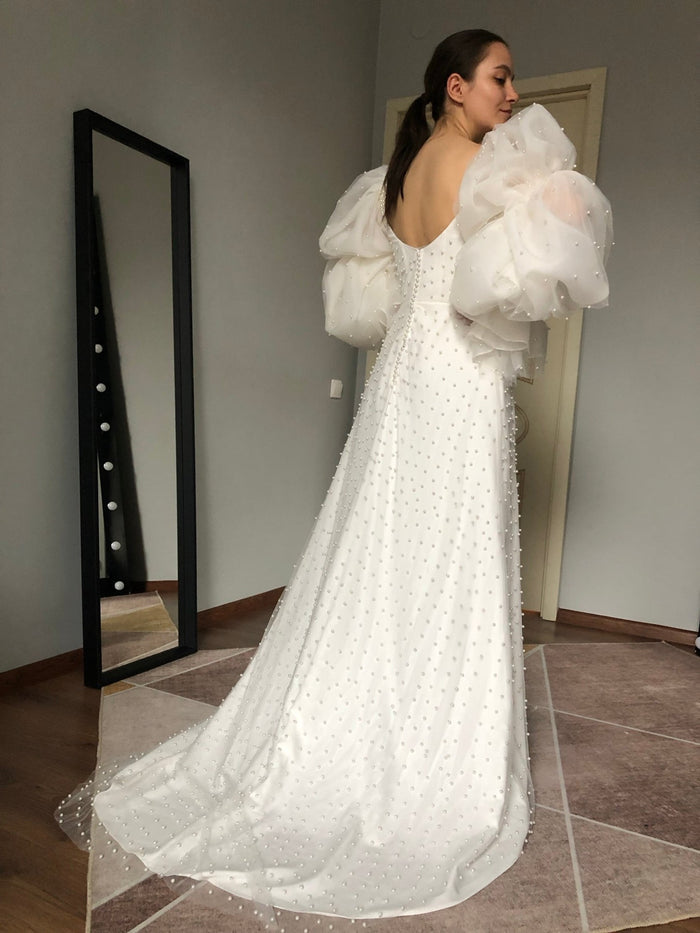
The visual effect is specific and recognizable. When a ballgown bride stands at the altar, a cathedral train can span the full width of an aisle. When she walks, the train follows in a slow wave. These are deliberate effects that come from the pairing of full skirt volume with extended train length, and they require exactly the right proportions to achieve.

In custom construction, ballgown trains can be built to any specified length. They can also carry decorative elements that extend from the skirt onto the train: embellishment that cascades down, a contrasting fabric finish at the trailing edge, or 3D details concentrated along the hem. These aren’t options you’ll find in a boutique. They’re design decisions made before production begins.

Venue and Surface: Where Long Trains Work
A cathedral or extended cathedral train is an architectural element of the dress. It needs the right setting to read correctly, and the right surface to survive the day.
Venues where extra long trains work well:
Traditional churches and cathedrals. Long aisles, stone or hardwood floors, architectural height that gives the scale of the dress room to register. This is the setting the cathedral train was designed for.
Formal ballrooms and event halls. Polished floors, low-pile carpet, wide spaces. A long train moves cleanly on smooth surfaces and photographs well under controlled lighting.
Stately homes and estates. Wide interior corridors and maintained floors. Outdoor terrain works if it’s level and the surface is maintained lawn, flagstone, or paving.
Formal garden ceremonies on prepared paths. A cathedral train on a flat, well-maintained surface reads correctly. What matters is levelness and surface type, not whether the ceremony is indoors or out.
Venues where long trains become complicated:
Outdoor ceremonies on natural terrain. Soft ground, gravel, mulch, and uneven grass catch fabric and retain moisture. A cathedral train on most natural outdoor terrain requires intensive management and accepts some damage.
Intimate venues without aisle space. A train that can’t lie flat in a straight line bundles instead. The visual effect you’re planning for doesn’t happen.
Beach ceremonies. Sand, salt water, and bare fabric don’t have a good outcome. A shorter sweep or no train is almost always the better structural decision for beach settings.

The surface question matters for two practical reasons: photography and fabric condition. Any fabric that drags across a floor acquires what it touches. Stone, polished wood, and maintained carpet are forgiving. Gravel, rough concrete, and damp grass are not. If the venue involves surfaces you’d classify as difficult, factor a dress cleaning into the post-wedding budget, or reconsider the train length.

Managing the Train on the Day
An extra long train is not self-managing. How it behaves before, during, and after the ceremony is part of the wedding logistics, not an afterthought.
Bustle. For any train longer than a chapel length, a bustle is almost always necessary for the reception. A bustle hooks or loops the train up to the underside of the dress, letting you move freely without stepping on it. There are several styles: the American bustle hooks at the back, the French bustle loops under the skirt at multiple points, and the ballroom bustle uses several pickup points for very long or heavy trains. The right style depends on the dress construction and the train length. This isn’t a decision to make at the last fitting, it’s designed into the dress at the custom order stage.
Train-bearers. For extended cathedral or royal-length trains, one or two designated people manage the train during the processional. They position it at the altar, manage it through the ceremony, and assist with the transition afterward. Flower girls and junior bridesmaids often serve this role, but it requires genuine coordination, someone who understands the job before the day, not someone figuring it out at the rehearsal.
Between ceremony and reception. This is where most long-train damage happens. The transition between spaces, particularly outdoors or across mixed surfaces, is when the train most often gets snagged, stepped on, or soiled. A dedicated person manages the train during any extended movement, and the bustle is deployed before any reception activity involving dancing.
Ordering an Extra Long Train Custom
The most significant advantage of a custom dress for a bride who wants an extra long train: the train length is a specification, not a constraint.
In a boutique, the sample trains are what they are. An alteration can extend a hem or shorten a train, but structural changes, converting a chapel-length dress into an 8-foot cathedral construction, require rebuilding the back of the skirt. That’s not an alteration; that’s a new skirt. And the bodice, which wasn’t built to support that weight, will strain under it.
In a custom dress, you specify the train length before anything is cut. The pattern is built for it. The waist seam, the skirt volume, the interior support structure, everything is designed together, for the length you want, in the silhouette you’ve chosen. The bustle design is also planned at this stage, not retrofitted after.
Most brides buy off-the-rack. For a bride who wants an extra long train on a specific silhouette with specific embellishment, that path makes it genuinely difficult to achieve the result through alterations alone. Our complete guide to ordering a custom wedding dress online lays out how the commissioning path works from first message to delivered dress.
At Lutien Bridal, the train conversation happens during the design consultation. Brides describe the visual they want: the length, whether the train should be as wide as the skirt at its widest point or narrower, how the hem should be finished, whether embellishment from the skirt should continue onto the train. We translate that into a specification, and then into a sketch.

The sketch shows you the full dress: silhouette, train proportion, back detail, hem finish. You see exactly what you’re approving before production begins. Changes happen at the sketch stage, not after fabric is ordered. Our from sketch to dress design process post walks through how we turn references and ideas into a construction plan.

From payment to completed dress runs 10 to 12 weeks; the custom wedding dress timeline covers that build week by week. Shipping to the US takes 3 to 5 days via UPS. Everything is included: customs duties, shipping, and handling, with no additional charges at delivery. Pricing depends on the train length, the interior structure that length requires, and any embellishment carried onto the train, so our guide to what a custom wedding dress costs is the place to start on budget.
We recommend starting about 10 months before your wedding date, and there is no surcharge at six months or more. Inside that window a rush fee applies: €500 at five months, €700 at four months, and €1,000 at three months, which is the hard floor, since we do not take orders inside three months. Even then, the production window for a train this size exists because the work requires it.

Start with a free sketch consultation
FAQ
What is considered an extra long train on a wedding dress?
Train length is measured from the natural waist to the trailing edge. Cathedral, approximately 6-8 feet, is the standard definition of “extra long.” Extended cathedral (8-10 feet) and royal (10+ feet) go further. Most brides searching for an extra long train are describing the cathedral range: long enough to be a visual statement at the altar and present in every photograph taken from the back.
Which silhouette looks best with an extra long train?
Ballgown and A-line are the strongest pairings. A ballgown’s full skirt volume creates a proportional transition to the trailing train, nothing looks appended. An A-line’s gradual flare leads the eye naturally toward the extension. Mermaid works well when the train flows from the trumpet flare rather than directly from a fitted waist. In a custom dress, the silhouette and the train length are designed together, which means the construction can be built to support exactly the pairing you want.
How long is a cathedral-length wedding dress train?
Cathedral: approximately 6-8 feet, measured from the natural waist to the farthest point of fabric on the floor. Extended cathedral: 8-10 feet. Both are “extra long” by most definitions. A royal or monarch train is 10 feet or longer. All three require bustle planning for the reception. At extended cathedral or royal lengths, a designated train-bearer for the processional is also necessary.
Do I need a bustle with an extra long train?
Yes, for any reception involving movement. A bustle hooks or loops the train up to the underside of the dress so you can walk, dance, and move freely without managing the train by hand or stepping on it. For cathedral and longer trains, the bustle design is built into the custom order, it’s specified at the design stage, not added as an afterthought at the final fitting. The right style depends on the dress’s back construction and the train weight.
How much does a custom extra long train wedding dress cost?
Pricing depends on the train length, the silhouette, the interior structure that length requires, and the embellishment level, all quoted in full before you commit. Custom wedding dresses at Lutien Bridal are quoted individually; an extra long train sits above that because of the added fabric and the internal support the length needs. Shipping to the US and all customs duties are included, with no additional charges at delivery.
All construction and process details in this guide are based on Lutien Bridal’s experience completing 1,000+ custom orders from our atelier in France.