Atelier · France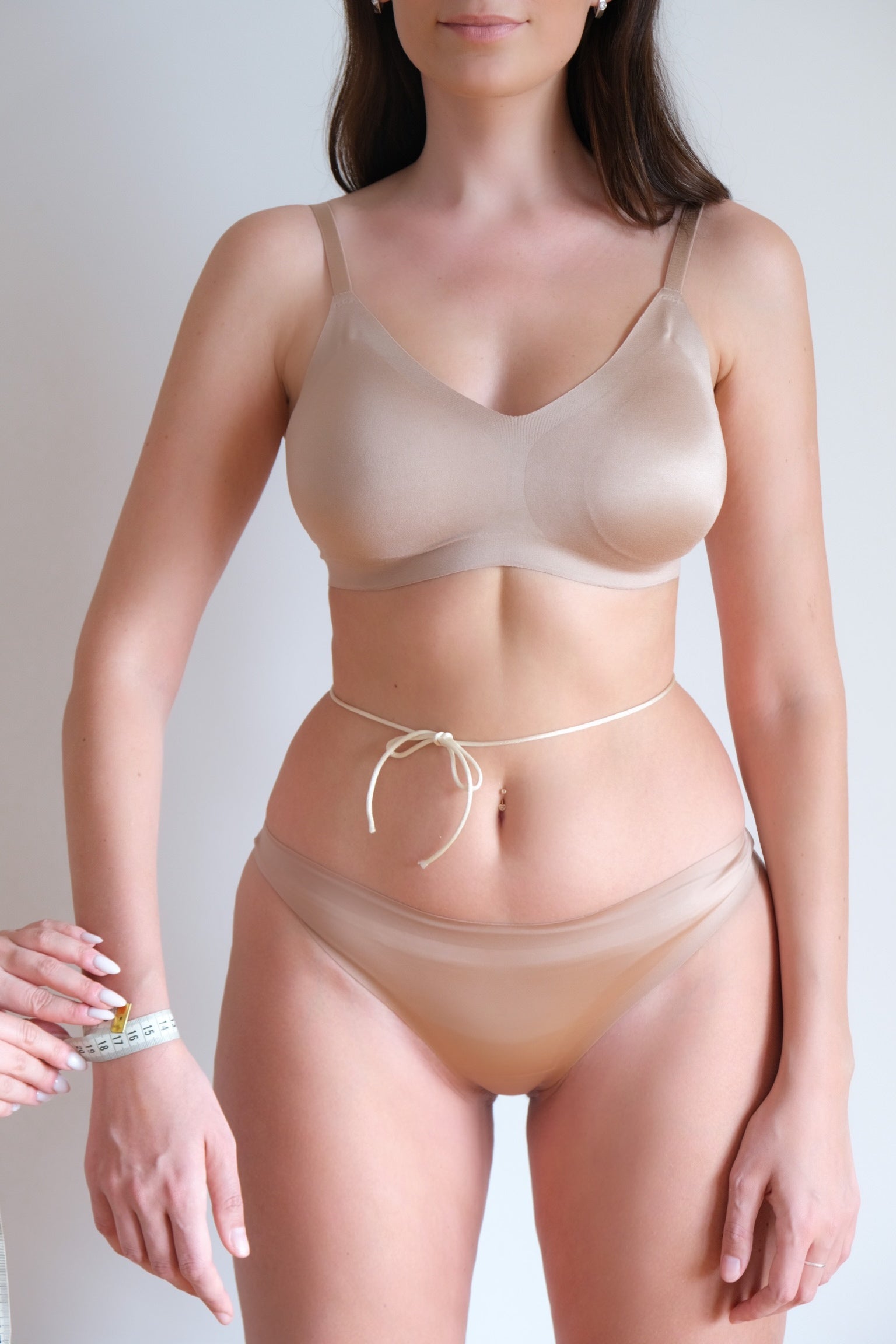

Key Takeaways
- Four measurements determine your dress size: bust, waist, hips, and hollow-to-hem. For a fully custom gown, we ask for three more.
- Always measure in the undergarments you'll wear on your wedding day. Any extra layer shifts your numbers.
- Bridal sizing runs 2-4 sizes larger than US street clothing, your measurements matter, not the number on the label.
- Wedding dress alterations cost $300-$800 on average (Zola, 2025), often more for structural work. Accurate measurements taken upfront eliminate most of that.
- Take your hollow-to-hem measurement in your wedding shoes. Barefoot is wrong by exactly the height of your heel.
Table of Contents
- Before You Start
- Step 1: Bust
- Step 2: Waist
- Step 3: Hips
- Step 4: Hollow-to-Hem
- Step 5: Custom Fit Points for a Made-to-Order Dress
- Lutien Bridal Size Chart
- 5 Mistakes That Cause a Poor Fit
- What to Do With Your Measurements
- FAQ
Taking your own measurements is straightforward, but five specific errors consistently produce a dress that needs major work before it fits. This guide documents exactly how we walk every Lutien Bridal client through the process before production begins.
At our atelier, no dress is cut from a standard block. Every pattern is drafted to your body. The measurements you send us become the foundation of that pattern, which means getting them right is the one step where precision genuinely matters.
The complete guide to ordering a custom wedding dress online →
Before You Start {#before-you-start}
You need four things before you take a single measurement. Missing any one of them will compromise your numbers.
What you need:
- A soft measuring tape, fabric or flexible plastic, at least 60 inches long, marked in inches. A metal tape measure cannot contour to body curves. It bridges across soft tissue and produces an inaccurate reading. Do not use one.
- A full-length mirror, so you can verify the tape is level at the back.
- The undergarments you'll wear on your wedding day, bra, shapewear, anything that will sit between your body and the dress. Measure in exactly this. Every extra layer adds to the number.
- A helper, this is a two-person job. Back measurements and hollow-to-hem cannot be taken accurately alone. Repositioning the tape while reading it shifts your number by 1-2 inches.
For the hollow-to-hem measurement only:
- Your wedding shoes, or any shoe with the same heel height. Length is measured standing at your finished height.
Stand naturally. Don't hold your breath, pull in your stomach, or tense your muscles. Measurements taken while bracing produce numbers your body won't maintain for 12 hours on your wedding day.
Step 1: Bust {#bust}

Accurate bust measurement determines bodice fit. Wrap the tape around the fullest part of your chest, approximately at nipple level. The tape runs parallel to the floor all the way around your body.
Stand straight, arms relaxed at your sides. Your helper holds the tape level at the back while you read the number at the front. The tape should be snug but not pressing into your skin. One finger should fit comfortably between the tape and your chest.
What this measures: The widest circumference of your torso at chest level. This is what the bodice is drafted around.
Not the same as your bra size: Bra sizing uses the underbust band plus a cup offset. Bridal measurement uses the fullest circumference directly. Do not substitute one for the other.
Common error: Pulling the tape too tight. Compression gives you a number that reflects the tape's tension, not your body. The dress will feel constricting across the chest when it arrives.
Step 2: Waist {#waist}

Your natural waist is the narrowest point of your torso, typically 1-2 inches above your belly button. This is where the dress narrows at the bodice, and where the skirt begins on most silhouettes.
How to find it: Stand straight and bend slowly to one side. The crease that forms is your natural waist. Mark it with your thumb, straighten up, and measure at that point.
Wrap the tape all the way around, parallel to the floor. Same rule as the bust: one finger of clearance. Take the measurement while breathing normally, not after exhaling fully.
Common error: Measuring at the waistband of your pants. That sits on or below the hip bones, not at the natural waist. On a fitted bodice, this error shifts the seaming placement and the dress won't sit correctly on your body even at the right measurement.
If your design includes a corset bodice, this waist number (taken while breathing normally, never exhaled) is exactly what determines where the boning channels sit, see corset construction in custom bridal for how that structure gets built from this one measurement.
Step 3: Hips {#hips}

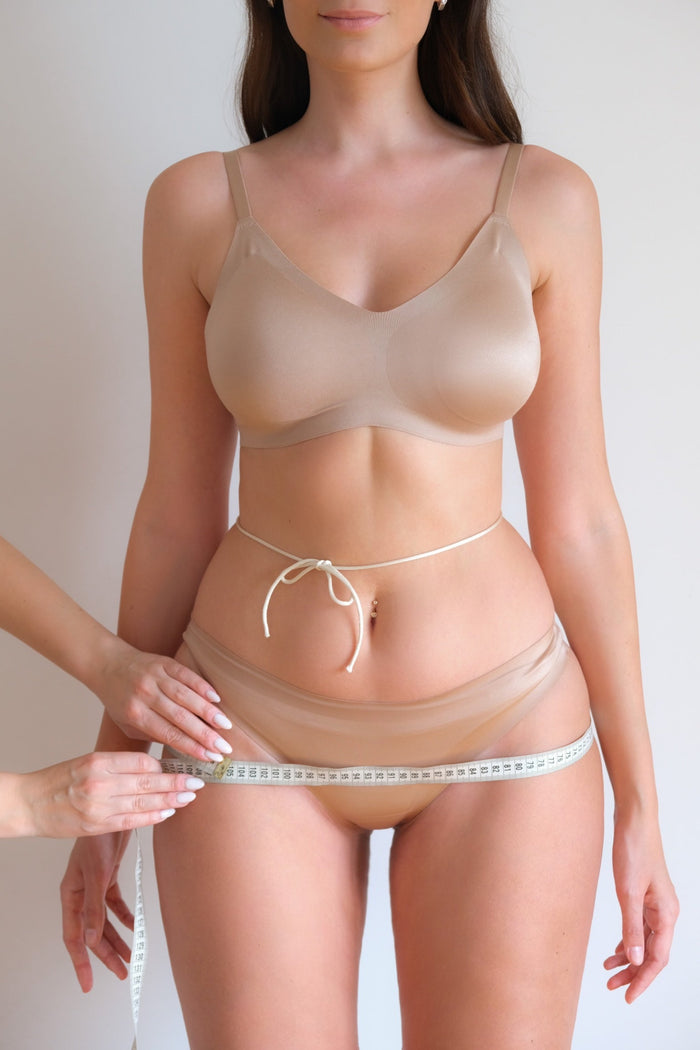
Hip measurement controls whether the skirt passes over your body. Wrap the tape around the fullest point of your hips and seat, typically 7 to 9 inches below your natural waist. Stand with your feet together.
The tape goes around the widest point of both hips and your seat, parallel to the floor. Don't tilt the tape down at the back, it must stay level all the way around.
Common error: Measuring around the hip bones rather than the fullest point of the seat. The hip bones are higher and narrower. The fullest circumference, which includes the seat, is the number the skirt is cut to. If you measure too high, a fitted skirt will not pass over your hips.
Step 4: Hollow-to-Hem {#hollow-to-hem}

Hollow-to-hem determines the length of your dress. Find the hollow at the base of your throat, the small indentation where your collarbones meet. From that point, the tape runs straight down the center of your body to the floor.
Stand in your wedding shoes. Stand straight. Your helper places the tape end at the hollow and lets it fall to the floor without angling it forward or back.
Why shoes are required: Three inches of heel is three inches of length. If you measure barefoot and your heels are 3 inches, the hem will arrive 3 inches too short. There is no workaround, the length is calculated at your finished standing height.
Standard range: For most brides wearing 2-inch heels, floor-length hollow-to-hem falls between 58 and 61 inches. If your number sits outside this range, verify you were standing straight in the correct shoes, that's almost always the cause.
Step 5: Custom Fit Points for a Made-to-Order Dress {#custom-measurements}
Standard boutiques size a dress to bust, waist, and hips. When we draft a pattern from scratch, we ask for three additional measurements. These determine proportions that a size chart can't capture.
High Bust

Wrap the tape around your chest just above the fullest point of your bust, above the nipple line, below the armpit. This is your high bust circumference.
The difference between your bust and high bust tells us how to proportion the upper bodice for your frame. It determines whether the neckline sits correctly and how the bodice transitions through the shoulder area, independently of cup size. For how this measurement interacts with a specific neckline choice, see wedding dress necklines explained.
Arm Circumference

For any dress with sleeves, fitted, puff, or sheer, we measure the fullest point of your upper arm. Your helper wraps the tape all the way around at the widest point. This measurement appears frequently in long-sleeve and off-shoulder styles. If you haven't settled on a sleeve style yet, wedding dress sleeve styles walks through bishop, puff, and illusion options and what each one asks of this measurement.
Shoulder Width
Measured across the back from shoulder point to shoulder point. Your helper places one end of the tape at the point where your shoulder meets your arm, on one side, and extends it to the same point on the other side. This controls the width of the back panel and the position of seams relative to your natural shoulder line.
Lutien Bridal Size Chart {#size-chart}

Find your size by measurement, not by the number. Bridal sizing conventions, rooted in decades-old European standards, mean most brides will size up 2-4 numbers compared to their regular US clothing (Kennedy Blue, Celia Grace, Kimberly James Bridal, 2024). A US street size 8 frequently corresponds to a bridal size 12 or 14. The number is irrelevant. Your measurements are not.
| US Size | EUR Size | Bust | Waist | Hips |
|---|---|---|---|---|
| US 0-0 | EUR 30 | 29.9" / 76 cm | 22.8" / 58 cm | 33.8" / 86 cm |
| US 0 | EUR 32 | 31.4" / 80 cm | 24.4" / 62 cm | 35.4" / 90 cm |
| US 2 | EUR 34 | 33" / 84 cm | 25.9" / 66 cm | 37" / 94 cm |
| US 4 | EUR 36 | 34.6" / 88 cm | 27.5" / 70 cm | 38.5" / 98 cm |
| US 6 | EUR 38 | 36.2" / 92 cm | 29.1" / 74 cm | 40.1" / 102 cm |
| US 8 | EUR 40 | 37.7" / 96 cm | 30.7" / 78 cm | 41.7" / 106 cm |
| US 10 | EUR 42 | 39.4" / 100 cm | 32.2" / 82 cm | 43.3" / 110 cm |
| US 12 | EUR 44 | 40.9" / 104 cm | 33.8" / 86 cm | 44.8" / 114 cm |
| US 14 | EUR 46 | 42.5" / 108 cm | 35.4" / 90 cm | 46.4" / 118 cm |
| US 16 | EUR 48 | 44" / 112 cm | 37" / 94 cm | 48" / 122 cm |
| US 18 | EUR 50 | 45.6" / 116 cm | 38.5" / 98 cm | 49.6" / 126 cm |
| US 20 | EUR 52 | 47.2" / 120 cm | 40.1" / 102 cm | 51.5" / 130 cm |
When your measurements fall between two sizes: Size up to the larger. Taking a dress in is a standard alteration. Adding fabric is not, and at a custom atelier, we account for this in the initial pattern draft before a single piece is cut.
When your three measurements point to different sizes: This is the common case, not the exception. If your bust corresponds to a US 8 but your hips correspond to a US 12, a standard boutique asks you to choose one. We don't. For a fully custom dress, we draft the pattern to each measurement point individually. No alterations needed to compensate for the difference, it's built into the construction from the start.
5 Mistakes That Cause a Poor Fit {#mistakes}
1. Measuring alone. Back measurements and hollow-to-hem require a second person. The movement required to hold the tape and read it simultaneously shifts your numbers by 1-2 inches. The Knot identifies this as the single most common at-home measurement error (The Knot, 2025).
2. Using a metal tape measure. A metal tape bridges across the soft contours of the body. It reads the gap, not the circumference. Do not use one.
3. Measuring over clothing. Even a thin layer adds to the number. Measure in only the undergarments you'll wear under the dress.
4. Forgetting your shoes for hollow-to-hem. The most consistently skipped step. The height of your heel determines where the hem falls. Every inch of heel is an inch of length.
5. Ordering to your goal measurements. Order for the body you have today. Taking a dress in as your measurements change before the wedding is routine. Letting a dress out, particularly a custom-made one, is expensive and time-consuming. Every experienced atelier will tell you the same: measure today, order today.
What to Do With Your Measurements {#next-steps}
Once you have bust, waist, hips, and hollow-to-hem, you're ready to start an order inquiry. Include all four measurements when you write to us. For sleeved styles, add arm circumference. If you're unsure about any reading, take it on two separate days and send both numbers.
Wedding dress alterations average $300-$800 nationally (Zola, 2025), with structural work reaching $1,200 or more. Precise measurements, taken correctly once, is the most effective way to arrive without that cost.
We review every measurement set before production begins. If anything looks inconsistent, we'll ask before we cut.
What happens after you send your measurements: the full ordering process →
FAQ {#faq}
What measurements do I need to order a custom wedding dress? Four measurements cover most styles: bust (around the fullest part of the chest), waist (the natural waist, narrowest point of the torso), hips (fullest circumference of the hips and seat), and hollow-to-hem (from the hollow at the base of the throat to the floor, measured in wedding shoes). For sleeved styles, add arm circumference. For a fully custom gown, we also request high bust and shoulder width.
Why does bridal sizing run larger than regular clothing? Bridal gown sizing follows conventions rooted in decades-old European standards, where sizes were numbered differently from US street clothing (Kennedy Blue, Celia Grace, Kimberly James Bridal, 2024). A US street size 8 typically corresponds to a bridal size 12 or 14. This is why we recommend sizing by measurement only, the number is a label, not a fit guarantee.
Do I need help to measure myself, or can I do it alone? You need a helper for accurate results. Back measurements and hollow-to-hem cannot be read correctly by one person. The repositioning required shifts your number by 1-2 inches, which is enough to affect fit across the bodice and length.
What if my measurements fall between two sizes? Size up to the larger. At a standard boutique, this means a simple take-in alteration before your wedding. At Lutien Bridal, we account for this in the initial pattern draft, no alteration needed.
What if my bust, waist, and hips are all different sizes? This is the normal case for most brides, and exactly where a custom dress outperforms an altered sample. We draft each pattern piece to its own measurement independently. A bust cut for a US 8 and a skirt drafted for a US 12 is standard practice here, built into the initial construction.
When should I take my measurements? Take them now, as close to placing your order as possible. If your measurements are likely to change before production begins, we can discuss timing during intake. But always order based on current measurements, not projected ones.
Related guides:
- The Complete Guide to Ordering a Custom Wedding Dress Online
- Custom Wedding Dress Timeline: How Long Does It Actually Take?
- How Much Does a Custom Wedding Dress Cost?
- Corset Construction in Custom Bridal: Why It Matters for Fit
- Wedding Dress Sleeve Styles: Bishop, Puff, Illusion
About the author: Alena Amros is the lead designer at Lutien Bridal Atelier in Ansignan, France, where she has designed and produced over 1,000 custom wedding gowns for brides across the US and Europe.
Measurement guidance reviewed against standards published by David's Bridal, Maggie Sottero, and Essense of Australia. Size chart is Lutien Bridal's proprietary sizing system, 2026. Alteration cost data: Zola Expert Wedding Advice, updated September 2025.