Atelier · France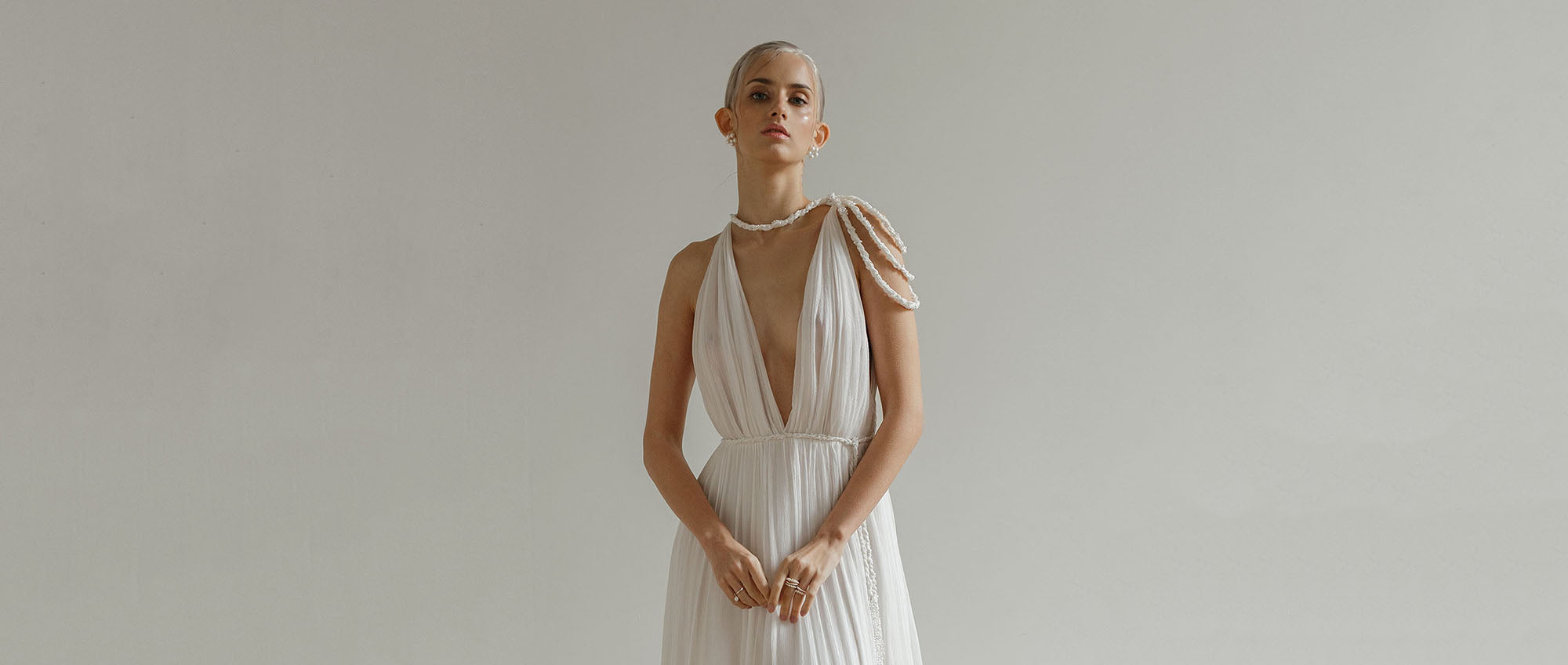
The dress you picture in your head has a specific quality to it, a weight, a drape, a way of catching light. You might not know what fabric name belongs to that feeling yet, and that’s completely fine. That’s what this guide is for.
Fabric choice is one of the most consequential decisions in a custom dress. The same A-line silhouette looks like a completely different garment in satin versus crepe versus chiffon. Each fabric moves differently on a body, photographs differently in light, and responds differently to embellishment. Choosing the wrong one doesn’t mean a bad dress, it means a dress that works against what you envisioned rather than with it.
After building over 1,000 custom gowns at our atelier in Ansignan, France, we’ve worked through almost every fabric scenario a bride can bring us. This guide covers the fabrics we use most often for custom wedding dresses, what each one does well, where it falls short, and which silhouettes and styles it serves best.
Key Takeaways
- Satin is the most photographed wedding fabric for a reason: liquid light, clean lines, works with almost any silhouette
- Crepe is satin’s quieter sibling, matte, structured, and forgiving on the body without being stiff
- Chiffon layers beautifully but needs volume and movement to show its best qualities; it doesn’t suit very fitted styles
- Lace is an accent and overlay fabric first, a standalone fabric second, even full-lace dresses usually have a base layer
- Your silhouette, venue, and wedding season should drive the fabric decision as much as personal taste
- See our complete guide to wedding dress silhouettes →

How to Think About Wedding Dress Fabric Before You Choose
Fabric isn’t just about how a dress looks in photos. It affects how you feel wearing it for eight to fourteen hours. It affects whether you can dance, sit, eat, and walk comfortably. It affects how the dress responds to your body temperature and your body shape. And it affects cost, both for the fabric itself and for the labor required to work with it.
Before comparing specific options, three questions are worth settling:
What silhouette are you building? Structured silhouettes (ballgown, mermaid, fit-and-flare) need fabric that holds shape, satin, structured crepe, or organza. Soft, romantic silhouettes (A-line with movement, empire waist, column) suit fluid fabrics like chiffon, silk crepe, or matte satin.
What’s your venue and season? A July outdoor wedding and a December ballroom wedding ask for different fabrics. Heavier satins and structured fabrics retain heat. Chiffon, organza, and lighter crepes breathe better.
How does the dress need to move? If you’re dancing, sitting on the ground for photos, and moving freely all day, you want fabric that gives and flows. If you’re doing a more formal ceremony with limited movement, structure becomes an asset rather than a constraint.
Satin: The Classic That Earns Its Reputation
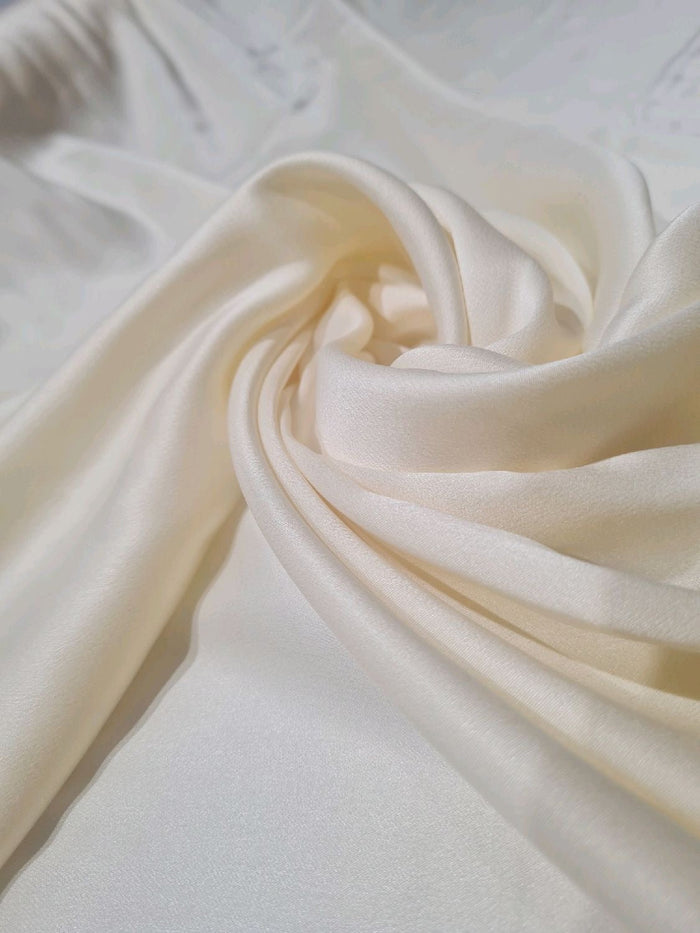
Satin is probably what you picture when you imagine a wedding dress. That luminous surface, the way it catches and holds light, the way it falls in clean, heavy lines, this is the fabric bridal photography is built around.
Satin’s defining quality is its surface: a tight weave that creates a reflective face and a matte back. The luminous side faces out. When light hits it, natural light, candle light, flash, it creates depth and dimension that photographs like nothing else in bridal fabric. It’s why so many iconic wedding dress images were shot in satin.
The weight of satin works in its favor for structured construction. A satin skirt holds its shape in an A-line or ballgown without needing as much internal support as lighter fabrics. A satin mermaid skirt clings and moves in ways that show the silhouette clearly.
Where satin requires care: it shows every bump and mark underneath, so undergarment choices matter. It doesn’t breathe as freely as matte fabrics, which can be relevant for outdoor summer weddings. And its surface picks up impressions easily, sitting for extended periods creates temporary marks that disappear with movement, but brides who’ll be seated for long ceremonies should know this.
We use artificial silk satin for most of our custom gowns. It gives the same luminous drape as natural silk satin at a fraction of the weight, which means the dress moves more freely and is easier to wear for a full day. The photographs are indistinguishable.
Best for: Column, A-line, mermaid, ballgown, essentially any silhouette. If you’re unsure, start with satin.
Crepe: The Refined Alternative to Satin
Crepe occupies a specific space in bridal fabric: matte where satin is luminous, soft where satin is structured, but no less sophisticated. It’s the fabric of choice for brides who want clean, architectural lines without the reflective surface.
The weave of crepe creates a slightly textured surface that reads as flat in photographs but carries movement beautifully in person. It drapes close to the body without clinging, which makes it exceptionally flattering across a wide range of body types. A crepe column gown smooths and elongates without the compression of a heavily structured fabric.
Crepe comes in weights from very light (almost chiffon-adjacent) to substantial (close to structured satin). For custom work, the weight is chosen based on silhouette: lighter crepe for soft A-lines and empire styles, heavier crepe for column gowns and mermaid styles where you want the fabric to work with the body’s own contours.
Because crepe’s surface is matte rather than reflective, it photographs differently than satin, it reads as rich and textured rather than luminous. Both are beautiful; the preference often comes down to whether you want the dress to glow or to carry depth.
Crepe is also a strong choice for brides who find satin too formal. There’s something inherently slightly more relaxed about a matte fabric, even in a structured silhouette, that suits garden weddings and venues with natural light well.
Best for: Column gowns, clean A-lines, minimalist styles. Particularly good for brides who want a sophisticated look without high sheen.

Chiffon: Movement and Layering
Chiffon is the most romantic bridal fabric, and also the most misunderstood. It’s extraordinarily lightweight and almost transparent in a single layer, which means it needs either layering or a more substantial base fabric to read as a wedding dress.
What chiffon does exceptionally: it moves. Even the slightest movement creates rippling layers that no heavier fabric can replicate. Walking, dancing, a slight breeze, chiffon responds to all of it with fluid motion that photographs beautifully in outdoor and candid shots.
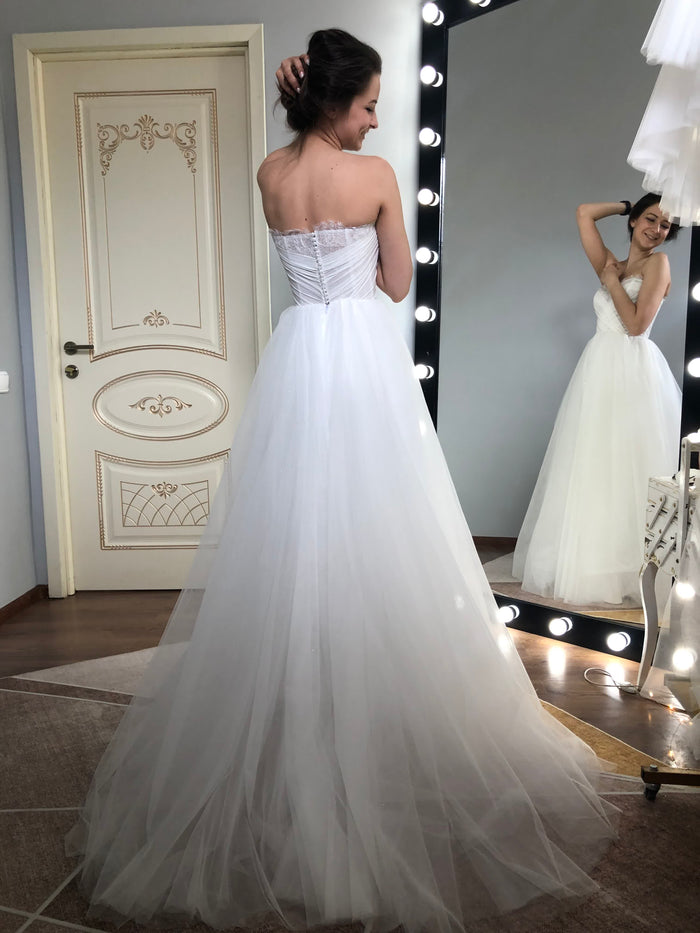
What chiffon cannot do: it cannot hold a structured silhouette on its own. A strapless mermaid in chiffon alone will not hold the mermaid shape. For fitted styles, chiffon is used as an overlay over a structured base (often satin or crepe). For soft styles, an A-line with a flowy skirt, an empire-waist dress, chiffon layers on top of itself to create the volume and movement that makes it so distinctive.
For warm-weather and outdoor weddings, chiffon is the top choice. It breathes better than any woven fabric and doesn’t trap heat the way satin can. It’s also significantly lighter to wear, which matters when you’re standing for hours.
The main consideration with chiffon is that it’s harder to work with in construction. The slippery, lightweight nature of the fabric makes precise cutting and seaming more demanding. In a custom context, this adds to the labor involved, something to factor into expectations around pricing.
Best for: A-line gowns with flowy skirts, empire waist styles, beach or outdoor weddings, layered romantic looks.
Lace: Accent, Overlay, and Full Coverage
Lace is not a structural fabric, it’s a decorative one. Even dresses described as “fully lace” almost always have a base layer of satin or crepe underneath that provides structure, modesty, and body. The lace goes on top.
This distinction matters because it changes how you think about lace in your design. Lace is an overlay, an accent, an embellishment. It can cover a dress entirely, in which case the silhouette and movement come from the base fabric, and the lace provides texture, pattern, and a sense of romance or tradition. Or it can appear at specific areas: bodice, sleeves, train, hem, adding detail without changing the fundamental nature of the dress.
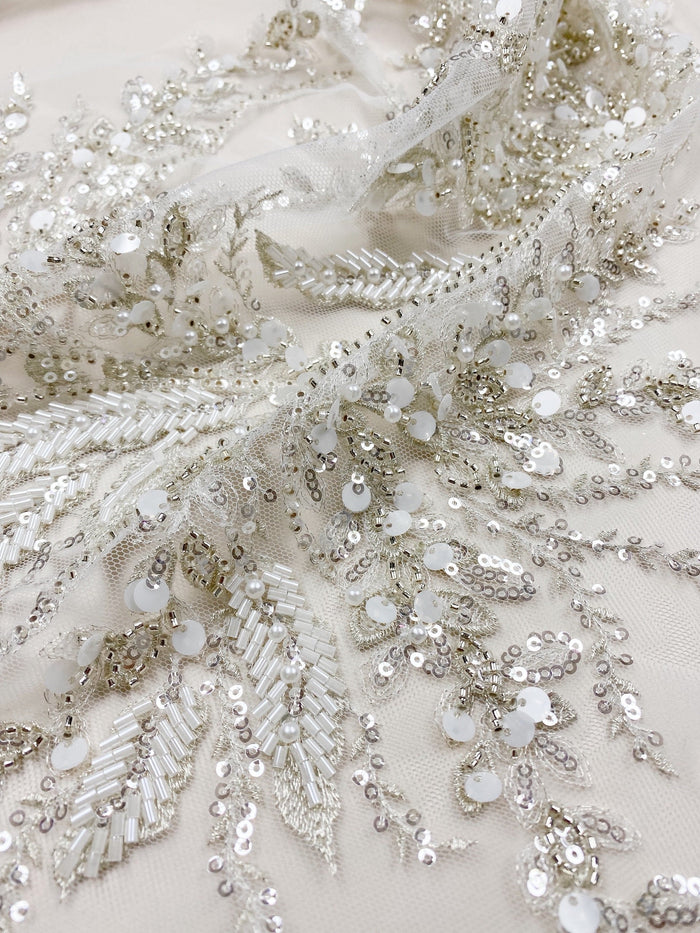
Different lace types behave very differently. Chantilly lace is the most delicate and romantic, fine, flat, with detailed floral motifs. Guipure (or Venetian) lace is heavier, bolder, with more three-dimensional texture. Stretch lace follows the body’s curves and works well in very fitted styles. Corded lace has a raised outline that photographs with strong graphic quality.
In our experience, the best lace applications on custom dresses are highly intentional: lace placed exactly where it serves the design, not applied universally out of tradition. A lace bodice on a clean satin skirt. A lace cape over a column gown. Lace sleeves that add to an otherwise minimal dress. When lace is used as a design choice rather than a default, it’s always stronger.
Best for: Bodice details, sleeves, overlays, trains, and accents on any base silhouette. Traditional and romantic aesthetics.
Organza and Tulle: Volume and Structure
Organza and tulle both create volume, the large, structured skirts of ballgowns, the layered underskirts that make A-lines float. They’re rarely the only fabric in a dress but often the fabric that makes the silhouette possible.
Organza is a crisp, slightly stiff plain weave that holds shape exceptionally well. A layer of organza under a satin skirt creates volume without weight. Organza can also be used as a top layer, where it creates a slightly translucent, luminous effect that photographs beautifully in bright light. It’s stiffer than chiffon, which means it stands away from the body rather than draping against it.
Tulle is the netting fabric of ballet and classic ballgowns, multiple fine layers of netting that create extraordinary volume with minimal weight. A full ballgown skirt typically involves many layers of tulle giving it the structure and fullness that makes the silhouette identifiable. Tulle on its own can feel scratchy, which is why in custom work it’s always used with a lining or a softer outer fabric.
Both fabrics are primarily construction fabrics in custom bridal, the designer uses them to build structure underneath or create shape, while the exterior of the dress uses whatever fabric is right for the overall aesthetic.
How Fabric Choice Affects Price
Fabric cost varies significantly, and it directly affects the total price of a custom dress. At Lutien, our custom gowns start at €1,490, the starting point reflects both the fabric and the complexity of construction.
The primary cost variables:
The fabric itself. Lace, particularly hand-made or imported lace, is among the most expensive bridal fabrics. High-quality satin and crepe are mid-range. Tulle and organza, used as structure layers, are typically less expensive per meter but may require larger quantities.
Construction labor. Chiffon and lace both require more precise, slower work than satin and crepe. A chiffon skirt with complex layering takes significantly more hours than a clean satin skirt. When a fabric increases labor, it increases cost.
Embellishment interaction. Some fabrics accept embellishment more readily than others. Beading holds well to satin and crepe. Lace already has pattern built in, so adding beading is a precise, labor-intensive process. Chiffon requires careful hand-stitching for any embellishment.
See our guide to custom wedding dress pricing for a full breakdown of what drives cost in a custom gown, fabric is one factor, but embellishment level, silhouette complexity, and construction details all contribute.
Which Fabric Is Right for Your Dress?
There’s no universally correct answer, but there are some clear patterns from seeing 1,000+ brides work through this choice.
If you want classic, polished, photographed beautifully in any lighting: Satin. It’s the default for a reason. If you’re uncertain, start here and work outward.
If you want sophisticated but less formal, matte, and body-flattering: Crepe. Particularly strong for minimalist aesthetics and brides who find satin too shiny.
If you want movement, romance, and a lighter feel for a warm wedding: Chiffon. Best with an A-line or empire silhouette. Plan for layering.
If you want intricate texture and a traditional or romantic feeling: Lace as an overlay or detail. The base fabric determines the silhouette; the lace determines the mood.
If you want a full ballgown or need structure and volume: Organza and/or tulle in the construction, with your chosen surface fabric on top.
Most custom dresses use more than one fabric, a satin bodice with a chiffon skirt, a crepe column with lace sleeves, an organza-supported satin ballgown. The combination is one of the things that makes custom work different from ready-to-wear.
We start every new order with a conversation about silhouette and feeling before we discuss fabric. The image in a bride’s mind usually points clearly to a fabric family, once we understand what she’s going for, the fabric choices become obvious. See how we approach references and inspiration for how that conversation typically unfolds.

Frequently Asked Questions
What is the most popular wedding dress fabric?
Satin is the most widely used bridal fabric across all price points, in both custom and ready-to-wear wedding dresses. Its combination of structure, drape, and photogenic surface makes it the most versatile choice. At our atelier, the majority of custom orders use artificial silk satin as either the primary or secondary fabric.
What fabric is best for a summer outdoor wedding?
Chiffon is the top choice for warm-weather outdoor weddings, it’s lightweight, breathes well, and creates beautiful movement in natural light and outdoor conditions. Lighter crepe is a strong alternative if you want more structure with less heat retention. Heavy satin is the hardest fabric to wear in heat.
Is lace a good fabric for a custom wedding dress?
Lace works exceptionally well in a custom context because placement can be precisely controlled. Full-lace custom dresses are beautiful, but they require a base layer fabric underneath, the base determines the silhouette and structure; the lace creates the surface texture and pattern. Lace is most impactful when used intentionally: a lace bodice, lace sleeves, a lace back panel, rather than applied uniformly.
What fabric holds up best for a long wedding day?
Crepe and structured satin hold their shape best through a long day of wearing, sitting, dancing, and moving. Chiffon and tulle can lose some of their freshness with extended wear, particularly in humid conditions. For very long receptions, a fabric with some body (crepe or mid-weight satin) tends to look better at the end of the night than a very lightweight option.
Can I combine fabrics in a custom wedding dress?
Yes, fabric combinations are one of the great advantages of going custom. A satin bodice with a chiffon skirt gives you structure where you need support and movement where you want it. Lace sleeves on a crepe column gown add detail without changing the silhouette. Organza layers under satin create volume without weight. At Lutien, mixed-fabric dresses are the rule, not the exception.
Finding the Fabric for Your Dress
The fabric conversation is one we have with every bride before we sketch anything. It doesn’t require you to know fabric names, you just need to be able to describe what you’re going for. Heavy or light? Shiny or matte? Movement or structure? Formal or romantic?
From there, we’ll show you options and explain what each one does on a body. Then we sketch. Then we build.
If you’re ready to talk through your dress, what you’re picturing, what fabrics might get you there, start with a free sketch consultation at Lutien Bridal. There’s no commitment until the sketch is right.
All Lutien Bridal custom gowns are made to your exact measurements in Ansignan, France. Production takes 10-12 weeks from order confirmation. Shipping to the US is 3-5 days via UPS. Starting price €1,490, average order €2,290. Everything, fabric, construction, shipping, customs clearance, is included in the price quoted.