Atelier · France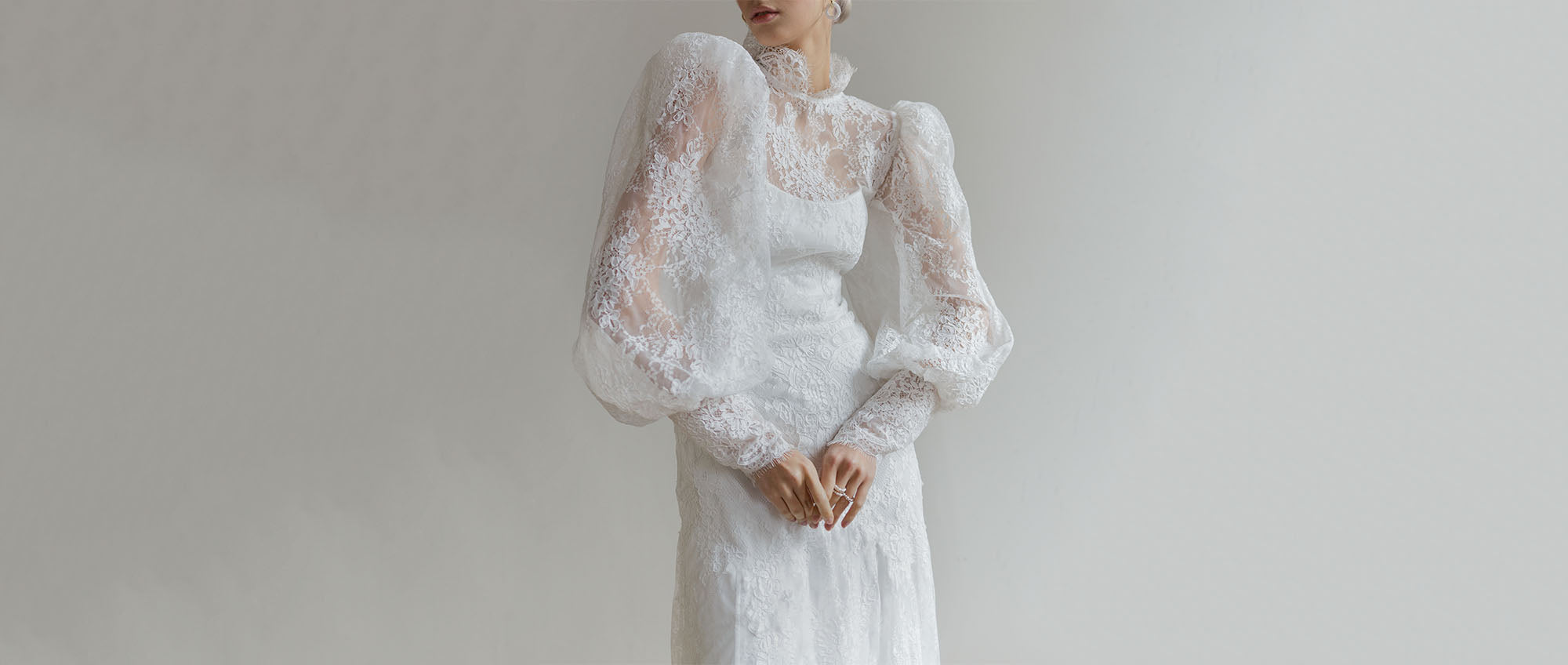
Every custom dress starts the same way: with an image the bride keeps coming back to. Not a pattern, not a catalog page, an image. Sometimes it’s a dress she saw on Pinterest three years ago. Sometimes it’s a film still, a grandmother’s photo, a description she’s been trying to articulate for months.
This post walks through how that image becomes a dress. We’ll use a real example, a fully lace gown with bishop sleeves, to show what actually happens between the first message and the moment the garment bag arrives.
Key Takeaways
- The design process begins with translation: we turn a bride’s references into a specific, buildable design
- Nothing is cut until the sketch is approved, the sketch is the only place where changes are free
- A dress like the one in this post, full lace overlay, bishop sleeves, high neck, involves sourcing specialty lace, fitting the sleeves to the bride’s arm length, and precise work at every seam where lace must align
- From first message to delivery, the total journey typically takes 3-4 months
- At Lutien Bridal, every bride approves the design, the sketch, and the final photos before the dress ships
What the Bride Sent Us
The brief for this dress came in as a collection of images. A vintage-inspired lace dress from an editorial shoot. A detail photo of bishop sleeves from another designer. A reference to the silhouette, column, minimal volume, nothing that competed with the lace itself.
The common thread across all the references wasn’t a specific design, it was a feeling. Feminine without being romantic. Lace without being traditional. A dress that would read as intentional and slightly unexpected.
That’s the starting point: not “make a lace dress,” but understanding what kind of lace dress, what kind of feeling, and what specific construction elements create it.
The questions we ask at this stage are precise: Is the high neck part of the vision, or is it just what appeared in the reference? How voluminous should the sleeves be? Should they taper at the wrist or stay full? Is the lace the outer layer, or is it the whole dress? These distinctions determine entirely different constructions.

The Sketch
After the conversation, we draw the sketch.
For this dress, the sketch showed: a column silhouette with lace from collar to floor. A mock turtleneck with a raw lace edge at the top. Bishop sleeves, full from the shoulder, gathered at the wrist into a lace cuff. No visible seam through the center front. A back with a concealed zip and a small covered button detail at the neckline.
The sketch went back and forth twice. The first version had the sleeves slightly fuller, more dramatic. The bride preferred a more controlled volume, closer to the arm. The second version was approved.
What we’ve learned about the sketch stage: the most valuable revisions aren’t about the dress itself, they’re about uncovering what the bride actually means. “Fuller sleeves” in one bride’s mind is “dramatic volume”; in another’s, it’s “slightly more fabric than a regular sleeve.” The sketch makes the ambiguity visible, which is why it exists before any fabric is touched.
This is the only stage where changes are free. A line on a sketch costs nothing. A seam in specialty lace costs the lace.

Material Selection: The Lace Decision
Once the sketch was approved, we turned to fabric.
For a fully lace gown, the lace itself is the design. The choice of lace determines the weight, the drape, the density of the pattern, how the fabric moves, and how it photographs. All-over floral lace with a dense pattern sits with more structure than a lightweight Chantilly. It holds the column silhouette rather than softening it.
We source lace from European suppliers. For this order, we needed a lace with a distinct floral pattern, visible at distance, but not overwhelmingly ornate. The lace needed to work at the neckline, through the sleeves, and across the body simultaneously, which means the pattern scale had to be right for all three applications.
The lining was a soft stretch fabric in ivory, close to skin in color, so the lace reads cleanly without a harsh contrast underneath.
One decision that often goes unnoticed: for bishop sleeves in lace, the cuff requires its own lace work. The sleeve is gathered into a narrow band at the wrist, the gathering must be even, which in lace means careful placement of the gather points so the floral pattern doesn’t bunch unevenly at the cuff. We mark gather points before sewing. It adds time. The alternative is a cuff that reads as rushed.
Construction: What It Actually Takes
After lace sourcing (which took close to three weeks for this order), production began.
Pattern making for a lace gown is more involved than for a solid fabric. Because lace has a visible pattern, the pattern pieces must be positioned on the lace deliberately, the floral motifs need to align at the seams, or the dress reads as disconnected panels rather than a single surface.
Cutting requires marking each piece against the lace pattern before cutting. For a dress with both a column body and voluminous sleeves, this means two very different approaches: the body is cut for pattern alignment; the sleeves are cut for fabric direction and the behavior of the gathered volume.
Assembly followed the standard sequence, internal structure first, then bodice, then skirt, then sleeves. The sleeves on this dress are the most labor-intensive element. The bishop shape is created through volume in the cap and upper sleeve, gathered progressively as the sleeve tapers toward the wrist. Setting lace sleeves requires matching the lace at the armhole seam, if the pattern breaks at the shoulder, it reads as a construction error.
The neckline was finished with the same lace trimmed to a raw edge, a deliberate choice that gives the high collar a slightly fragile, refined quality rather than a finished-off industrial look.
The Finished Dress
The complete dress was photographed in the atelier before packaging. Front, back, sleeve detail, collar, cuff, a full documentation of every element, sent to the bride for approval before the dress was packed.

What the image shows is what the brief described, feminine, intentional, slightly unexpected. Not a generic lace dress. A specific one, designed for one person.
This dress is one of 1,000+ completed at Lutien Bridal since 2022. The design process for each one followed the same sequence: references → conversation → sketch → approval → fabric → pattern → construction → photos → shipping. This dress took 11 weeks from payment to delivery.
What This Means for Your Order
Every custom order follows the same sequence, regardless of the silhouette or fabric. The design process doesn’t change between a simple satin column and a fully embellished ballgown, the number of decisions does.
For a dress like this one, specialty lace, volumetric sleeves, a precise neckline, the design conversation takes longer, the sketch goes through more revisions, and the construction requires more detailed work at every seam. That’s reflected in the timeline and the price.
What doesn’t change: the sketch is approved before cutting. You see photos at every major stage. The final set arrives before the dress ships. Nothing is sent without your sign-off.
If you’re collecting references and building a vision, the next step is a conversation. We’ll look at your images, ask the questions that matter, and show you what a sketch of your dress would look like.
Start with a free sketch consultation at Lutien Bridal →
Frequently Asked Questions
Do you work from Pinterest boards?
Yes. Pinterest boards are one of the most useful starting points, they show pattern and preference across many images, which tells us more than a single reference can. Send the whole board, not just your favorite one. The images you saved but aren’t sure about are often as useful as the ones you’re certain of.
What if the lace I want isn’t available?
We’ll tell you during the fabric sourcing stage and propose alternatives before committing to a substitute. For orders where a specific lace is important to the design, we discuss sourcing options during the consultation so you know what to expect.
Can I request a specific construction detail I saw on another dress?
Yes. If you can show us the detail, a photo, a video, a description, we’ll assess whether it’s buildable and tell you upfront if there are structural reasons it wouldn’t work in your silhouette. Most details are achievable; some require specific silhouettes or fabrics to function correctly.
How do I know the dress will look like the sketch?
The sketch is approved by you. The construction photos at each stage show you what the dress looks like as it’s built. The final photo set shows the completed dress before it ships. If anything deviates from the design, it’s addressed before shipping, not discovered after.
Related reading: Inside the Atelier: How a Custom Wedding Dress Is Made, What Photos and References to Send Your Dress Designer