Atelier · France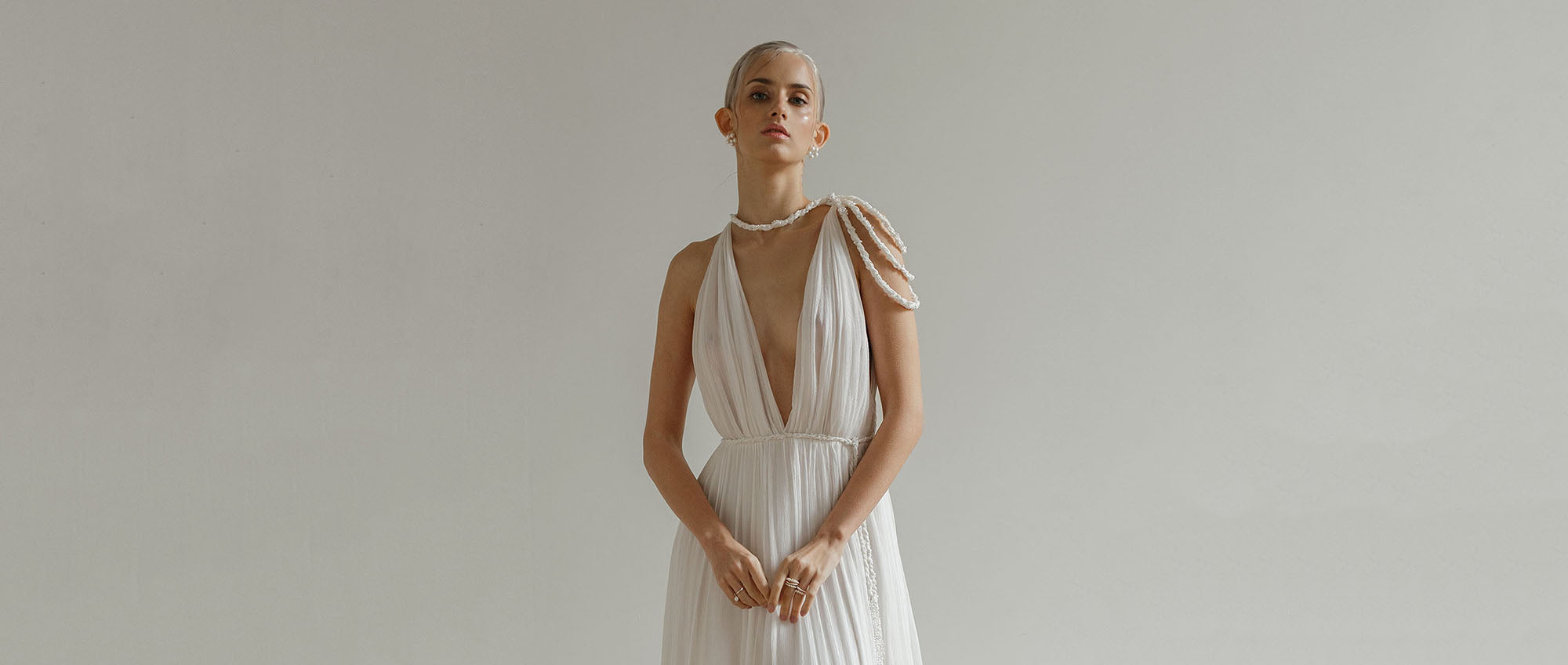
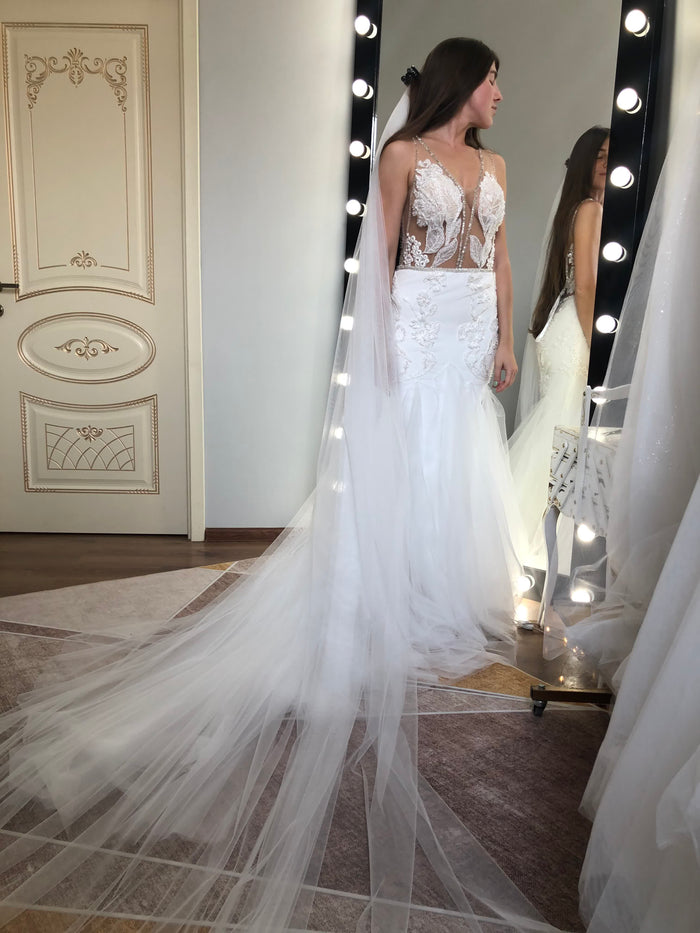
The backless wedding dress is one of the most requested silhouettes we see at Lutien Bridal. The visual is immediately compelling, a low-cut back, bare skin, clean lines falling to the floor. But it comes with questions most ateliers don’t answer upfront: How does it stay in place? Can you wear a bra? What does it actually feel like for twelve hours?
This post covers the construction logic behind an open-back gown, the fabric choices that work, what we measure and why, and the comfort realities no one mentions until the fitting.
Key Takeaways
- “Backless” covers four distinct silhouettes, full open back, low V, keyhole, and cowl back, each built differently
- A well-made backless gown stays in place through internal boning and sewn-in cups, not straps
- Fabric choice determines how cleanly the back opening lies: crepe and charmeuse hold a sharp edge; heavy fabrics pull and gap
- Backless gowns require additional back measurements beyond the standard guide, back height, back width, and shoulder-to-bust depth
- At Lutien Bridal, the back cut depth and opening shape are sketched to your proportions before we cut anything

What “Backless” Actually Means, Four Versions
The term covers a wide range of silhouettes, and they’re built differently enough that treating them as the same design is a mistake.
Full open back, the opening extends from the shoulders to the waist or below. No panels, no crossbars. Skin is exposed continuously. This version requires the most internal structure to compensate for the complete absence of back support.
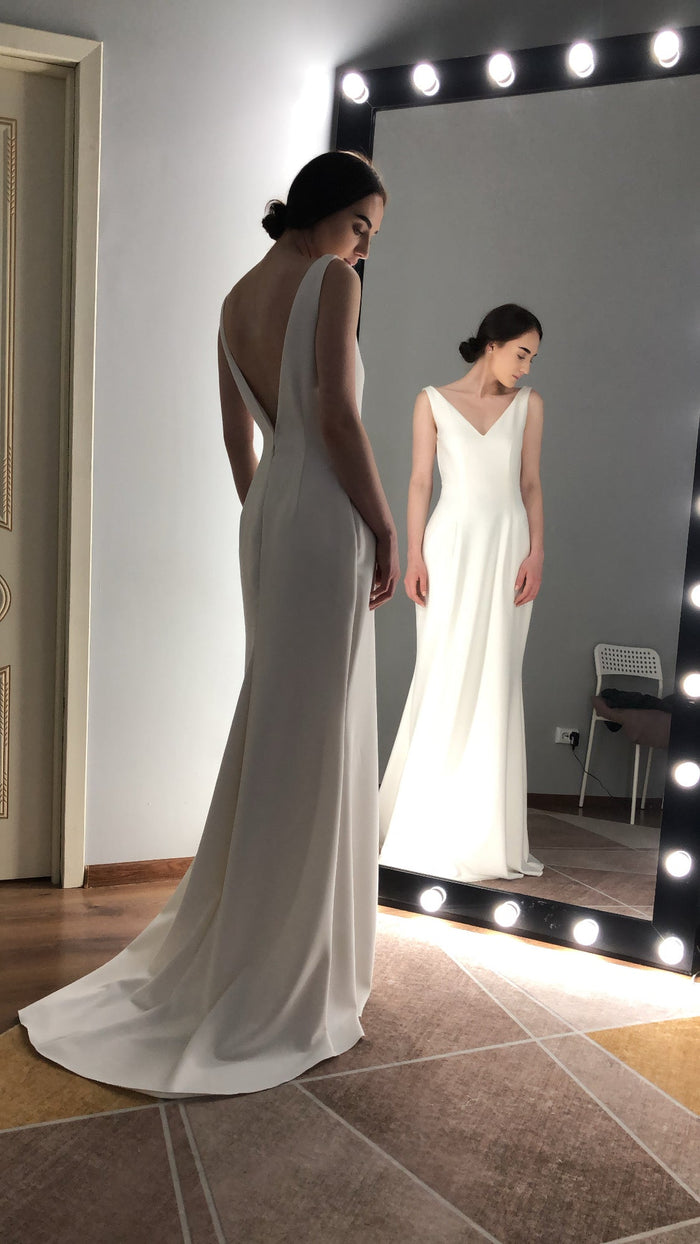
Low V-back, a V-shaped cutout that draws the eye down the spine. The V’s depth determines how much structural work the front bodice has to carry. A shallow V is relatively straightforward; one that dips below the natural waist requires more careful boning placement.
Keyhole back, an oval or teardrop opening at mid-back, with the rest of the back covered. This is structurally the most forgiving of the backless styles. The fabric above and below the keyhole carries the gown; the opening is primarily decorative.
Low cowl back, fabric draped rather than bare skin. The back hangs in a loose fold, created through bias-cutting rather than an actual opening. This is a different construction logic entirely. If you’re drawn to this version, our guide on the cowl neck wedding dress covers the full breakdown.
When you’re collecting references, identify which version you’re actually looking at. The construction differences affect your timeline, your measurements, and your fabric options in ways that matter.
How a Backless Dress Stays Up
This is the question we hear most often, and it’s exactly the right question to ask before you commit to this silhouette.
The short answer: internal structure. A well-made open-back gown stays in place the same way a strapless gown does, through boning sewn into the bodice, structured inner panels, and sewn-in cups fitted to your measurements.
Boning runs vertically through the bodice lining, creating a rigid scaffolding that holds the front of the gown against the body without straps or a back panel to pull against. Spiral steel boning moves with the body; flat steel boning is more rigid. For a fully open back, we typically use a combination, determined by the silhouette and your measurements.
Sewn-in cups, custom-fitted to your measurements, eliminate the need for an external bra. In a made-to-measure gown, the cups are built to your exact dimensions. In an off-the-rack backless gown, the cups are a size approximation, which is why so many open-back dresses from a boutique feel insecure. The cups are in the right position, but they’re not for you specifically.
Strategic seaming at the sides and front takes the tension that would normally run across the back. The side seams and front bodice work harder in a backless gown than in any other construction.
What we’ve seen across 1,000+ orders: the support concerns brides have before ordering almost entirely disappear after the first fitting. The gown doesn’t move. What creates insecurity is poor construction, boning placed incorrectly, cups positioned too far apart, bodice lining too loose. In a custom gown where measurements drive the pattern, these errors don’t happen by accident.
Fabric Choices That Work With an Open Back
Not every fabric behaves well at a back opening. The choice affects how cleanly the edge lies, whether the gown pulls or sags, and how the silhouette reads from behind.
Crepe is one of the strongest performers. It has enough body to hold a clean edge at the back opening without going stiff, drapes smoothly over the hips, and photographs well, the matte finish eliminates the distraction of reflections at the edge of the opening.
Charmeuse is the highest-sheen option. A charmeuse backless gown catches light as the wearer moves; the back becomes a focal point in every photo. It’s also the most unforgiving, any fit imprecision shows immediately at the opening edge.
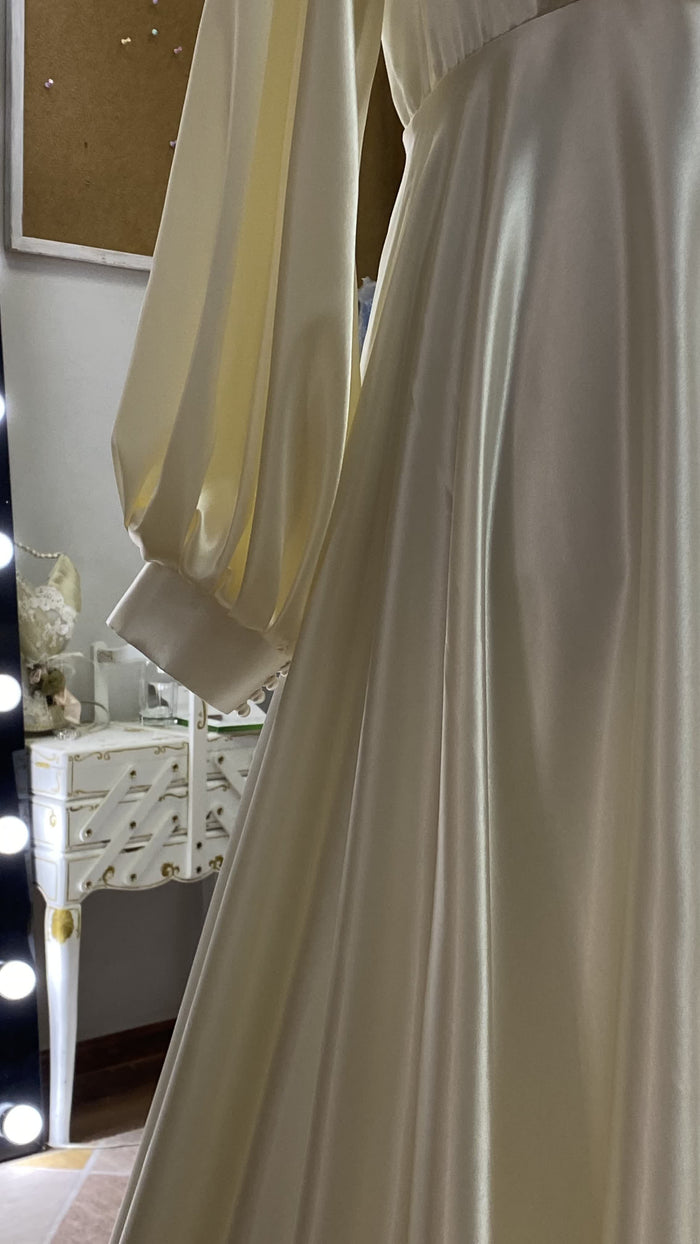
Lightweight satin (not duchess) works when the weight is right. Duchess satin is too rigid. It holds its shape rather than following the body, which creates a gap at the back opening instead of a clean line against the skin.
Chiffon and tulle are typically used in the outer layers of a skirt rather than the bodice. For the bodice of a backless gown, you need a fabric with enough substance to hold the internal structure in place.
For a full comparison of how different satins behave across silhouettes, our satin wedding dress guide walks through the decisions worth making before you commit to a fabric.

Measurements for a Backless Dress: What’s Different
Standard measurement guides cover the essentials, bust, waist, hips, height. For a backless gown, we need more.
Back height, the distance from the base of the neck to the point where the back opening ends. This determines where the structural boning terminates and exactly where the opening begins. A one-centimeter error here places the opening at the wrong position relative to your proportions.
Back width, measured across the shoulder blades. This sets the width of the back panel (if any) and the position of the side seams.
Shoulder to bust apex, the distance from the top of the shoulder to the highest point of the bust. This positions the sewn-in cups correctly within the bodice.
Waist-to-hip depth at the back, determines how the back opening relates to the natural waist and how the silhouette transitions below the cut.
When we receive measurement sets for remote orders, backless designs also require a specific set of back photos, standing upright with hair up, shot directly from behind at shoulder height. These photos let us verify the back height measurement against actual proportions before cutting. A number on a tape and a photo of how a person carries their posture are two different things. We use both.
If you’re working from our how to measure yourself for a wedding dress guide, the measurements above supplement the standard set, they don’t replace it.
Comfort: What Twelve Hours Actually Feels Like
Brides worry about two things: whether the dress will stay in place, and what to do about underwear.
Security. In a properly built backless gown, this isn’t a constant concern. When the boning is fitted correctly and the bodice is firm, the gown doesn’t shift. You’ll feel it holding from the moment you put it on. What creates an insecure feeling is under-boning, a bodice that doesn’t have enough structure to function without a back panel. In a custom gown, this doesn’t happen by accident. Every component is planned.
Underwear. The sewn-in cups handle bust support. Standard bras are impossible with a true open-back cut. Stick-on bras are an option some brides use as a backup, but they’re not necessary in a well-structured gown and can interfere with the bodice fit when layered on top of existing cups. Low-back converters, straps that attach a standard bra band to a lower hook, work for some back cuts but not full open-back designs. Discuss this during your consultation; it affects how the cups are positioned.
Movement. Backless gowns are often more physically comfortable than heavily structured gowns. Without a back panel, the bodice has more lateral give. Dancing, sitting, reaching, these feel less restricted than in a fully corseted or zip-back construction. The tradeoff is that the front bodice carries all the structural work, which is exactly why boning placement matters so much.
Working With a Designer on an Open-Back Gown
The backless silhouette is where the difference between a custom and an off-the-rack gown is most visible, and most felt. The support structure, the position of the back opening, the fabric tension at the edges, these are design decisions that depend entirely on your measurements and proportions.
At Lutien Bridal, we start every open-back design with a sketch that shows the exact opening depth and width relative to your specific back. You approve the design before we cut anything. Production takes 10-12 weeks from payment; delivery to the US is 3-5 days via UPS. Gowns start at €1,490, all-inclusive, shipping, customs, everything.
We recommend starting at least 6 months before your wedding date. Rush orders aren’t taken. The construction timeline for a correctly structured backless gown doesn’t compress without compromising what makes it work.
If you’re still working through the overall silhouette decision, our wedding dress silhouettes guide maps out every major option with notes on construction, fit, and how each one photographs.
Frequently Asked Questions
Can I wear a bra with a backless wedding dress?
A properly constructed custom backless gown has built-in support, sewn-in cups fitted to your measurements. Standard bras aren’t possible with a low or fully open back. Stick-on bras work as a backup but aren’t typically necessary when the internal structure is correct.
How low can a backless dress go?
The practical lower limit depends on your natural waist and hip curve. Most full open-back designs end at or just below the natural waist. Going lower requires very precise boning placement to keep the gown secure. We map the opening depth to your measurements during the design phase before anything is cut.
Will the back opening change if I need alterations later?
A custom gown is built to your measurements from the start, so major alterations aren’t expected. In off-the-rack backless gowns, the back opening is one of the most difficult elements to alter, changing its depth or width affects the entire bodice structure and is expensive to correct properly.
Does a backless design take longer to produce?
The construction complexity is built into our standard 10-12 week production timeline. The additional work for an open-back gown is in the boning placement and cup fitting, which happen in the early production phase. The timeline doesn’t extend unless there are unusual embellishments.