Atelier · France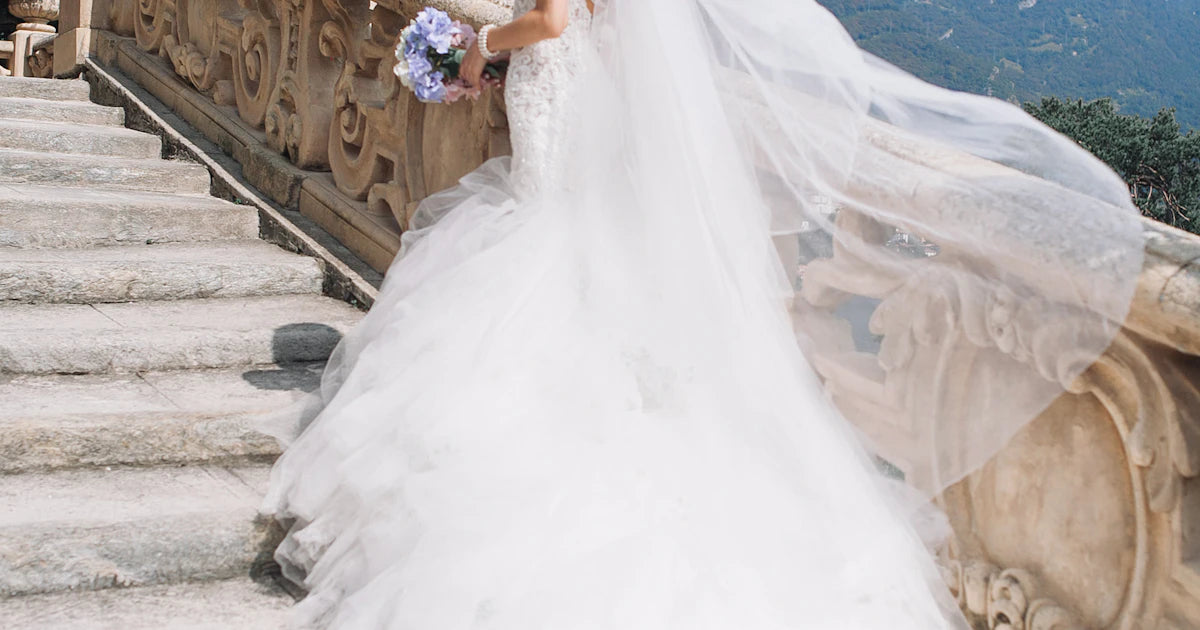

Key Takeaways
- A-line is the most widely produced wedding dress silhouette in bridal, not because it's a compromise, but because the construction genuinely adapts to more body types than any other shape.
- The key variables, flare point, flare degree, and waist seam placement, are all adjustable in a custom dress. Off-the-rack A-lines fix these at standardized points for a graded body, not yours.
- In a custom A-line, the flare begins at your actual waist measurement. That single adjustment changes how the entire silhouette reads on your body.
- Plan for 10-12 weeks of production. Order at least 6 months before your wedding date.
Every bride has heard it: "A-line flatters every body type." That's accurate. But it's stated as if it's a coincidence, a lucky byproduct of clean lines and a classic shape. It isn't. The versatility is structural, and understanding it helps you make a better decision about whether A-line is right for you, and what kind of A-line actually serves your proportions.
The short version: A-line creates a vertical line from waist to hem while distributing fabric away from the body in a controlled flare. That flare moves past the hips without defining them. The construction is what makes the silhouette work across bodies. The long version is worth knowing.
For an overview of all six bridal silhouettes and how to choose between them, see our complete visual guide to wedding dress silhouettes.
What Makes A-Line Work: The Structural Logic
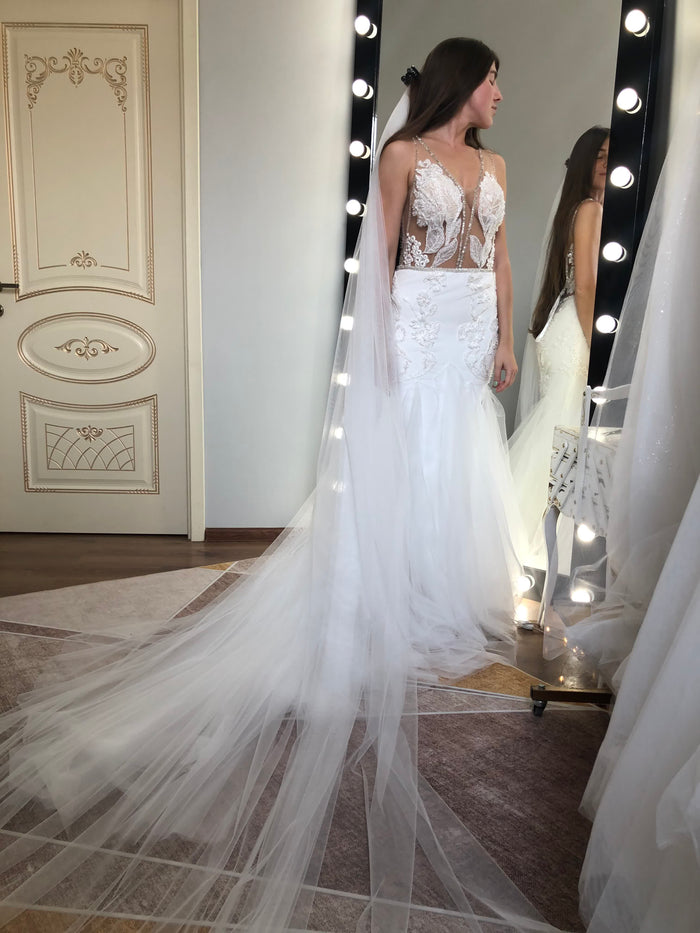
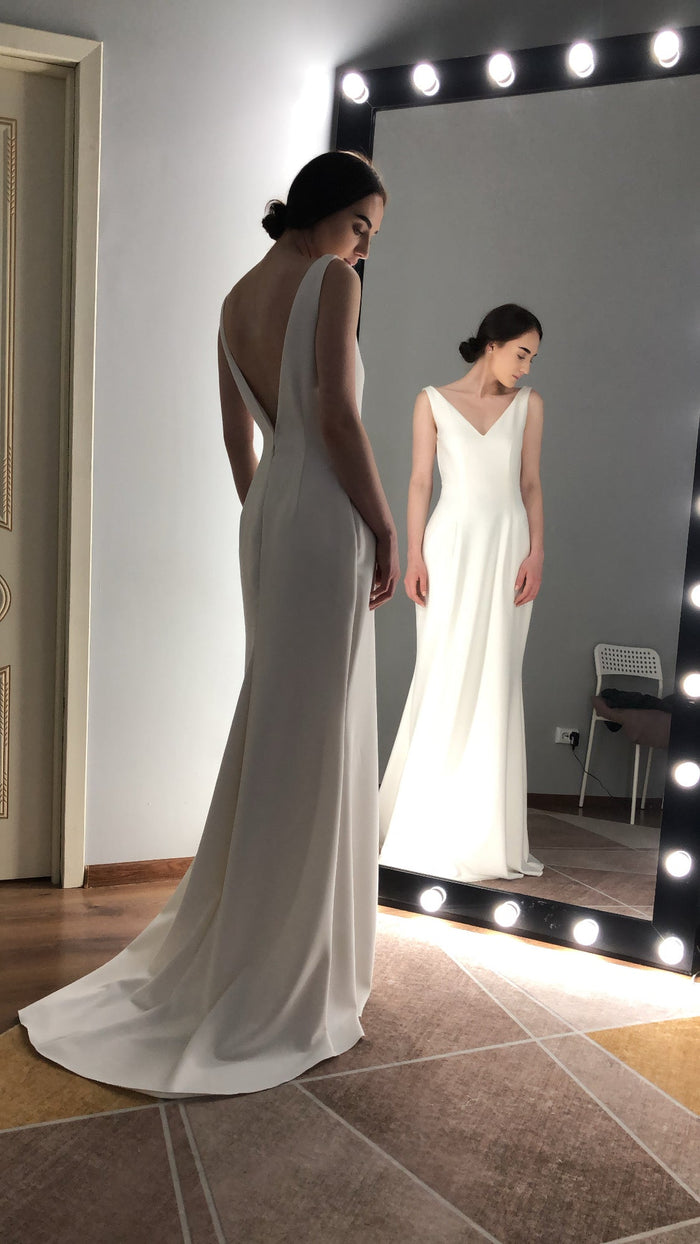
The A-line silhouette fits through the bodice and upper hip, then flares gradually from the waist or hip toward the hem, producing the letter-A shape from the front and side. Its versatility isn't aesthetic. It's mechanical.
The flare moves fabric away from the body. When a skirt flares rather than clings, it doesn't register as tight at the hip, it moves past it. The eye follows the vertical sweep to the hem, not the circumference at the widest point. This is why A-line doesn't require a specific hip-to-waist ratio to look proportional. The silhouette does the work of creating proportion, rather than borrowing it from the body.
The vertical line dominates. From waist seam to hem, the A-line creates the longest unbroken visual element in the silhouette. That vertical dominance creates an impression of height and length that works with most frames rather than against them. It's the same principle that makes vertical stripes read as lengthening, but structural, not printed.
The waist seam is a design decision. The seam that begins the flare can be placed at the natural waist, slightly lower for a longer-waisted effect, or slightly higher for an empire-adjacent proportion. Where it falls changes the entire reading of the dress on the body. In an off-the-rack gown, it falls where the manufacturer's grading placed it. In a custom dress, it falls where your measurements call for it.
These three elements, flare direction, vertical emphasis, and seam placement, are what make A-line adaptable. What "working for every body type" actually means is that these variables can be tuned for different proportions. That tuning is exactly what custom construction makes possible.
How A-Line Adapts to Different Bodies
Standard advice for A-line says it "works" without explaining how. Below are the specific structural adjustments that serve different bodies, and why they matter in a custom dress versus an off-the-rack sample.
Petite Frames (Under 5'4")
The primary challenge for a petite bride is proportion: an A-line's skirt volume can overwhelm a smaller frame if the flare is too wide or starts too low. In a custom dress, the flare point is raised to begin slightly above the standard hip placement, keeping the skirt volume lighter and the vertical line longer relative to the body. The hem is set precisely to the floor, not estimated and hemmed later.
Off-the-rack, this calculation doesn't exist. You alter after purchase and hope the proportions survive. A cathedral train on a petite bride is a design statement, not a default. We typically discuss whether that much length serves the overall silhouette before committing to it.
Curvy and Full-Figure Brides
A-line is frequently recommended for curvy brides, but the recommendation is usually vague. What actually matters: the flare degree and the bodice structure.
In a custom dress, the bodice is built with structured boning set for your measurements, not altered from a sample cut for a different body. The flare begins at your actual hip point. For a fuller figure, a slightly more pronounced flare (a wider A) creates clear visual separation between the bodice and the skirt, which is what makes the waist appear defined without compression. The alternative, a tight bodice that fights the body, creates a different kind of visual. A-line reads as intention.
Athletic and Straight Frames
For brides with minimal hip-to-waist differential, A-line offers structure that adds visual curve rather than requiring it from the body. A custom bodice for an athletic frame can include side boning, lightly structured hip panels, or curved side seams that create the waist definition the silhouette calls for.
Without those custom additions, an A-line on a straight frame often reads as formless, not because the silhouette is wrong, but because the bodice wasn't engineered for that body. This is the most common missed opportunity in off-the-rack A-line fitting.
Tall Brides (5'8" and Over)
Tall brides have the widest range of A-line options, the silhouette generally scales with height. The main design decision is hem length and train weight. A cathedral train on a tall bride reads as proportional; the same train on a petite bride can read as weighted. Custom allows designer and bride to consider that proportion before production begins.
One adjustment specific to tall brides with a long torso: dropping the waist seam slightly creates better bodice-to-skirt proportion. This isn't a standard alteration, it's a pattern decision, made at the drafting stage.

The Six Variables That Define a Custom A-Line
In an off-the-rack gown, all six variables are fixed at the manufacturer's grading standard. You can alter the hem. You can take in the bodice at the side seams within limits. The waist seam, flare point, and flare angle are structural decisions locked into the pattern, and they were made for a different body.
In a custom dress, every one of these variables is a decision made for your specific measurements before the pattern is cut.
What Off-the-Rack A-Line Doesn't Tell You
The most common frustration brides report after buying an off-the-rack A-line is that "it just didn't look like it did on the model." That gap has a structural explanation.
The flare point was set for a standardized body. In a graded pattern, the hip point, where the flare begins, is placed at a standard distance below the waist seam. If your actual hip-to-waist distance is shorter or longer than the grading average, the flare opens in the wrong place. The silhouette reads slightly off. It's difficult to name but visible in photographs.
The bodice torso length is fixed. If your torso is longer or shorter than the sample's, the bodice seams shift up or down relative to your body. A waist seam that lands above your actual waist creates a short-waisted appearance, the opposite of what A-line is built to create.
Alterations address fabric, not pattern. A skilled seamstress can take in a bodice, raise a hem, add a bustle. She can't move the flare point. That structural decision is permanent once the dress is cut. By the time you're in a fitting room, the key variables have already been decided for you.
How to Get an A-Line Built for Your Body
At Lutien Bridal, an A-line order starts the same way every order does: with a conversation, not a catalog.
Tell us what you're working toward. Send photos that resonate, editorial images, screenshots of dresses you've tried on, images of silhouettes you're uncertain about. Tell us whether movement matters, what the venue looks like, whether you want a dramatic train or something cleaner. Tell us how you felt in the dresses you've already tried. All of that is useful information.
We identify the right variables for your proportions. Based on your measurements and your vision, we make specific design decisions: where the waist seam lands, how pronounced the flare is, whether the bodice needs structural shaping. These aren't style preferences, they're engineering decisions with direct consequences for how the dress fits and photographs.
We produce a bespoke sketch. Before any fabric is cut, you see exactly what the dress will look like: the silhouette, the structural details, the embellishment placement. You approve it. You request changes. Nothing goes into production until the design is locked.
Production is 10-12 weeks from payment. A-lines with clean lines and minimal embellishment sit at the lower end of that range. A-lines with hand embroidery, beading, or lace overlay work toward 12 weeks. Shipping to the US via UPS: 3-5 days. We recommend ordering at least 6 months before your wedding date. Rush orders are not accepted.
The full consultation and sketch are included, no separate charge, no commitment to proceed until you're ready.
For everything you need to know about the ordering process, see our guide to ordering a custom wedding dress online. For a week-by-week breakdown of production, see the custom wedding dress timeline.

Start with a free sketch consultation at Lutien Bridal →
Frequently Asked Questions
Is A-line really the most flattering silhouette for every body type?
The A-line is bridal's most adaptable silhouette, not flattering by default, but structurally capable of working with the widest range of bodies. In a custom dress, the key variables (flare point, waist seam placement, bodice fit) are set for your measurements specifically. That precision is what makes the difference between "almost right" and a dress that reads like it was made for you, because it was.
How does A-line differ from empire waist?
An A-line places its seam at the natural waist or hip and flares from there. An empire waist places the seam just below the bust and falls straight to the floor with no defined hip flare. A-line creates more structure and definition through the torso; empire waist creates a longer, more fluid vertical line. For a comparison of both silhouettes, see our complete visual guide to wedding dress silhouettes.
What fabric works best for an A-line wedding dress?
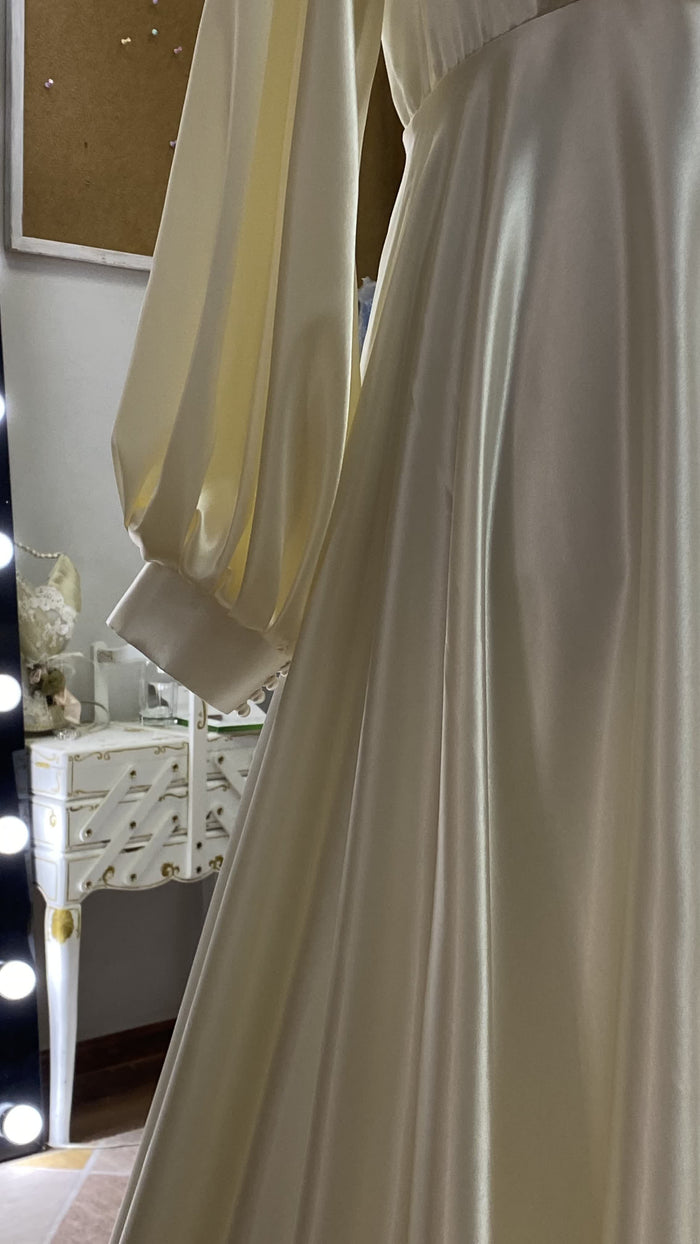
A-line works well across a wide range of fabrics because the silhouette provides its own structure. Satin and artificial silk create a clean, polished surface that photographs clearly in the A-line's vertical line. Lace overlays work well because the gradual flare gives the lace pattern room to read across the skirt. Chiffon and georgette add movement for brides who want a lighter, more fluid result. Fabric choice depends on formality, venue, and how much movement you want in the skirt.
Can I add a train to an A-line wedding dress?
Yes, a train is an addition to the silhouette, not a structural change. Common options: sweep train (a few inches past the hem), chapel train (roughly 3.5 feet from the waist), cathedral train (6+ feet). In a custom dress, the train length is a design decision made before production begins, so proportions are considered alongside the full silhouette.
How much does a custom A-line wedding dress cost?
Custom A-line dresses at Lutien Bridal start at €1,490, which covers a well-made gown in satin or artificial silk with clean construction and minimal embellishment. The average order across all styles is €2,290. Hand embroidery, beading, or lace overlays add to the cost. All pricing is all-inclusive: no customs charges, no shipping fees. For a full breakdown of what drives the cost, see our custom wedding dress price guide.